Worlds deadliest food kills more than 200 people per year and is still eaten by 500 million!
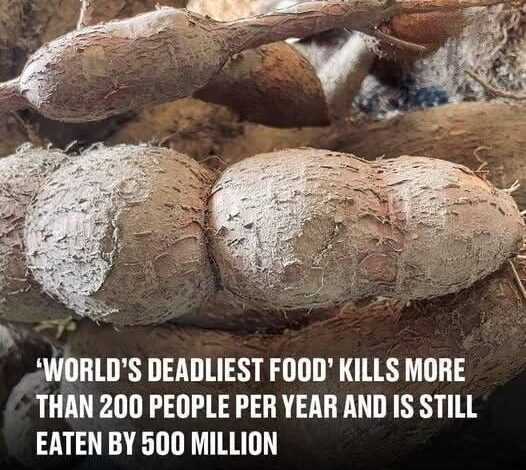
The relationship between humanity and its food sources is often a delicate dance of survival, adaptation, and risk. While most of us view our dinner plates as a sanctuary of nourishment, there exists a global staple that carries a hidden, lethal potential. It is a crop consumed by over half a billion people across the globe, a plant so resilient it flourishes where others wither, yet so dangerous that improper preparation can lead to a quick and agonizing death. This is the story of cassava—a vegetable often labeled as one of the “world’s deadliest foods,” despite being the lifeblood of entire civilizations.
Cassava, also known as manioc or yuca, is a woody shrub native to South America, though its influence has expanded far beyond its ancestral home. Today, Nigeria stands as the world’s leading producer, and the crop has become an indispensable foundation for diets throughout Africa, Asia, and Latin America. Hundreds of millions of tonnes are harvested annually to sustain a growing global population. However, beneath its rugged exterior and starchy flesh lies a chemical defense mechanism designed to ward off herbivores: the ability to produce hydrogen cyanide.
To understand the danger of cassava, one must understand its chemistry. The plant contains cyanogenic glycosides—compounds that, when the plant cells are crushed or chewed raw, break down into hydrogen cyanide. This is a potent toxin that interferes with cellular respiration, essentially suffocating the consumer from the inside out. The plant exists in two primary varieties: “sweet” and “bitter.” While the sweet varieties contain as little as 20mg of cyanide per kilogram—a level that can often be managed with basic cooking—the bitter strains can contain upwards of 1,000mg per kilogram. In these higher concentrations, a single underprepared root can be a fatal dose for an adult.
The World Health Organization estimates that cassava poisoning claims approximately 200 lives every year. While this number may seem small compared to the 500 million people who eat it daily, it represents a tragic failure in the essential ritual of food preparation. These deaths are not the result of the food being inherently “evil,” but rather a consequence of circumstance, often driven by extreme poverty, famine, or a lack of time. When prepared correctly, cassava is as safe as a potato; when rushed, it is a weapon.
Humanity’s ability to turn this toxic root into a safe, versatile flour or vegetable is a testament to our collective ingenuity. Over centuries, indigenous cultures developed sophisticated processing techniques to “tame” the plant. The most common method involves a laborious cycle of peeling, grating, and soaking the roots in water for up to 24 hours or more. This process, known as fermentation or “retting,” allows the toxic compounds to leach out into the water or dissipate into the air as gas. Following the soak, the pulp is often pressed to remove excess moisture and then roasted or sun-dried. This thermal treatment further breaks down any remaining toxins, rendering the final product—be it farinha, fufu, or tapioca—safe for consumption.
However, the risk profile of cassava shifts dramatically during times of social and environmental upheaval. The plant is incredibly drought-resistant, often the last thing standing when other crops fail. This makes it a “famine food,” but it also creates a dangerous paradox. During food shortages, hungry people may not have the luxury of waiting three days for a proper soak. They might skip steps to stave off immediate starvation, unwittingly exposing themselves to chronic or acute cyanide poisoning. In 2017, during a period of severe economic crisis and food scarcity in Venezuela, reports emerged of families dying after consuming bitter cassava out of sheer desperation.
Beyond immediate lethality, cassava poses a more insidious threat to long-term health if not processed meticulously. Chronic exposure to low levels of cyanide, often exacerbated by a lack of protein in the diet, has been linked to severe neurological conditions. One such disorder is tropical ataxic neuropathy (TAN), which causes loss of sensation in the hands and feet, or “konzo,” an irreversible paralytic disease that primarily affects children and young women. These conditions are a sobering reminder that for millions, the “deadliness” of their food is not a headline, but a daily reality of managing risk against the backdrop of malnutrition.
Yet, despite these dangers, cassava remains a hero of global food security. It is highly efficient at converting solar energy into carbohydrates, requires few pesticides, and can be left in the ground for years as a living storehouse of calories. It is the base for pearls in “bubble tea,” the starch in high-end gluten-free baking, and the primary source of calories for some of the world’s most vulnerable populations. The plant itself is not the enemy; it is a mirror reflecting the conditions of those who eat it. Where there is stability and knowledge, cassava is a miracle; where there is chaos and hunger, it can be a curse.
The fascination with “deadly delicacies” often focuses on the rare and the expensive, like the Japanese fugu fish, which requires years of specialized training for a chef to master. Cassava, however, is the “deadly food” of the masses. It doesn’t require a high-end restaurant or a licensed expert; it requires the traditional wisdom of grandmothers and the patience of a community. It is a stark example of how humans have learned to thrive in challenging environments by mastering the chemistry of nature.
As we look toward a future shaped by climate change and unpredictable agricultural yields, cassava’s role will only grow. It is likely to remain a cornerstone of the global diet, serving as a resilient buffer against a changing world. The challenge for the coming decades is not to fear the plant, but to ensure that the infrastructure of safety—clean water for soaking, education on processing, and general food security—reaches every one of the 500 million people who rely on it. The world’s “deadliest” food is also one of its most important, proving that with enough time and care, even the most toxic of roots can be turned into a gift of life.