Venezuelan leader Nicolas Maduro, wife indicted in US after capture, Trumps $50M bounty!
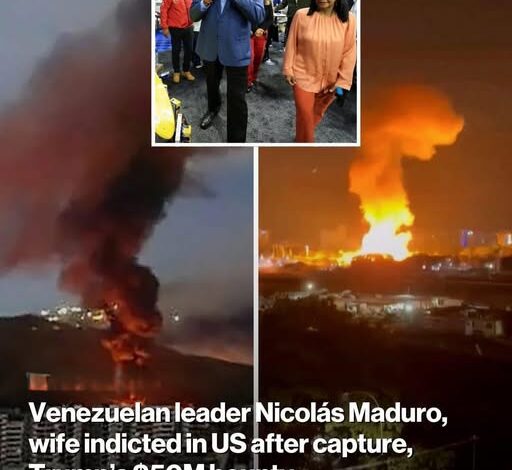
The political landscape of the Western Hemisphere shifted on its axis in the early hours of January 3, 2026, following a high-stakes military operation that resulted in the capture of Venezuelan leader Nicolás Maduro and his wife, First Lady Cilia Flores. This “kinetic action,” authorized by President Donald Trump, represents one of the most audacious uses of American military power in the 21st century—a targeted extraction of a foreign head of state on his own soil. For over a decade, Maduro had maintained a defiant grip on power in Caracas, surviving international sanctions, internal uprisings, and diplomatic isolation. However, that tenure came to a definitive, explosive end as U.S. forces executed a mission that has effectively dismantled the executive leadership of the Venezuelan state.
The operation commenced under the cover of darkness at approximately 2:00 a.m. local time. Residents of Caracas were awakened by a series of precise airstrikes targeting strategic military installations throughout the capital. Among the primary targets was Fuerte Tiuna, the sprawling military complex that serves as the nerve center for the Venezuelan armed forces. While the strikes were designed to neutralize air defenses and communication hubs, their primary objective was to create a window for tactical teams to secure Maduro and Flores. By daybreak, the smoke rising from military bases across the city signaled more than just a battle; it signaled a total collapse of the status quo.
Shortly after the operation, Attorney General Pam Bondi announced on social media that Maduro and Flores had been successfully apprehended and were being transported to the United States. They have been indicted in the Southern District of New York on a litany of severe charges, including narco-terrorism conspiracy, cocaine importation conspiracy, and the illegal possession of machine guns and destructive devices. Bondi’s statement was unyielding: “They will soon face the full wrath of American justice on American soil in American courts.” The Attorney General credited President Trump’s “courage” and the precision of the military for bringing an end to what the U.S. has long characterized as a criminal enterprise masquerading as a government.
The legal and financial pressure on Maduro had been mounting for years. Since the first Trump administration in 2020, the U.S. had categorized Maduro as a fugitive, placing a $15 million bounty on his head. That figure was escalated to a staggering $50 million in August 2025, as evidence mounted regarding the regime’s ties to international criminal syndicates. U.S. officials allege that Maduro utilized the “Cartel of the Suns”—a drug-trafficking organization allegedly run by high-ranking Venezuelan military officers—to flood American streets with narcotics. The Drug Enforcement Administration (DEA) reports having seized over thirty tons of cocaine linked to the regime, with seven tons tied directly to Maduro’s personal oversight. This narco-trafficking was not merely a side venture; it was, according to the U.S. government, the primary financial engine that kept the “illegitimate” regime afloat.
The geopolitical implications of this arrest are profound. Secretary of State Marco Rubio, a longtime hawk on Venezuelan policy, characterized the status quo as “intolerable.” He pointed to the regime’s role in inviting hostile actors like Iran and Hezbollah to operate within the Western Hemisphere, as well as providing a sanctuary for Colombian terror groups like the ELN and FARC. By removing Maduro, the U.S. argues it is not merely enforcing an arrest warrant but defending the security of the entire region. Senator Mike Lee echoed this sentiment, suggesting the operation falls under the President’s inherent authority in Article II of the Constitution to prevent imminent attacks and protect U.S. personnel.
In Venezuela, the atmosphere is one of profound uncertainty and “suspended animation.” Executive Vice President Delcy Rodríguez, the constitutional successor to the presidency, has demanded “proof of life” for Maduro and Flores. Rodríguez, a powerful fixture in the Chavista movement for over two decades, remains a staunch ally of the captured leader, but her ability to maintain control of the military and the state remains in question. Meanwhile, the international community has reacted with a blend of shock and caution. While European leaders, represented by Kaja Kallas, acknowledged that Maduro lacked democratic legitimacy following the widely disputed 2024 elections, they have also called for “restraint” and respect for international law.
The vacuum left by Maduro’s departure has intensified the focus on María Corina Machado, the opposition leader and 2025 Nobel Peace Prize winner. Many view Machado as the legitimate voice of the Venezuelan people and the only figure capable of leading a peaceful transition to democracy. However, the path forward is fraught with peril. The “Cartel of the Suns” and other paramilitary groups loyal to the former regime remain armed and active, and the potential for a protracted civil conflict is a looming shadow over the “new dawn” described by U.S. diplomats.
President Trump, speaking from his Mar-a-Lago resort, praised the “brilliant operation” as a victory for the American people and a fulfillment of a long-standing promise to hold the regime accountable. The capture of a sitting head of state is a rare event in modern history, drawing comparisons to the 1989 capture of Manuel Noriega in Panama. As Maduro arrives in New York to stand trial, the world will be watching a judicial process that is likely to reveal the dark inner workings of a regime that transformed a once-prosperous nation into a hub for international crime.
The “silent warning” to other autocratic leaders is unmistakable. In the 2026 landscape, the boundaries of sovereignty are increasingly porous when national security and narco-terrorism are at stake. The capture of Nicolás Maduro is a reminder that in a hyper-connected world, there is no corner of the globe beyond the reach of those seeking “accountability.” For the millions of Venezuelans who have fled the country’s economic collapse and political repression, this event represents a moment of hope—a chance to rebuild a nation from the ashes of a failed dictatorship.
Ultimately, the story of January 3, 2026, is about the intersection of military might and legal resolve. It is a story of a “tyrant” who believed he was untouchable and a superpower that decided the status quo was no longer an option. As the sun sets over a transformed Caracas, the true challenge begins: the difficult, messy, and essential work of restoring the rule of law to a country that has forgotten what it looks like. The “new dawn” has arrived, but the day that follows will be the true test of Venezuela’s resilience and the international community’s commitment to its future.