Valerie Bertinelli Reflects on Self-Acceptance While Sharing a Throwback Swimsuit Photo!
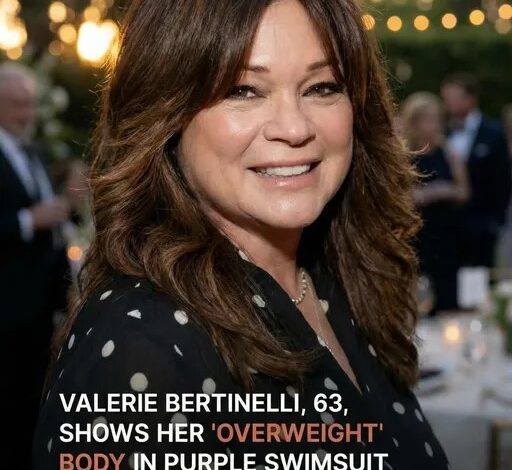
The digital age is often defined by a relentless drive toward perfection, where curated images and filtered realities set an unattainable standard for beauty and success. However, on February 15, 2026, Valerie Bertinelli disrupted this narrative with a single, unvarnished throwback photo that has ignited a national conversation on the politics of the female body and the arduous journey toward self-acceptance. By sharing a swimsuit image taken nearly a decade ago, the 63-year-old actress and culinary icon did not merely offer a nostalgic glimpse into her past; she staged a quiet rebellion against the societal habit of equating a woman’s worth with her silhouette.
The photograph in question captures Bertinelli during a period when she was publicly labeled as “overweight” by various media outlets and even by the standards she had internalized for herself. Looking back at that image now, through the lens of a woman who has endured profound personal loss and significant professional growth, she sees something entirely different. She sees a woman who was healthy, active, and vibrant, yet who was being held to a punishing, arbitrary metric of “enoughness.” Her reflection serves as a poignant critique of how appearance-based labels can obscure the reality of a person’s physical and emotional health.
For much of her career, Bertinelli was the face of high-profile weight loss campaigns, a role that placed her at the epicenter of the scale-obsessed culture of the early 2000s. She admits that for decades, she lived under the crushing pressure to achieve and maintain a specific number, believing that her professional success and personal happiness were inextricably linked to that digit. This constant vigilance was not just physically taxing; it was emotionally corrosive. The realization that she had spent years distracted from the beauty of her life by the shadow of self-criticism is a theme that has resonated deeply with her audience. Her “admission” is one of exhaustion—an exhaustion felt by millions who have been taught to view their bodies as projects to be managed rather than vessels to be inhabited.
The catalyst for this radical shift in perspective was the death of her former husband, rock legend Eddie Van Halen, in 2020. Facing the finality of death stripped away the trivialities of vanity. In the wake of such a significant loss, the numerical value on a scale felt increasingly inconsequential. Bertinelli has spoken openly about how this period of mourning recalibrated her priorities, teaching her that time is a non-renewable resource that should not be squandered on the pursuit of external approval. She began to see that happiness is not a destination reached at a certain weight, but a byproduct of presence, gratitude, and emotional well-being.
Her recent post and the subsequent dialogue have highlighted a growing cultural movement toward authenticity. By refusing to frame her story as a “transformation” or a “before-and-after” success, Bertinelli has challenged the very structure of health and fitness narratives. She is advocating for a middle ground—a place where health is defined by how one feels and functions rather than how one looks in a swimsuit. This move toward balance over extremes is a hallmark of her current philosophy. She encourages her followers to focus on what their bodies allow them to do—the places they can go, the people they can hug, and the life they can lead—rather than the space they occupy.
The public reaction to her vulnerability has been a tidal wave of shared experiences. In the comment sections and across social media, people of all ages have expressed a profound sense of relief. There is a collective weariness with the “perfection” industry, and Bertinelli’s willingness to be seen in her “imperfection” acts as a permission slip for others to do the same. She has become an accidental leader in the movement to de-stigmatize aging, proving that confidence at 63 is far more attractive than the anxious striving of one’s younger years.
Bertinelli’s writing and interviews in 2026 suggest a woman who is finally at peace. She has replaced the harsh internal monologue of “not good enough” with a softer, kinder inner voice. This shift toward emotional well-being is not just a personal victory; it is a roadmap for a society that is increasingly realizing the high cost of body shame. She argues that when we stop fighting our bodies, we free up immense amounts of energy to pursue our passions, nurture our relationships, and contribute to the world in meaningful ways.
The significance of her message lies in its simplicity. By sharing a ten-year-old photo, she reminded the world that we are often our own harshest critics. The woman in that photo, whom the world called “overweight,” was beautiful then, just as Bertinelli is beautiful now. The only difference is that now, she knows it. She is no longer waiting for the scale to tell her she has permission to enjoy her life. She has claimed that permission for herself, and in doing so, she has invited everyone else to do the same.
In the final estimation, Valerie Bertinelli’s reflection on self-acceptance is a call to action. It is a call to look in the mirror with kindness, to appreciate the scars and the changes that come with a life well-lived, and to reject any narrative that suggests our value is found in our appearance. As she continues to share her journey, she remains a powerful advocate for the idea that caring for oneself is the ultimate act of defiance in a world that profits from our self-doubt. Her story is a reminder that the most important “transformation” is the one that happens within the heart and the mind, leading to a place of lasting, quiet confidence.
The cultural impact of her honesty will likely be felt for years. She has shifted the conversation from “how to lose weight” to “how to love the life you have.” It is a lesson in resilience, a meditation on aging with grace, and a celebration of the freedom that comes when we finally stop trying to be anyone other than who we are. In the “after” of her life’s many chapters, Valerie Bertinelli has found her most authentic role yet: herself.