Understanding Claims About Long-Range Missile Strikes! Separating Facts from Speculation
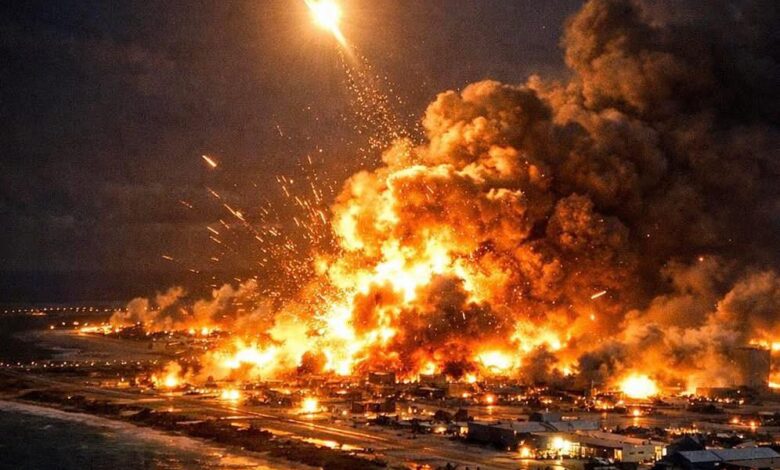
In the high-velocity landscape of 2026, where a single notification can ripple across the globe in milliseconds, the distinction between a major international crisis and a viral fabrication has never been more critical. Recently, a dramatic and highly specific claim began to colonize social media feeds, suggesting that Iran had launched a direct missile strike against a United States military installation located on the remote island of Diego Garcia. The reports, often characterized by urgent, emotionally charged language, described a long-range ballistic missile traversing thousands of kilometers to inflict significant damage on one of the most strategically guarded facilities in the Indian Ocean. However, as is often the case with sensational digital rumors, a closer examination reveals a stark absence of verified evidence, highlighting a growing tension between the speed of information and the necessity of truth.
To understand why such a claim—however unverified—can gain significant traction, one must look at the psychological and technological levers it pulls. The mention of Diego Garcia is not accidental; the island is a linchpin of global military strategy. Located in the British Indian Ocean Territory and jointly operated by the United Kingdom and the United States, it serves as a critical node for long-range bomber deployments, naval support, and high-level intelligence surveillance across the Indo-Pacific. Because of its isolation and its role in regional stability, any credible threat to this facility would not be a footnote in a social media thread; it would be the lead story on every major international news network, from the BBC to the Wall Street Journal. The fact that such a monumental event remained unconfirmed by official government statements or satellite defense data strongly suggests that the narrative is a product of speculation rather than a reflection of reality.
The claim also ventures into the complex world of ballistics, citing a strike from a distance of approximately 4,000 kilometers. In the lexicon of modern defense, this would place the weapon in the category of an Intermediate-Range Ballistic Missile (IRBM), a class of weaponry that bridges the gap between regional medium-range systems and global intercontinental ballistic missiles (ICBMs). While several nations, including Iran, have demonstrated significant advancements in their indigenous missile programs, the deployment of such a weapon against a distant U.S. base would represent a massive geopolitical escalation. Such a launch is not a stealthy affair; it involves thermal signatures detectable by global early-warning satellites and trajectory tracking that would immediately trigger international defense protocols. An event of this magnitude creates a “data trail” that is impossible to hide from the global community, further casting doubt on reports that rely on vague citations rather than transparent evidence.
The rapid spread of this misinformation underscores a broader systemic issue in how we consume media today. We currently inhabit an era where “credibility” is often a costume worn by sensationalism. Misleading headlines frequently employ common tactics to deceive the reader, such as using all-caps for emphasis, omitting direct sources, or—as seen in this instance—invoking the names of respected publications like the Wall Street Journal without providing a verifiable link or citation. This tactic is designed to hijack the reader’s trust, making the claim appear as though it has already been vetted by the institutional gatekeepers of journalism. When these headlines are paired with emotionally charged language about “shattered buildings” or “global conflict,” they bypass the rational mind’s defenses and encourage immediate, reflexive sharing.
This cycle of unverified sharing has consequences that extend far beyond a few mistaken social media posts. In the context of international relations, false reports of military strikes can create unnecessary public anxiety, influence market volatility, and even undermine the diplomatic efforts required to maintain peace. When speculation is allowed to masquerade as fact, it erodes the collective trust in reliable information sources, making it harder for the public to discern real threats when they do arise. For this reason, the burden of verification has shifted from the publisher to the consumer. A responsible approach to such news requires a simple but disciplined checklist: Is the event being reported by multiple, independent international news organizations? Are there official statements from the governments involved? Does the report provide specific, verifiable data rather than vague emotional appeals?
In 2026, the concept of “media literacy” has evolved from an academic skill into a vital tool for civic stability. To be an informed citizen is to recognize that the digital fog of war is often thicker than the physical one. We must learn to read beyond the provocative headline and question the intent behind the information we encounter. The absence of confirmed satellite imagery or diplomatic fallout in the hours following the alleged strike on Diego Garcia is, in itself, a form of evidence. It suggests that the status quo of regional security remains intact and that the “explosion” described online was a linguistic one rather than a kinetic one. Geopolitical tensions are a reality of our modern world, but addressing them requires a foundation of verified intelligence and careful analysis, not the reactive panic fueled by unproven digital narratives.
As we move forward into an increasingly connected future, the role of the individual in shaping the information environment cannot be overstated. By choosing to engage with original sources and refusing to amplify sensationalist speculation, readers contribute to a more accurate and stable public discourse. In the high-stakes arena of global security, clarity is more than a preference; it is a necessity. The story of the missile strike that wasn’t serves as a poignant reminder that in the age of instant connectivity, the most powerful defense we possess is a critical mind. Verification remains the ultimate arbiter of truth, and in matters that could define the future of international relations, it is always better to wait for the facts than to be first with the fiction.