U S Marines Arrive at Florida Detention Centers Under New Orders and the Move Is Sending Shockwaves Through Local Communities
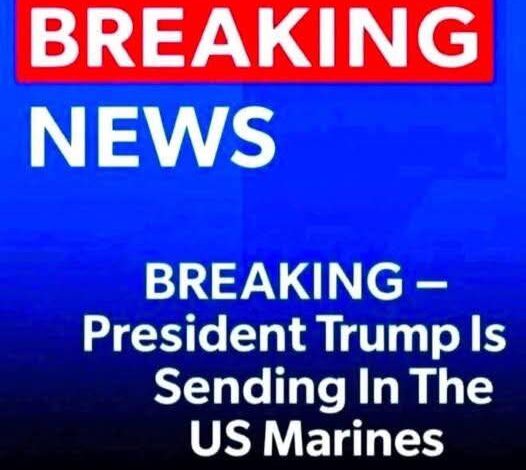
The quiet but highly visible arrival of U S Marines at detention facilities throughout Florida has become a major stress test for a foundational American principle: the strict separation of military force and domestic policing. While the administration emphasizes that these troops are currently handling administrative tasks and logistical support, their presence in civilian spaces of confinement has ignited a fierce debate over the militarization of the immigration system. Even if these service members are only handling clipboards, managing supply crates, or coordinating transportation, the psychological impact of seeing active-duty military personnel on American soil is sending a message that is impossible to ignore.
For the thousands of migrants, legal advocates, and local residents already living under the shadow of deportation, the sight of camouflage and military rank carries a heavy weight. In a community where trust in federal authorities is often fragile, the presence of the Marines is frequently perceived as a warning rather than a sign of reassurance. Advocates argue that the visual of the military patrolling or managing detention centers creates a climate of fear, suggesting that the mission has shifted from civil processing to a combat-style operation. This shift in optics, they claim, fundamentally alters the relationship between the government and the people it is tasked with processing.
Supporters of the deployment, however, view the move as a purely practical and necessary intervention in a system that is currently on the brink of collapse. They argue that the influx of individuals has overwhelmed civilian staff, leading to dangerous backlogs and administrative chaos. From this perspective, using the unparalleled logistical expertise of the U S Marines is a sensible solution to a crisis. Proponents insist that the military is uniquely equipped to manage large-scale housing, food distribution, and medical logistics, which could theoretically improve the living conditions within the facilities by speeding up processing times and relieving the burden on exhausted border and immigration officers.
Yet, the ultimate verdict on this controversial experiment will depend on the duration and scope of the mission. The primary concern among constitutional experts is whether this deployment remains a narrow, temporary measure designed for a specific emergency, or if it quietly expands into a “new normal.” History has shown that temporary military interventions into domestic issues often have a way of becoming permanent fixtures of government policy. The erosion of the line between civilian and military authority is rarely a sudden event; instead, it tends to happen through a series of incremental steps justified by perpetual crises.
To maintain public trust and prevent the confirmation of the community’s worst suspicions, the mission requires more than just logistical efficiency. It demands absolute transparency, rigorous independent oversight, and meaningful engagement with the communities most affected by the presence of the troops. Without clear, publicly available rules of engagement and a definitive end date for the military’s involvement, the deployment risks being seen as a move toward a more authoritarian approach to domestic issues.
As the experiment continues, the nation is watching to see how these service members interact with the civilian population and whether their involvement actually leads to a more humane and efficient system. For now, the Florida detention centers remain at the center of a national conversation regarding the role of the military in American life. Whether this move restores order to a broken system or permanently damages the trust of the immigrant community remains to be seen, but the presence of the Marines has undeniably changed the stakes of the ongoing debate over the nation’s borders.