Two poor boys always lived by their late grandmothers teachings of love and kindness
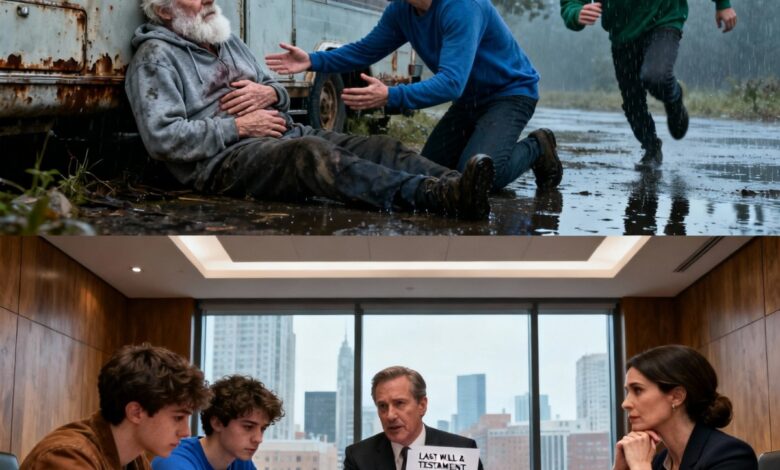
Rain hammered the cracked road as Ethan and Mason trudged home from school, their jackets soaked through and their shoes squishing with every step. They were used to being drenched—the two boys had spent their entire childhood in weather like this, raised by mothers who worked double shifts and a grandmother who’d taught them one lasting rule: Kindness is your real inheritance.
That rule was the only reason they stopped when they spotted an elderly man kneeling beside a toppled cart, groceries scattered everywhere, his thin hands shaking with cold. Cars splashed past him without slowing. The rain didn’t let up.
“Sir, you okay?” Mason called out.
The old man looked up, startled, rain dripping from his silver eyebrows. “My wheel… broke. I can’t—” A cough interrupted him.
Ethan was already kneeling beside him. “We got you.”
They gathered the spilled cans, the bruised fruit, a single loaf of bread now soggy at the edges. When they tried to lift the cart, the axle snapped clean in half.
“Forget the cart,” Mason said. “We’ll carry the bags.”
The old man tried to protest, but his voice was barely a whisper. They slung his groceries over their shoulders and followed him through the rain, through thick grass and puddles, past trees bending under the storm’s weight.
They stopped in front of a rusted metal trailer slouched sideways like a wounded animal. The windows were patched with cardboard. The roof sagged in the middle. The door dangled from one hinge.
“You live here?” Mason asked softly.
The old man—Mr. Turner—nodded with embarrassment. “I’m sorry you had to see it like this.”
“You don’t need to apologize,” Ethan said.
Inside, everything was sparse. One chair. One thin blanket. A table that wobbled if touched. Mr. Turner opened his wallet—empty. He swallowed hard, reached for the single apple on his counter, and held it out with trembling hands.
“It’s all I have. Please, take it. Let me repay you somehow.”
Mason shook his head. “We didn’t help you for money.”
Ethan gently placed the apple back. “You keep it. You need it more.”
When the boys left, Mr. Turner stood in the doorway watching them disappear into the rain, hands pressed to his lips, eyes watery.
They didn’t know then that this small moment—two boys choosing kindness—would change their lives forever.
The next morning, they met at the same crossroads.
“You thinking what I’m thinking?” Ethan asked.
“Yeah,” Mason replied. “Let’s go.”
They pooled their saved lunch money, the coins from sweeping porches, the few dollars their mothers insisted they keep “just in case.” With all that, they bought rice, canned vegetables, bread, soap, and scrap fabric. Mason borrowed tools from a neighbor’s shed.
They knocked on Mr. Turner’s door that afternoon. He opened it carefully, as if expecting bad news. When he saw the bags in their hands, he froze.
“What is all that?”
“Just a few things,” Ethan said.
“For you and the trailer,” Mason added.
The bags were filled to bursting. Mr. Turner stared at them, stunned.
“B-Boys… I can’t accept this.”
“Yes, you can,” Mason said, smiling. “We brought too much food. We’ll get in trouble if we bring it home.”
It was the worst lie in the world, but it worked.
Mr. Turner’s voice broke. “Why would you do this?”
“Our grandma always said,” Ethan replied, “love isn’t love unless you give it away.”
The old man covered his mouth as tears slipped down his cheeks. “May I… hug you boys?”
They nodded, and his arms wrapped around them—frail, trembling, full of gratitude.
That day became the first of many.
They visited twice a week, sometimes more. They patched his windows. Repaired the roof. Replaced cardboard with real glass they found at a junkyard. Mason dug a drainage ditch so the trailer wouldn’t flood. Ethan reorganized the inside, fixed the wiring, cleaned everything.
They cooked meals together. They talked for hours. Mr. Turner told stories—some funny, some heavy, some told in a whisper like they hurt to remember.
“You know,” he said one evening, “a great man does the right thing when no one is watching.”
Mason nudged him. “Sounds like something on a poster.”
Mr. Turner grinned. “Nope. That one’s mine.”
The boys grew to love him. The old man who had nothing became part of their lives—part of their family.
Then spring came.
One day, Ethan and Mason approached the trailer with a basket of fruit. They knocked.
“Mr. Turner? We got strawberries!”
Silence.
They knocked again. Called his name. No answer.
Ethan pushed the door open. The trailer was empty. No clothes. No food. No blankets. The air felt hollow.
“Where is he?” Mason whispered.
They searched everywhere—woods, hospital, police station. Nothing.
“He’s old,” one officer said dismissively. “People wander.”
“No,” Ethan snapped. “He wouldn’t leave without telling us.”
But he was gone.
Days passed. Then weeks. Then months.
They kept checking the trailer. Sometimes they left food on the step. Hope faded, but they still visited. The trailer became a silent monument to a man who had become family.
Two years later, they were eighteen. High school graduates with no money for college, working small jobs while trying to figure out life. They still walked the old road sometimes, always glancing toward the abandoned trailer.
Until one morning, Ethan’s phone rang.
“Is this Ethan Wells?”
“Yes.”
“My name is Jonathan Reed. I’m the attorney for Mr. William Turner. I need you and Mason to come to my office.”
“Did you find him?” Ethan asked, breath catching.
There was a pause.
“I’m sorry. Mr. Turner passed away two weeks ago. He left instructions to contact you.”
The world tilted. Ethan told Mason. They sat together, stunned and quiet.
That afternoon, they walked into a small legal office. The attorney slid a sealed envelope across the table.
“This letter is for you.”
Ethan opened it. Mr. Turner’s handwriting trembled across the page.
“My dear Ethan and Mason,
If you are reading this, I am gone.
Forgive me for disappearing—I did not want you to see me in my final days.
I lived most of my life surrounded by money and people who pretended to care. When betrayal took everything, I walked away from it. I chose that trailer because I thought loneliness was all I deserved.
Until you two arrived.
You brought me food, laughter, friendship. You brought me dignity. You brought me love.
You became the grandsons I wished I’d had.
What little I kept, I now leave to you.
Use it to chase your dreams.
With all my love,
William Turner”
Ethan wiped tears with the back of his hand. Mason sat frozen.
The lawyer opened a folder.
“Mr. Turner left each of you $150,000.”
Both boys stared.
“That’s—impossible,” Mason whispered. “He was poor.”
“He lived simply,” the lawyer said. “But he didn’t lose everything. He kept a trust for the future—for you. He wanted you both to go to college. He wanted you to become teachers.”
Ethan’s voice cracked. “We’ll make him proud.”
Three years later, they did.
Brookdale Community College’s auditorium overflowed with applause as Ethan and Mason walked across the stage to receive their teaching credentials. They looked older now. Steadier. But the same spark of quiet kindness burned behind their eyes.
After the ceremony, they drove back to the old trailer. It still sagged, rusted and tired.
Ethan placed his hand on the weathered door. “We made it, Mr. Turner.”
Mason set wildflowers on the step. “Hope you’re watching.”
They turned away, not in sadness, but gratitude.
Five years later, their names echoed across the school district—two beloved teachers known for their patience, their compassion, their ability to see the kid no one else noticed.
Every year, they awarded The Turner Scholarship to a student who needed a chance. A student who reminded them of the boys they once were.
And one day, a timid freshman lingered after class.
“Mr. Wells?” he asked. “Is it true you started the Turner Scholarship… because someone helped you?”
Ethan smiled. “Yes.”
“Why?” the boy whispered.
Ethan rested a hand on his shoulder. “Because a great man once told me… a real man does the right thing when no one is watching.”
Mr. Turner’s words lived on—in them, in their students, in every quiet act of compassion that rippled outward.
All because two poor boys stopped in the rain one day…
and helped a stranger who became their family.