This Just Got Personal, JD Vance Fires Back After Joe Rogans Brutal Attack on MAGA Sparks Political Firestorm
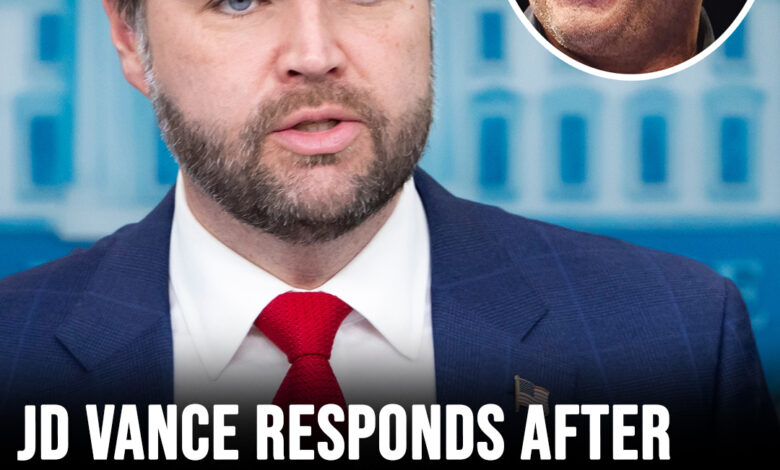
What started as a podcast rant has quickly escalated into a full-blown political clash, pulling in major voices and exposing growing tension inside a movement that once seemed tightly aligned. When Joe Rogan openly criticized MAGA supporters in unusually blunt terms, it didn’t just raise eyebrows—it triggered a direct response from JD Vance that has added fuel to an already heated debate.
Rogan, who had previously shown support for Donald Trump leading into the 2024 election, has recently taken a noticeably different tone. His commentary has shifted from cautious backing to pointed criticism, especially when it comes to foreign policy decisions and what he sees as contradictions between campaign promises and real-world actions.
During a recent episode of The Joe Rogan Experience, Rogan didn’t hold back. While discussing the possibility of escalating conflict involving Iran, he described the situation as chaotic and fundamentally at odds with what voters had been told to expect. The idea of avoiding unnecessary foreign wars had been a central talking point, and in his view, current developments seemed to move in the opposite direction.
But it wasn’t just policy that Rogan targeted.
In a moment that quickly spread across media and social platforms, he turned his attention to the movement itself. Referring to MAGA supporters in blunt, provocative language, Rogan described the group as “uninteresting” and “unintelligent,” going even further by calling it a movement filled with “dorks.” It was a sharp break from the more neutral or supportive tone he had taken in the past.
That comment alone was enough to ignite backlash.
For many, it wasn’t just criticism—it felt like a betrayal coming from someone who had previously been seen as sympathetic, or at least open, to the movement’s ideas. The reaction was swift, and it wasn’t long before JD Vance was asked to weigh in.
His response came with a mix of dismissal and subtle pushback.
Rather than engaging directly with the insult, Vance reframed the conversation. He acknowledged that every political group has its share of eccentric or unconventional supporters but made it clear he didn’t see that as a defining trait.
“I think we have many fewer ‘dorks’ than the far left,” he said, leaning into the remark without fully embracing it. “But every group has them. We welcome everyone who wants to help move the country in the right direction.”
It was a calculated answer—one that avoided escalating the insult while still pushing back against the broader implication.
But the exchange didn’t stop there.
Rogan had also reportedly criticized the administration’s approach to immigration, suggesting that previous administrations, including those led by Barack Obama and Hillary Clinton, had been more effective at deportations. That claim raised eyebrows, and when Vance was asked about it, he responded more directly.
He made it clear he hadn’t seen the exact statement but didn’t hesitate to challenge the premise.
“That’s definitely wrong,” he said, adding that he intended to reach out to Rogan personally to address it.
From there, Vance shifted into a broader defense of the administration’s record. He argued that current policies are focused on reversing what he described as a surge in illegal immigration under Joe Biden, framing the situation as one where the current administration is dealing with the consequences of previous decisions.
According to Vance, the scale of enforcement and deportation efforts now exceeds anything seen in earlier administrations.
“We’ve been doing more than any administration in history,” he said, emphasizing that the challenge lies not only in policy execution but in the volume of cases that need to be addressed.
It was a firm rebuttal, but it also highlighted something deeper—an emerging divide between influential media voices and political leadership.
Rogan’s platform has long been one of the most widely listened to in the world, reaching millions of people across different political backgrounds. His willingness to shift positions or criticize figures he once supported gives his commentary a particular weight. It doesn’t fit neatly into partisan lines, and that unpredictability makes it harder to dismiss.
At the same time, political leaders like Vance are navigating a different reality—one where messaging, consistency, and public perception all play critical roles.
When those two worlds collide, the result is rarely simple.
This situation reflects more than just a disagreement between a podcaster and a politician. It reveals tension within a broader coalition of voices that don’t always move in sync. Support doesn’t always remain fixed, and when expectations clash with outcomes, even allies can become critics.
Rogan’s comments about foreign policy suggest frustration with perceived inconsistencies. His remarks about supporters, however, strike at something more sensitive—the identity of the movement itself.
And that’s where the reaction becomes more intense.
For many supporters, criticism of policy can be debated. But criticism of people—especially in dismissive or insulting terms—feels personal. It challenges not just decisions, but the legitimacy of those who back them.
Vance’s response, measured as it was, aimed to defuse that tension rather than inflame it. By acknowledging imperfections without conceding the larger point, he attempted to keep the focus on shared goals rather than internal conflict.
Still, the exchange raises a larger question about the relationship between media figures and political movements.
Rogan is not a traditional political actor. He isn’t bound by party discipline or campaign strategy. His influence comes from conversation, from questioning, from saying things that others might avoid. That freedom allows him to shift positions quickly—but it also means his statements can carry unpredictable consequences.
For politicians, those consequences can’t be ignored.
The fact that Vance responded at all shows the level of attention Rogan’s comments generated. It also suggests an awareness that narratives shaped outside traditional political channels can have real impact.
As this exchange continues to circulate, it’s likely to spark further debate—not just about who is right or wrong, but about the evolving dynamics between public figures, media influence, and political identity.
Because what’s unfolding here isn’t just a disagreement.
It’s a glimpse into how quickly alliances can shift, how narratives can change, and how even a single comment—delivered on a podcast—can ripple outward into something much larger.