They Ignored Her Warning About Winter, Then Her Underground Shelter Saved Them All!
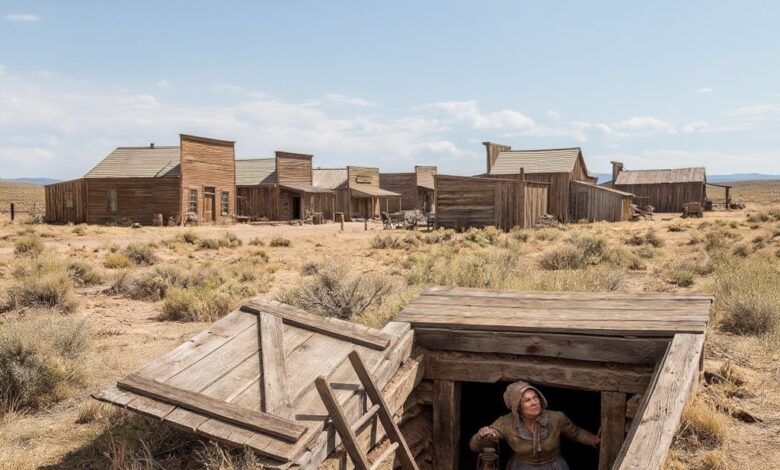
They started laughing the moment Eleanor Hayes picked up a shovel.
At first, no one paid much attention. It looked like nothing more than a shallow trench behind her small cabin on the edge of town. Easy to ignore unless you walked right up to it. But Eleanor didn’t stop. Each day, the trench grew deeper, more defined, less like a passing project and more like something intentional.
By the end of the first week, people noticed.
By the second, they started talking.
By the third, they were openly mocking her.
“She’s finally lost it,” one man said at the general store, leaning back like he’d just delivered a punchline. “Digging herself a hole like she’s planning to disappear.”
Another laughed. “Or maybe she thinks she’s some kind of animal. Going underground for winter.”
The room filled with easy laughter. It was simple, harmless entertainment for people who didn’t take her seriously.
Eleanor heard about it. In a town like that, you always did.
But she didn’t respond. She didn’t defend herself or try to explain.
She just kept digging.
Eleanor had always been different, though not in a way that demanded attention. She kept to herself, living quietly where the land stretched wide and the wind carried more truth than conversation ever did. She wasn’t interested in gossip, didn’t spend her evenings in crowded places, didn’t try to convince people of anything.
She observed.
She paid attention.
And this year, something wasn’t right.
The birds had left earlier than usual, abandoning the sky before autumn had fully settled in. The nights had turned sharp too quickly, the kind of cold that didn’t belong yet. And the wind—it carried a bite to it, something dry and unforgiving that hadn’t been there in years.
Eleanor didn’t need forecasts or reports.
She knew what was coming.
A winter that wouldn’t just be difficult—but dangerous.
She tried to tell them.
“You should gather more firewood,” she said to Mrs. Langley one afternoon.
The woman smiled politely, already halfway turned away. “It’s autumn. It always gets cold.”
“This isn’t the same,” Eleanor insisted. “The frost came too early.”
“You worry too much,” came the dismissive reply.
At the general store, she tried again.
“Stock up,” she told the group of men gathered there. “Food, blankets—anything you can. This winter is going to be worse than you think.”
One of them smirked. “Since when are you predicting the weather?”
“I’m not guessing,” she said.
“We’ve lived here our whole lives,” another added. “We know what winter looks like.”
Eleanor looked at them, calm but certain.
“No,” she said quietly. “You don’t.”
They laughed.
So she stopped talking.
And started building.
What she was digging wasn’t just a hole. It was a shelter—designed, deliberate, and practical.
She worked from sunrise until her hands gave out, then picked up again the next day. She reinforced the walls with timber, shaped the space to hold heat, kept the ceiling low so warmth wouldn’t escape. She carved out areas for food storage—preserved vegetables, grains, dried meat—everything measured and planned.
The entrance was narrow, angled to block wind and trap warmth inside. From the outside, she covered it carefully, blending it into the land until it looked like nothing more than a raised patch of earth.
Inside, she placed blankets, lanterns, and a small stove.
It wasn’t comfortable.
It wasn’t meant to be.
It was meant to survive.
The first snow came too early.
Heavy, silent, covering everything before most people had finished preparing.
“It’s just early,” they said. “It happens.”
But Eleanor stayed inside, checking her supplies, reinforcing what she could.
Then the temperature dropped.
Fast.
The wind came next—strong, relentless, tearing through the valley with a force that didn’t feel natural. It rattled doors, shook walls, and froze everything it touched.
Still, people held onto their confidence.
“We’ve seen worse,” they said.
They hadn’t.
By the second week, the cracks started showing.
Firewood ran low faster than expected. Food supplies began to shrink. Roads vanished under thick layers of ice and snow, cutting off any chance of outside help.
And the cold—it didn’t stay outside.
It crept in.
Through walls, through floors, through every weak point.
Homes that had stood for decades began to fail under the pressure. Windows iced over. Doors froze shut. Fires struggled to stay lit.
Then came the storm.
It arrived at night, sudden and overwhelming.
The wind didn’t just blow—it screamed, tearing through the town like something alive. Roofs rattled. Shingles ripped away. Entire structures groaned under the force.
Inside, families huddled together, trying to hold onto warmth.
But it wasn’t enough.
Below the ground, Eleanor sat in her shelter, listening.
The storm above was deafening, but down there, it was different. The thick earth absorbed the sound, softened it. The air stayed warm. The small stove burned steadily.
It wasn’t comfort.
But it was safety.
Then she heard something.
A faint knock.
She froze, listening.
It came again.
Weak. Barely there.
Eleanor grabbed her lantern and moved to the entrance. When she opened it, the wind hit her like a wall.
And there, struggling to stand, was Mrs. Langley.
Her face was pale, her lips trembling, her body shaking uncontrollably.
“Please…” she whispered.
Eleanor didn’t hesitate.
She pulled her inside.
After that, they came one by one.
Not because someone told them.
Because they had no other choice.
The same people who had laughed. The same ones who had dismissed her warnings. Now they arrived cold, hungry, and afraid.
And Eleanor let them in.
All of them.
The shelter filled beyond what it was designed for. Space became tight. Supplies had to stretch. But they made it work.
They shared warmth, rationed food, took turns tending the fire.
Above them, the storm raged without pause.
Below, there was something else.
Stillness.
Survival.
Days passed. Then more.
The storm didn’t let up—but neither did they.
Eleanor kept things organized. Calm. Controlled. She didn’t panic, didn’t complain, didn’t remind anyone of what they had ignored.
She just did what needed to be done.
And they followed her.
When the storm finally ended, it left behind something unrecognizable.
The town was buried. Buildings damaged, some beyond saving. The silence that followed felt heavier than the storm itself.
The people stepped out slowly, adjusting to the light, taking in what remained.
Then they looked at Eleanor.
No laughter now.
No doubt.
“You saved us,” one man said.
Eleanor shook her head slightly. “I warned you.”
Mrs. Langley stepped forward, her voice unsteady. “We should have listened.”
No one argued.
“What do we do now?” someone asked.
Eleanor looked out over the frozen remains of the town.
Rebuilding wouldn’t be easy.
It never was.
But this time, things would be different.
“This time,” she said, “we prepare.”
Spring didn’t come quickly, but it came.
The snow melted. The ground softened. Life began to return.
The town rebuilt—stronger, more careful.
And Eleanor’s shelter remained.
No longer hidden. No longer mocked.
Now, it was something else entirely.
Proof.
People came to see it, to understand it, to learn from it.
And sometimes, they’d find Eleanor there, still working, still improving it.
“Still getting ready?” someone asked her once.
Eleanor gave a small, knowing smile.
“Winter always comes,” she said.
Then she looked out over the land.
“But next time, we won’t be caught off guard.”