They Cut Down My Trees for a Better View, So I Took Down Their Brand New Fence!
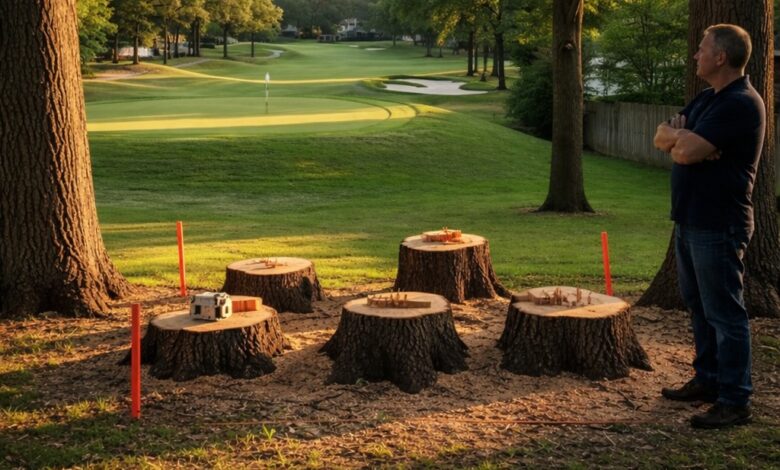
The morning after I discovered the butchered remains of my property line, I didn’t reach for a phone to scream at a lawyer or leave a vitriolic voicemail for the golf course management. Rage is a loud, chaotic emotion that makes a person easy to categorize as “difficult” or “unstable.” I didn’t want to be difficult; I wanted to be undeniable. I needed proof, and proof required a professional who spoke the language of the earth itself.
I found Pete Holloway through a string of local reviews that used words like “obsessive” and “no-nonsense.” When I called him and described the situation, there was a long, gravelly pause on the other end of the line. Pete didn’t ask if I was sure or if I might have misread the markers. He simply chuckled, a low sound like grinding stones, and remarked that he’d seen plenty of developers who thought property lines were merely suggestions. He promised to be there at sunrise.
True to his word, Pete arrived in a truck that looked like it had survived three decades of Wyoming winters and intended to survive three more. He was a man in his sixties, weathered by the sun and silence, who moved with a methodical lack of wasted motion. There was no small talk, no performative sympathy. He simply set up his tripod and began a private, technical argument with the land.
For an hour, he checked angles, cross-referenced historical deeds, and pounded stakes into the dirt. Finally, he straightened up, wiped his hands on his denim thighs, and looked at me. “You’re not crazy,” he said. It wasn’t a comforting sentiment; it was a clinical observation. He pointed to the raw, pale stumps of my trees. “Every single one of those is at least six feet inside your boundary. It’s not even a close call.”
Six feet isn’t an accidental drift of a chainsaw; it’s an invasion. It’s the calculated gamble of someone who assumes the victim won’t have the stomach for a fight. Pete planted bright orange flags along the actual line—vivid, undeniable markers that fluttered in the breeze like tiny warnings. Before he left, he handed me a certified copy of the updated survey. “If this goes where I think it’s going,” he muttered, “you’re going to want that paper.”
After he drove off, I walked the line again. Slower this time. The orange markers felt like anchors in a world that had felt surreal since I’d returned home to find my privacy eviscerated. I took photos—hundreds of them. I documented the distance between the stumps and the markers, the clear line of sight from the golf course’s new tee box into my living room, and the raw jaggedness of the cuts. I wasn’t just taking pictures; I was building a case.
But proving they were wrong was only the beginning. People like Daniel Cross, the golf course’s redevelopment lead, didn’t care about being right or wrong. They cared about “deliverables” and “deadlines.” To move him, I didn’t need a moral argument; I needed leverage.
I spent the next several hours in the digital basement of the county planning department. I scoured zoning filings, environmental impact reports, and redevelopment permits. It was boring, tedious work, but boring paperwork is where people hide their shortcuts. Eventually, I found the golden thread: a conditional use permit specifically tied to the new tee box. Because the course had changed the elevation and drainage patterns of the land, the county had imposed strict requirements. One line, buried in a section on residential impact, stood out: “Existing tree buffers adjacent to residential properties must be maintained to preserve safety and visual separation.”
By cutting my trees to give their golfers a better view, they hadn’t just trespassed; they had violated the very condition that allowed their project to exist. Without that buffer, the tee box was a safety hazard, and the permit was void.
That afternoon, I filed a formal complaint with the county. I didn’t write a rant; I wrote a technical report. I cited the survey, the property markers, the specific permit clause, and the safety risk of sliced golf balls flying into a residential yard. I attached my photos and waited.
Five days later, a white county truck pulled into my driveway. Two inspectors emerged—one young and eager with a clipboard, the other older and weary. They walked the line, performed their own measurements, and looked at the stumps. The older inspector ran a hand over a cut surface and noted that the trees had been perfectly healthy. They took their own photos and left without a word.
Two days later, a neon-orange “STOP USE ORDER” was posted on the brand-new tee box. The expensive, polished infrastructure was officially a monument to a mistake. The project was frozen. The golfers gathered in confused knots, and the staff looked on in silence. I watched from my porch, feeling a quiet, cold satisfaction. I hadn’t yelled once.
Inevitably, there was a knock at my door. Daniel Cross stood there, looking slightly less like a man who owned the world. His polished smile was tighter, his eyes darting toward the orange flags in my yard.
“Hey,” he said, trying for a casual tone that didn’t quite land. “Got a minute to talk about solutions?”
I leaned against the doorframe, refusing to invite him into the space he’d tried to violate. “Depends,” I said. “Are you here to talk about the miscommunication with your landscaping crew, or the fact that you’re currently in violation of your county permit?”
Daniel exhaled, his shoulders sagging just a fraction. He tried to pivot, mentioning that they believed the trees were part of a shared buffer. I corrected him instantly, pointing out that “shared” doesn’t mean “expendable.”
“Look,” he said, finally dropping the corporate mask. “What is it going to take to get that stop order lifted? We have a tournament in three weeks.”
I looked past him at the stumps. I thought about the decades those trees had spent growing, providing shade and silence, only to be cleared away for a better view of a fairway.
“The solution is simple, Daniel,” I said. “You’re going to pay for the professional installation of mature, twenty-foot privacy trees—not saplings, but fully grown buffers. You’re going to pay for the surveyor’s fees, the soil remediation, and a settlement for the timber value of the trees you stole. And until the last tree is in the ground and the county signs off on the safety buffer, that tee box stays closed.”
He started to argue about the cost of mature trees, but I simply pointed to the orange order on his fence. “The tournament is in three weeks, Daniel. I’d suggest you start calling nurseries.”
He looked at me then, really looked at me, and realized that the “emotional” neighbor he’d expected was nowhere to be found. He left without another word. A week later, a convoy of heavy machinery arrived—not to cut, but to plant. Giant root balls were lowered into the earth, and a wall of green began to rise where the stumps had been.
As the new trees took root, I realized that true leverage doesn’t come from being the loudest person in the room. it comes from being the one who knows exactly where the lines are drawn. They had tried to take my view, but in the end, I was the one who decided what the horizon looked like. When the county finally lifted the stop order, the golfers had their tee box, but I had my sanctuary back—taller, stronger, and clearly marked.