THE UNTOLD TRAGEDY OF TERRY BRADSHAW, Why the NFL Legends Secret Battle with Humiliation and Heartbreak Is Finally Coming to Light
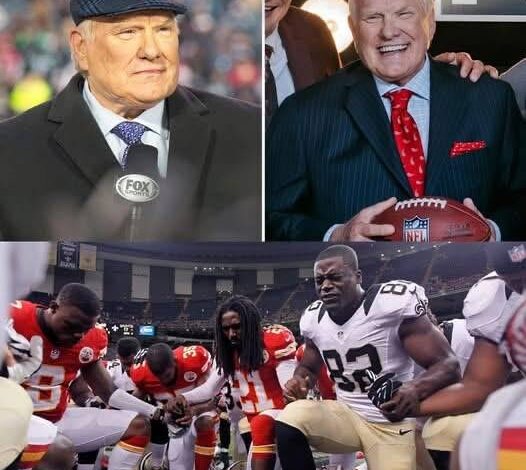
The narrative of Terry Bradshaw is often painted in the vibrant, primary colors of Sunday afternoon broadcasts—a whirlwind of boisterous laughter, self-deprecating jokes, and the gleaming silver of four Super Bowl trophies. But beneath the polished veneer of the “Blonde Bomber” lies a story etched in the shadows of psychological warfare, a journey defined not by the ease of his talent, but by the staggering weight of the humiliation he was forced to endure. To understand the “sad news” often whispered regarding Bradshaw’s legacy is to understand a man who spent decades fighting a ghost: the persistent, cruel insinuation that he was never smart enough for the stage he conquered.
The genesis of this resilience began in the humid air of Shreveport, Louisiana. Long before he was a household name, Bradshaw was merely a boy who slept with a football as if it were a talisman against the world. He was a small-town phenom with an arm like a cannon and a heart that hadn’t yet been calloused by the cold cynicism of professional sports. When he was selected as the first overall pick in the 1970 NFL Draft, it was supposed to be the fulfillment of a Southern dream. Instead, it became a baptism by fire. The transition from the slow, rhythmic life of the South to the industrial, unforgiving grit of Pittsburgh was a cultural collision that nearly shattered him.
In those early years, the statistics were brutal, but the rhetoric was worse. Bradshaw struggled with interceptions and the complex nuances of an NFL playbook, and the media pounced with a ferocity that bordered on the personal. He wasn’t just criticized for his play; he was mocked for his intelligence. The “dumb blonde” trope was weaponized against him, creating a narrative that he was a physical marvel with a mental vacuum. For a young man seeking validation in a big-city franchise, the boos from his own fans weren’t just noise—they were a constant, psychic assault. There were nights when the weight of the city’s expectations and the media’s ridicule made the simple act of stepping onto the field feel like a walk toward a firing squad.
Yet, it is within this crucible of shame that the true “sadness” of his story transforms into something transcendent. Most men would have folded under the concentrated vitriol of a national audience, but Bradshaw possessed a stubbornness that bordered on the divine. He didn’t just survive the interceptions; he internalized the pain and used it as fuel. He developed a quiet, unshakable strength that allowed him to tune out the roar of the doubters. This was the era of the “Steel Curtain,” and while the defense was the soul of the team, Bradshaw became its iron will.
The apex of this journey was, of course, the four Super Bowl titles—a feat that, at the time, seemed impossible for a man so recently dismissed as a “bust.” He delivered the “Immaculate Reception” pass, a moment of such sheer, chaotic brilliance that it remains the most iconic throw in the history of the league. But even as the rings piled up, the scars remained. The victory wasn’t just over the Dallas Cowboys or the Minnesota Vikings; it was a victory over every columnist who had ever called him slow-witted and every fan who had ever questioned his worth.
When the cleats were finally hung up, the world expected Bradshaw to fade into the quiet life of a retired athlete. Instead, he engaged in a radical act of self-reinvention. He took the very thing that had been used to hurt him—his persona—and turned it into his greatest asset. He entered the broadcasting booth and, rather than trying to prove he was the smartest man in the room, he leaned into the joy of the game. He became the beloved uncle of the NFL, the man whose easy laughter and quick wit made football feel like a conversation over a backyard grill. It was a masterclass in psychological alchemy: he took the ridicule of his youth and transformed it into a life of purpose and grace.
However, the “sad news” that often lingers around Bradshaw today isn’t about a lack of success, but about the toll that such a life takes on the human spirit. In recent years, Bradshaw has been candid about his battles with clinical depression and the long-term physical effects of a career spent being pummeled by 300-pound linemen. He has spoken openly about the anxiety that haunted his playing days and the vulnerability he felt even at the height of his fame. This transparency has added a new layer to his legend; he is no longer just a quarterback or a broadcaster, but a survivor of the invisible wars that many men are too afraid to acknowledge.
To look at Terry Bradshaw today is to see a portrait of a man who refused to let humiliation define the boundaries of his life. He is a man of deep, grounded gratitude, fully aware that the path from a Shreveport bedroom to the Hall of Fame was paved with more thorns than roses. His story is a poignant reminder that the loudest laughter often comes from those who have known the deepest silence. He turned the pressure of a big-city franchise into a diamond-hard legacy, proving that while talent might get you drafted, it is resilience that makes you immortal.
As he navigates the later chapters of his life, Bradshaw remains a beacon for anyone who has ever been told they weren’t enough. The true “shock” of his story isn’t that he won four championships, but that he did so while the world was trying to convince him he didn’t have the brains to lead. He stands as a testament to the power of the human spirit to rewrite its own narrative. Terry Bradshaw isn’t just a football hero; he is a man who stared down the barrel of public mockery and chose to smile back. His life is a masterpiece of survival, a reminder that the greatest catches aren’t made on the field, but in the quiet moments when a man decides to believe in himself when no one else will. The laughter we hear every Sunday isn’t just entertainment; it is the sound of a man who has finally, after a lifetime of fighting, found his peace.