THE SURPRISING SECRET BEHIND THE TINY BOW ON YOUR UNDERWEAR, WHY IT IS ACTUALLY THERE
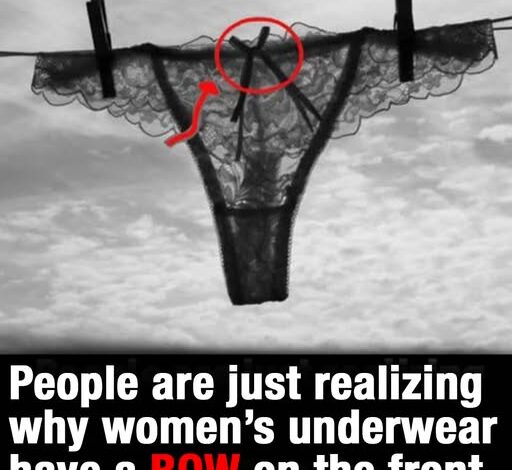
It is a feature so ubiquitous that most people have stopped seeing it entirely. Whether folded in a drawer or hanging on a retail rack, nearly every pair of women’s underwear features a small, dainty ribbon bow sewn precisely into the center of the front waistband. While many dismiss it as a simple aesthetic choice or a touch of feminine flair, the history of this tiny loop is far more fascinating and practical than modern consumers ever imagined. Recent online debates have sent the internet into a spiral as the true, centuries-old purpose of the underwear bow is finally being unraveled.
For most of human history, the convenience of the elastic waistband—a marvel of textile engineering we now take for granted—simply did not exist. Long before the invention of spandex and synthetic stretch fabrics, undergarments were far less forgiving. In the eras of corsets, petticoats, and heavy gowns, “drawers” were often constructed as two separate leg pieces held together by a drawstring at the waist. This string had to be pulled tight and secured to prevent the garment from slipping down under the weight of several layers of clothing. Naturally, the easiest place to tie a knot and a bow was at the front, where a woman could see what she was doing. Over time, as construction methods evolved, the drawstring was replaced by ribbon threaded through eyelet lace, but the central bow remained the anchor that kept everything in place.
However, the bow’s historical significance wasn’t just about security; it was a vital tool for survival in a world without electricity. Before the flick of a light switch became a standard part of our morning routine, women often had to dress in near-total darkness or by the flickering, dim light of a single candle. In an age where clothing was complex and layers were numerous, the tiny bow served as a tactile landmark. By feeling for the ribbon, a woman could instantly identify the front of her garment without needing to see it, ensuring she didn’t struggle with backward seams or uncomfortable fits during a hasty morning change.
As the Industrial Revolution gave way to the modern era and elastic became the standard for intimate apparel, the functional necessity of the ribbon bow vanished. Yet, the design persisted. It transitioned from a mechanical requirement to a symbolic gesture—a “nod to tradition” that maintained the classic silhouette of feminine lingerie. For designers, the bow became a way to hide the structural seam where the elastic waistband meets, providing a polished, finished look to the garment. It evokes a sense of innocence and vintage charm, bridging the gap between the utilitarian “drawers” of the 19th century and the high-fashion aesthetics of today.
The revelation of these practical roots has left many modern netizens stunned. While some critics argue that the bow is a “useless” or even “annoying” design element—with many admitting they snip the ribbons off immediately after purchase—others find a newfound appreciation for the humble detail. It is a rare example of a “vestigial” design feature: something that has lost its original function but remains a permanent fixture in our visual culture.
Ultimately, that tiny bow is a testament to how history is woven into the very fabric of our daily lives. It is a reminder of a time when getting dressed was a labor-intensive ritual involving ribbons, knots, and candlelight. So, the next time you spot that small loop of satin on your waistband, know that it isn’t just there to look cute. It is a 200-year-old navigation tool, a relic of the pre-elastic era, and a silent tribute to the women who once tied their world together with a simple piece of string.