The Sound of Silence! A Chronicle of My Familys Betrayal
The end of the world as I knew it didn’t arrive with a grand orchestration; it manifested in the screech of tires, the visceral crunch of metal yielding like wet cardboard, and a silence so sudden and absolute it felt like an physical weight.
My name is Laura Bennett. For the better part of two decades, I have been a Project Manager—a woman defined by Gantt charts, risk mitigation, and contingency plans. I am the “fixer,” the one who carries the spare charger and the first-aid kit, the one who anticipates every disaster before it strikes. But on a rain-slicked Tuesday night, as a drunk driver’s SUV tore through an intersection and pulverized the passenger side of my sedan, I learned that no amount of planning can insulate you from the utter chaos of other people’s choices.
The impact was a brutal assault. Shards of glass dusted my lap like diamonds of ice, and the acrid, chemical dust of the airbag filled my lungs. My first thought was my eleven-year-old son, Ethan, in the back seat. For three agonizing heartbeats, my ragged cries went unanswered. Then came a whimper—a small, broken sound that terrified me more than the crash itself.
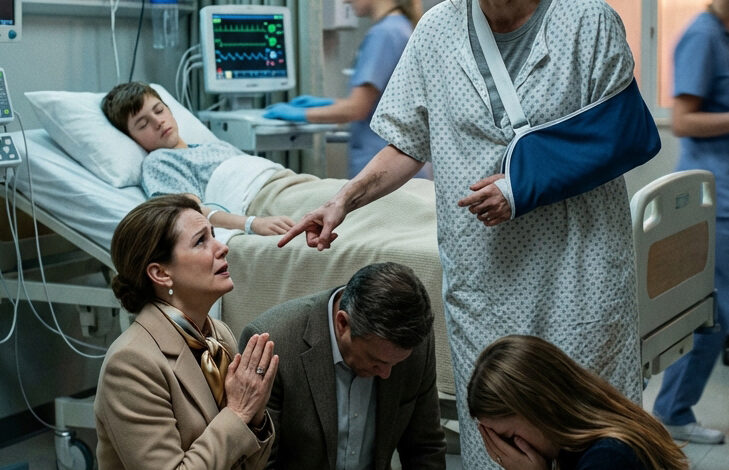
The hours that followed were a disorienting montage of flashing blue lights, the metallic tang of adrenaline, and the sterile, blinding white of the Emergency Room. My left arm was a throbbing, useless weight in a sling, and my head beat a frantic rhythm against my skull. But we were alive. By 2:00 AM, the hospital had settled into a rhythmic hum of monitors. Ethan was sleeping fitfully, a concussion monitor taped to his forehead.
With a trembling hand, I reached for my cracked phone. I needed my tribe. I opened “The Bennett Clan” group chat—a digital space usually reserved for my mother’s weather complaints and superficial birthday wishes. I typed with fingers that wouldn’t stop shaking: “My son and I are in the hospital. We were hit by a drunk driver. We’re alive, but very shaken. Please call when you can.”
I watched the screen. The timestamps appeared almost instantly. Seen by Mom. Seen by Dad. Seen by Emily. Seen by Aunt Sarah. The tiny blue checks stared back at me, mocking in their brightness. I waited for the three dancing dots that signify a reply. I waited for the phone to vibrate with a frantic call. I waited for an hour, then two. The nurse came in to adjust Ethan’s IV and asked if family was on the way. I lied through a hollow throat, saying it was late and they would be here soon. I stared at that dark screen until the battery died, a heavy, suffocating realization settling in my chest. I was not just injured; I was invisible.
By noon the next day, the “brunch photo” arrived.
While I was managing Ethan’s groggy recovery and swallowing back the pain of a torn shoulder, the group chat exploded with activity. My heart leaped, expecting an apology or a frantic check-in. Instead, I found a high-resolution photo of a sun-drenched table overflowing with fluffy pancakes, crystal flutes of orange mimosas, and pastel balloons. My mother was laughing, my father was mid-bite, and my sister Emily was posing for a selfie. The caption read: “Such a perfect day celebrating our little princess! #FamilyFirst #Blessed.”
My message about the accident—the one about being hit at fifty miles an hour and sitting in an ER—sat just inches above the picture of the pancakes. They hadn’t missed it; they had stepped over it. To them, my crisis was an inconvenience, a smudge on the lens of a perfect Sunday. When we were discharged that evening, I had to call a ride-share service. A stranger with kind eyes helped me buckle my concussed son into the car and carried our bags to our door. He did more for me in twenty minutes than my family had done in thirty-six years.
Four days passed in a haze of antiseptic and silence. I slept on the floor beside Ethan’s bed, terrified of a delayed seizure, managing my pain with over-the-counter pills so I wouldn’t be too drowsy to keep watch. The family chat remained a stream of thank-yous for the brunch. It was as if the crash had never happened.
On the fourth afternoon, my phone suddenly erupted with sound. It was my father. Then my mother. Then Emily. Forty-eight missed calls in two hours. Fear is a reflex, not a choice, and I finally answered, wondering if there had been a tragedy.
“Laura?” my father barked, his voice laced with the frantic irritation of a man kept waiting. “Where the hell have you been? We’ve been calling all day.”
“I’m here,” I whispered, looking at the bandage on Ethan’s forehead.
“Your mother fainted this morning. Her blood pressure is through the roof. I need you to come over, handle the insurance paperwork, and then drive her home. I forgot my glasses, and Emily is busy with the kids.”
I tasted the word “help” in my mouth. It tasted like ash. I told him I couldn’t come. I told him about the accident again, my voice steadying. There was a thick, heavy silence on the other end.
“Well,” he finally said, his tone shifting to a dismissive shrug I could hear through the line. “We saw that message. But you didn’t say you were dying. We assumed you were fine. Now, are you coming or not?”
Something inside me, a tether that had held me to them since childhood, snapped. It wasn’t a loud break; it was the quiet, final give of a thread under too much tension. I told him I was a mother recovering from a traumatic event and that I would not be coming. I hung up.
The backlash was a coordinated assault. Emily messaged to call me selfish. Aunt Sarah lectured me on “family coming together in emergencies.” My mother told me she raised me better. Their emergency was a headline; my trauma was a footnote.
That evening, Emily appeared at my door, flushed with yoga-class glow and indignant rage. When I refused to let her in, she rolled her eyes at my sling and the bruising on my face. “I know you had a little fender bender,” she shrieked, “but Mom is really scared! You’re always so dramatic, Laura. You always have to be the martyr.”
“You saw my message,” I said softly, “and you posted a picture of pancakes.”
“It was my daughter’s birthday!” she shot back. “Was I supposed to ruin her day because you had bad luck?” She threatened that if I didn’t help now, they wouldn’t be there when I “actually” needed them.
I looked her in the eye, seeing clearly the self-absorption that had been masked for years by superficial holiday closeness. “You weren’t there when I needed you. That’s the point.”
I locked the door and for the first time in years, I breathed. I was the “fixer,” and I finally realized the one thing in my life that was truly beyond repair. My family wasn’t a tribe; they were a collection of people who viewed my service as a right and my suffering as a distraction. As I sat down next to Ethan, I knew the project was over. The spreadsheets were closed. I was finally mitigating the greatest risk of all: the people who were supposed to love me.