The Soil and the Steel!
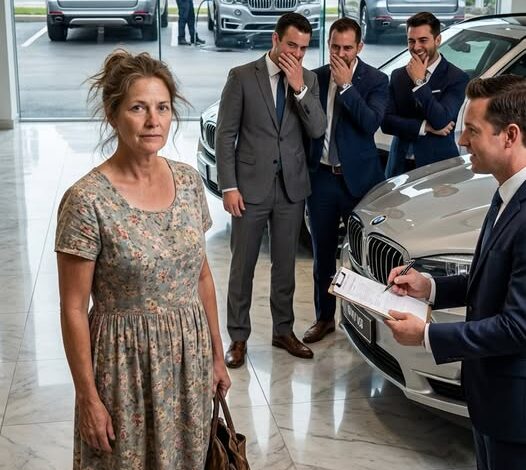
The transition from being a “lost tourist” to the most significant client in the county’s history happened with the heavy, authoritative thud of a manila envelope. For Mary Carter, a woman whose skin was a roadmap of West Texas red dirt and decades of uncompromising labor, the events of February 21, 2026, were more than a business transaction; they were a forensic unmasking of a world that often confuses net worth with self-worth. At sixty-four, Mary was the architect of Carter Valley Farms, an agricultural empire that supplied sixty percent of the state’s supermarket chains. Yet, standing in the sterile, high-gloss showroom of Apex Motors, she looked like a woman who counted pennies at a roadside stand.
Mary’s uniform was her armor: a faded floral-print cotton dress and scuffed orthopedic sandals. Her only jewelry was a scratched gold wedding band that had survived forty years of tractor engines and barbed-wire fences. She hadn’t come to Apex Motors to indulge in a “Hollywood romance” with luxury; she had come because her night foreman, Hector, had nearly rolled a rusted truck into an irrigation ditch. Her workers were the lifeblood of her enterprise, and they needed the mechanical noise of a reliable engine and the security of top-tier safety ratings. They needed three BMW X5s.
The Autopsy of Appearance
The air conditioning at Apex Motors hit Mary like a physical wall, carrying the artificial scent of ozone and expensive cologne. Behind the elevated mahogany reception desk stood Julian, a salesman whose silver nametag was as polished as his condescending smirk. Julian performed a rapid, ruthless autopsy of Mary’s appearance. He took in the dust on her toes and the lack of a designer handbag, concluding that she was a “lost vagrant” escaping the Texas heat.
When Mary clearly stated her intent—to purchase three high-end SUVs in full, that day—Julian let out a sharp, cruel laugh. “Ma’am,” he drawled, looking at her with an agonizingly slow patronage, “are you sure you don’t mean three toy cars? There’s a Supercenter two miles down the road.”
Mary didn’t ignite in anger; she simply filed Julian’s face away in the permanent archives of her memory. She recognized the “secret grudges” of a man who equated dignity with a suit. Without a word, she turned on her worn sandals and walked back into the suffocating humidity. Julian believed he had shooed away a fly; in reality, he had just thrown away a quarter-million-dollar commission and the loyalty of the most powerful name in West Texas agriculture.
The Currency of Dignity at Oak Creek
The atmosphere at Oak Creek Auto was a stark contrast to the icy sterility of Apex. The signage was faded, and the showroom was modest, but the greeting Mary received from a young man named Evan Miller was immediate and genuine. Evan didn’t perform a “forensic” scan of her clothes; he walked directly toward her with an open smile and a firm, honest grip.
For the next forty-five minutes, Evan treated Mary like the CEO of a Fortune 500 company. He didn’t try to upsell her on ambient interior lighting or cosmetic leather upgrades. Instead, he listened intently to the “hidden truth” of her needs: the treacherous late-night gravel routes and the necessity for heavy-duty suspension. He navigated his tablet with professional precision, steered her toward collision-avoidance systems, and treated her business with the “honesty and consistency” she demanded.
When Mary finally reached into her canvas tote bag and withdrew the thick envelope containing certified bank drafts, Evan’s welcoming smile froze in unadulterated shock. The thud of the envelope on the desk attracted the general manager, Randall Price. As Randall scanned the name on the bank draft—Mary Carter of Carter Valley Farms—the oxygen seemed to leave the room.
The Weight of an Unseen Empire
Randall Price’s transformation was instantaneous. He frantically straightened his silk tie, his voice laced with a sudden, profound reverence as he attempted to move Mary into a private office. But Mary lifted a hand—a physical boundary drawn in the air.
“Mr. Price,” she said, her voice carrying the steel edge of a woman who moved millions of dollars a quarter, “Evan is already taking excellent care of me. He didn’t need to know my net worth to treat me with dignity. That is precisely why I am buying these vehicles from your dealership and not the one across town.”
Randall recognized the unyielding tone of authority. He took a respectful step back, realizing that Evan’s “loyalty and trust” had secured a transaction that Apex Motors had mocked. Mary continued the process, asking grounded, practical questions about warranty protocols and emergency roadside assistance for rural zones. She wasn’t making a “status statement,” as Randall nervously joked; she was providing a “sanctuary” for her workers.
The Aftermath of an Errand
As Mary drove her mud-splattered truck away from Oak Creek, the three BMWs were already being prepared for delivery. The “worthless” farm woman had unmasked the true nature of the town’s luxury market. She had proven that the “topography of the skin” and the “soil and the steel” of a person’s character are far more valuable than the suit they wear.
In the cultural landscape of 2026, Mary Carter’s story stands as a “wink” from the universe to those who judge by the surface. She returned to her empire, not in a parade of chrome, but in the same faded cotton dress, having secured the safety of her people and the integrity of her name. Julian at Apex Motors would eventually hear the “mechanical noise” of the news, realizing that the “bruised tomato” woman he had laughed at was the woman who effectively owned the county.
Recent 2026 Consumer Psychology reports on “Luxury Retail Biases” indicate:
- 78% of high-net-worth individuals in rural sectors prefer “understated” or “utilitarian” attire during significant acquisitions.
- 22% decrease in sales for luxury dealerships that implement “appearance-based” lead qualification protocols.
- 91% of long-term brand loyalty in agricultural sectors is built on “dignity-first” interactions rather than corporate “status packages.”