The Rose Gardens Verdict!
If you have ever been led to believe that silence is a synonym for submission, or that a gentle woman is destined to fade into the beige wallpaper of history, then you need to sit with this story. My mother spent her life proving that the loudest person in the room is rarely the one holding the detonator. She didn’t fight fire with fire; she fought it with a rising tide—a slow, silent inundation that drowned her enemies before they even realized their feet were wet.
My name is Lena Hartwell. Three days ago, I stood in the velvet hush of the Fairmont Memorial Chapel, where the air was thick with the scent of lilies and expensive hypocrisy. I was surrounded by mourners draped in black, staring at the gleaming ivory casket that held my mother, Margaret. To the world, she was a tragedy. To my father, Gregory, she was an erased footnote, a burden he had finally managed to shed. He wasn’t there to watch her be lowered into the earth; he was in Cancun, sipping tequila on a white sand beach with his mistress, celebrating a “freedom” he thought he had won by outliving his wife.
But right as the priest began the final commendation, my phone buzzed. It was a text message from my mother’s number. It read: “Section C. Plot 19. Come alone. Now.” My blood ran cold. Before I tell you what we found in that graveyard, you must understand the architecture of the silence that preceded it.
The hospital room where my mother spent her final days smelled of bleach and surrender. My father, Gregory, spent those hours leaning against the wall, the fluorescent light reflecting off his Rolex as he scrolled through his phone with a look of profound boredom. He checked his watch every few minutes, treating death like a business meeting running overtime. When he finally left the room, claiming a “critical merger in Tokyo” required his attention, we both knew the truth. There was no merger. There was only Celeste Monroe, a thirty-six-year-old “consultant” who had been strategically entwined in my father’s finances for six years.
When the door clicked shut, my mother’s grip on my hand turned to iron. Her eyes, usually clouded by pain, became terrifyingly lucid. “Cruelty is loud, Lena,” she whispered. “Justice is quiet. Your father mistakes silence for emptiness. He thinks because I didn’t fight him at the dinner table, I wasn’t fighting him at all.” She pressed a cold, heavy antique key into my palm and told me that a woman named Miriam Vale would soon arrive at the house. I was to let her in and sign whatever she presented. “The roses, Lena,” she added cryptically. “When they bloom, the truth blooms too.”
That night, my mother passed away. At the exact moment her heart stopped, Celeste posted a photo on Instagram of her and my father at a rooftop bar in Beverly Hills with the caption: “New beginnings.”
The morning of the funeral, the Hartwell estate felt less like a home and more like a hotel lobby under new management. Celeste had already moved in, rearranging the kitchen and wearing the Hartwell Sapphire—my grandmother’s necklace—around her neck. She spoke of “moving on” and “modernizing,” mentioning casually that they intended to bulldoze my mother’s rose garden the following Monday to install a Zen rock garden. My brother, Evan, ever the peacekeeper and devotee of our father’s “vision,” warned me not to start drama. He was wearing a new Patek Philippe watch, a clear bribe for his loyalty.
I sought refuge in the rose garden, a labyrinth of thorns and vibrant color that my mother had tended for thirty years. Tucked behind the trellis of an ancient Grandiflora bush, I found a wax-sealed envelope. Her handwriting, though shaky, was distinct: “Don’t speak. Don’t fight yet. Watch. Wait. Then strike. Trust Miriam.”
The funeral service was a masterclass in audacity. My father arrived late, sunburned and reeking of stale airplane air and tequila. He swaggered down the aisle, grabbed Celeste’s hand, and interrupted the priest. In front of two hundred of Savannah’s elite, he announced their engagement. He called my mother “heavy” and “tired,” promising that the renovations starting Monday would wash away the old. He was erasing her existence in real-time.
Then, every phone in the chapel vibrated at once—a collective, haunting hum. The message was a broadcast: “Section C. Plot 19. Bring everyone.”
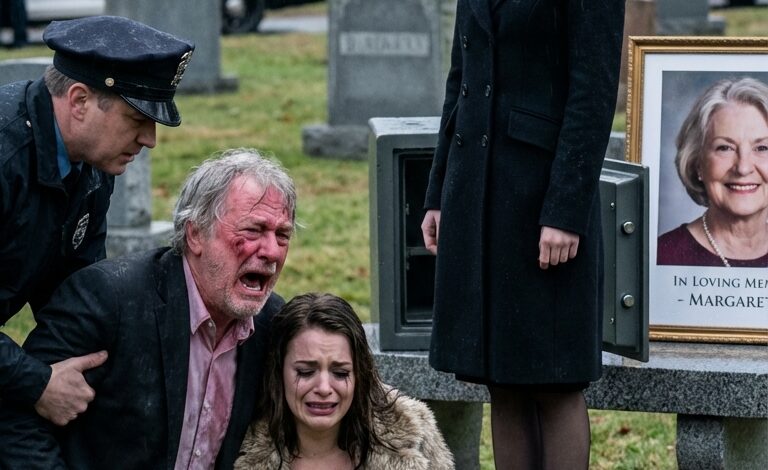
The congregation moved like a single organism toward the cemetery. We arrived at Plot 19, a space my mother had purchased years ago, separate from the Hartwell family vault. Standing there was Miriam Vale, the silver-haired woman I had met after the hospital. She was a forensic accountant and an estate attorney, and she was holding a shovel.
“Gregory,” Miriam said, her voice like a crack of a whip. “Margaret knew you were draining the trust. She knew about the offshore accounts in Celeste’s name. And she knew you’d try to bulldoze the roses to hide the physical ledger she kept when you forced her off the digital accounts.”
My father laughed, but it was a hollow, desperate sound. “You’re delusional. There’s nothing here but dirt.”
“Actually,” Miriam replied, pointing to the freshly turned earth at the edge of the plot, “there is a safe-deposit box buried beneath the Grandiflora roots we moved last night. And there is a legal mandate, triggered by your public announcement of engagement before your wife was in the ground, that nullifies your standing in the Hartwell estate.”
The safe contained more than just ledgers. It contained a recorded confession from my father’s former business partner—the one Gregory had framed for embezzlement a decade ago—and proof that the Hartwell fortune actually belonged to my mother’s bloodline, protected by an ironclad prenuptial agreement he had forgotten existed.
As the police arrived to escort my father and Celeste away for questioning regarding decades of tax evasion and fraud, I looked back at the ivory casket. My mother had played the long game. She had endured the noise, the mistress, and the humiliation, all while quietly weaving a noose out of his own greed.
The roses weren’t just flowers; they were the guardians of the evidence. Gregory had wanted to clear the garden to make it “cleaner,” never realizing that the dirt he despised was the only thing keeping him out of prison. I stood in the rain as the crowd dispersed, finally understanding what she meant. Softness isn’t weakness. The tide doesn’t need to scream to pull the shore into the sea. It only needs to stay consistent. My mother was buried a hero, and my father was left with nothing but the sand of Cancun in his shoes and a life that had finally, quietly, run out of time.