The morning after my soldier husbands funeral, I came home to find my in-laws changing the locks
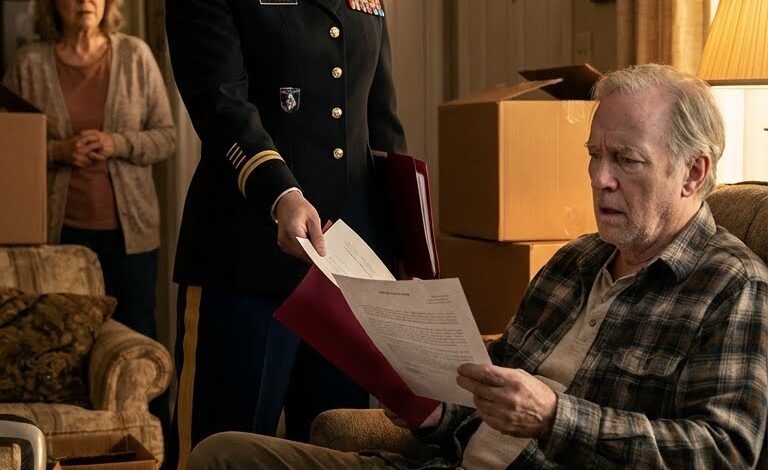
My name is Major Molly Martin, thirty-five, Army intelligence. Yesterday I buried my husband, Staff Sergeant Marcus Coleman—the only man who ever saw the woman beneath the uniform. This morning, twenty-four hours after the flag was folded and placed in my hands, I returned home to silence, humidity, and the metallic taste of grief. I expected a hollow house. Instead, I walked into a hostile takeover.
My front door was cracked open. My key didn’t fit the lock. That was my first warning. I rang the bell once. The cheerful chime echoed inside like a sick joke. The door swung open and there stood my brother-in-law, Timothy, chewing chips, shirtless, looking at me like I was an Amazon delivery.
“Oh. You,” he muttered, stepping aside just enough for me to slip past him.
The living room was chaos. Boxes everywhere, my belongings being hauled out as if I had already died. My father-in-law, Raymond, stood in the center of the room with a clipboard, barking orders to two movers. He didn’t even look up when he spoke.
“You’re back sooner than expected,” he said flatly. “We’re proceeding with the transfer.”
Transfer. Like my home was a piece of equipment being reassigned.
My mother-in-law, Patricia, floated down the stairs holding my jewelry box. She opened it, unimpressed.
“These pieces look awfully simple,” she murmured. “You can take them. We certainly don’t need them.”
On the mantle, she pulled our wedding photo from its frame, slid my picture out, and tossed it into the trash. “We’ll keep Marcus’s half,” she said lightly. “He doesn’t need you in the background anymore.”
When her eyes drifted upward to the framed medals I’d earned—Bronze Star, Purple Heart, the commendations that cost me blood—she waved her hand dismissively.
“Gerald,” she called to her elder son, “take those down. They’re an eyesore.”
Raymond finally stepped forward, jaw tight with authority he didn’t earn. He tapped his clipboard.
“Listen carefully,” he said. “Marcus may have married you, but he couldn’t make you a Coleman. Blood is blood. This property stays with the family. You have two hours to collect your personal effects. Anything left becomes ours.”
Grief evaporated. Instinct took over. A soldier doesn’t panic in an ambush—she studies it.
I didn’t scream. I didn’t argue. I stepped back, arms crossed, and watched. They mistook my silence for defeat. They didn’t realize I was gathering intel.
I watched them carry out my grandmother’s armchair. I watched them strip my medals from the wall. I watched Patricia wander my house like she was inspecting real estate she just acquired. And I watched Raymond—smug, self-satisfied—command the dismantling of my life.
The problem was simple: they were fighting the wrong opponent. Marcus had warned me years ago that his family didn’t accept outsiders. But he hadn’t just warned me. He’d spent seven years building a counteroffensive.
The memory hit like a flare in the dark.
Three months before he died, at a cousin’s wedding, I’d stepped outside for air. On my way back, I heard voices on a veranda. Raymond’s voice.
“When Marcus is gone,” he whispered, “we move fast. The wife has certain rights, but pressure can make her leave.”
Gerald chimed in. “The vet clinic is the real prize. Henderson wants to buy it.”
And Patricia, sweet as poison, added, “Oh, I know exactly what buttons to push. She’ll walk away with nothing.”
I’d pressed myself against the wall, listening to them map out my exile.
That night, in the Jeep home, Marcus sensed something was wrong. I told him what I heard. Not emotionally—tactically. He didn’t deny it. He didn’t even look surprised. He pulled into our driveway, killed the engine, and the softness in him vanished.
“They’ve declared war,” he said quietly. “Time for a battle plan.”
Inside, he opened a leather briefcase I’d never seen. It wasn’t documents—it was fortifications.
“Line One: joint tenancy,” he explained. “Everything we own automatically transfers to you upon my death.”
“Line Two: an ironclad will.”
“Line Three,” he said, handing me a sealed envelope, “is the nuclear option. A documented record of every insult, every slight, every attempt to undermine you. If they move against you, this letter detonates.”
He’d built a legal minefield while smiling politely at their Sunday dinners.
Six weeks later, cancer marched through him with ruthless efficiency. He died faster than anyone was ready for—except him.
Which brings us back to my front lawn, where the enemy thought they’d cornered a widow. Instead, they triggered his defenses.
I stood at the end of the driveway, blocking their moving truck. Raymond stormed out.
“You need to leave before we call the police,” he snapped.
Right then, a black BMW glided up, sleek and deliberate. A tall man in a charcoal suit stepped out, radiating authority.
“Raymond Coleman?” he asked coldly.
“Who are you?” Raymond barked.
“Charles Peyton,” the man said. “Estate attorney for the late Marcus Coleman. And personal counsel to Major Molly Martin.”
Raymond paled.
Charles didn’t waste breath. “You are currently committing unlawful trespass, theft of property, and attempted illegal eviction. Every item you’ve removed must be returned immediately. If not, I will have the Chief of Police here within ten minutes.”
The color drained from every Coleman face.
Inside, Charles opened his briefcase with sharp snaps that sounded like gunshots.
“Joint tenancy,” he said, sliding documents across the table. “Upon Marcus’s death, every asset became the sole property of my client.”
Patricia stammered, “No—no, he wouldn’t—”
“He did,” Charles cut in. “And his will includes a no-contest clause. One hostile move from you and you forfeit everything.”
Then Charles pulled out the final envelope.
“Marcus left one last message,” he said. “He wanted it read aloud.”
He broke the seal.
The letter was a scalpel.
Marcus listed every cruelty they’d ever shown me—mocking my service, belittling my deployments, dismissing my sacrifices. He stripped away their illusions one sentence at a time.
And then his final line landed like a hammer:
“Now get out of her house.”
There was no argument left to make. Under Charles’s supervision, the Colemans dragged every stolen item back inside. Furniture, boxes, even the framed wedding photo—my half restored. The medals went back on the wall, not a scratch on them.
By the time they left, defeat clung to them heavier than the Charleston humidity.
Word spread through Charleston like wildfire. The Coleman name—their pride—collapsed overnight.
A week later, I mailed back the $100,000 check they tried to send as an apology. Burned to ash. Symbolic, and final.
The house felt different after that. Not empty. Steady. Silent in a peaceful way. It wasn’t just a home—it was the fortress Marcus built for me. And he wanted it to become something more.
So I turned his veterinary clinic into the Marcus Coleman Memorial Animal Hospital and started a fund that covers pet care for service members and veterans. It became something bigger than both of us.
Months later, while sorting his desk, I found a hidden letter addressed: To Molly, My Soldier.
“Winning the battle isn’t the end,” he wrote. “It’s the start of your next mission. Turn our fortress into a lighthouse.”
This morning, I stood on the porch watching the sun rise over Charleston. The house was strong. So was I.
I held the line. Now I live the mission he left behind.