The Missing Child Case That Took 51 Years to Solve!
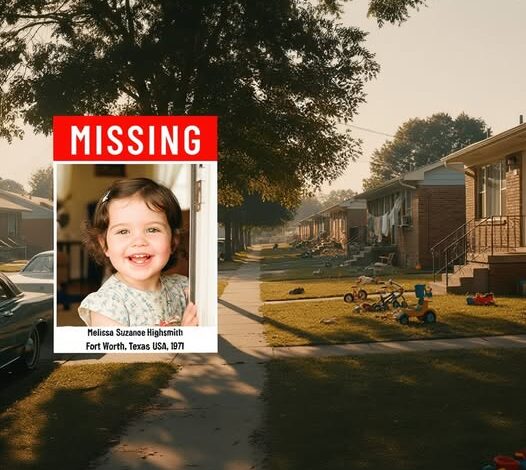
The summer of 1971 in Cedar Ridge, Ohio, felt ordinary in the way small towns often do. Lawns were trimmed on Saturdays, kids rode bikes until dusk, and neighbors left their doors unlocked. Nothing about July 12th hinted that it would carve a permanent scar into the town’s history.
That morning, Margaret Carter dressed her two-year-old daughter, Emily, in a yellow sundress. Emily insisted on bringing her stuffed rabbit, Mr. Whiskers, gripping it by one floppy ear. Margaret remembered the small details forever—the peanut butter on Emily’s cheek, the way her curls bounced as she laughed.
They drove to Harlan’s Grocery on Main Street for milk and flour. It was supposed to be a ten-minute stop.
At 10:17 a.m., the bell above the store door chimed as they entered. Margaret placed Emily in the shopping cart and moved toward the baking aisle. She reached for a bag of sugar and glanced down.
The cart was empty.
For a second, her mind refused to process it. She assumed Emily had toddled a few feet away. “Emily?” she called gently, expecting to hear a giggle.
Silence.
What followed unfolded in frantic fragments. Margaret racing down aisles. Cans crashing to the floor. The store owner shouting for someone to check outside. A customer sprinting toward the parking lot.
Police arrived within minutes.
By noon, Cedar Ridge was unrecognizable. Search parties combed fields and riverbanks. Volunteers formed lines through cornfields. Helicopters circled overhead. Margaret and her husband, Thomas, stood stunned as neighbors moved around them with flashlights and hope.
There were rumors—a blue pickup seen idling nearby, a stranger at the gas station, travelers passing through town. But no one saw a child being taken. No ransom demand arrived. No clues emerged.
By fall, the FBI joined the case. By winter, the investigation stalled.
Margaret kept Emily’s room untouched. The crib stayed beneath the window. Mr. Whiskers sat propped against the pillow. Each night she whispered goodnight into the quiet.
Thomas buried himself in factory work. He rarely spoke about that day. Grief hollowed him out from the inside. When Margaret found him sitting alone in the garage long after midnight, she understood they were both drowning in questions.
Years slipped by. Flyers faded from telephone poles. The town moved on because it had to.
Margaret did not.
She clipped articles about missing children and kept them in a scrapbook. She studied photographs for familiar eyes. On Emily’s tenth birthday, she baked a cake and placed two candles on top—one for the daughter she had lost and one for hope she refused to surrender.
In 1973, Margaret gave birth to a son, Daniel. Some people whispered that he was a blessing meant to replace what had been taken. Margaret never allowed that idea to take root. Daniel was loved fiercely, but the presence of his missing sister hovered like a quiet ghost in the house.
Photographs of a curly-haired toddler lined the hallway. Daniel learned early not to ask too many questions.
Thomas died of a heart attack in 1998. Margaret endured another loss without answers. When she passed away in 2019 at eighty-eight, Daniel inherited the old house on Maple Street and the boxes in the attic.
Inside were decades of investigation files—police reports, letters to officials, maps dotted with red pins marking possible sightings. Margaret had never stopped searching.
In 2021, Daniel submitted his DNA to a public genealogy database. He had watched documentaries about cold cases solved through genetic matches. He didn’t expect a miracle. It felt like a final gesture, a message in a bottle tossed into open water.
Meanwhile, in Denver, Colorado, Laura Mitchell lived an ordinary life. At fifty-three, she was a high school history teacher, divorced, with a grown son. She had been adopted at age two through a private agency that no longer existed. Her adoptive parents had been loving and steady, but much of her early history was sealed or lost.
There had always been a question inside her—a quiet space where origins should have been.
On a spring afternoon in 2022, Laura opened an email from the DNA service she had used out of curiosity.
“Close Family Match Identified.”
She clicked.
Predicted relationship: Parent/Child or Sibling.
The name attached to the match was Daniel Carter, age forty-nine, Columbus, Ohio.
Carter.
The name tugged at her, though she couldn’t explain why.
With trembling fingers, she sent a message.
Hello. It appears we share a close DNA connection. I was adopted in 1971 and am searching for biological relatives. I don’t know if this is a mistake, but I would love to talk.
Daniel read her message that evening.
Adopted in 1971.
Age fifty-three.
Close family match.
His pulse hammered in his ears. He typed back carefully.
My sister disappeared in July 1971 at the age of two. Her name was Emily Carter. Can you tell me your birthdate?
Laura responded quickly.
July 10, 1969.
Emily Carter had been born on July 10, 1969.
Daniel felt the air leave his lungs.
Further testing was arranged. Both agreed immediately. While they waited, Laura searched through her adoption papers. One faded document listed her original name as “Baby Girl C.” The agency had been located in Ohio.
Ohio.
Memories stirred faintly—sensations rather than images. The smell of farmland. Wind brushing tall grass. A woman humming softly. She had always dismissed them as imagination.
Three weeks later, the confirmation arrived.
Probability of sibling relationship: 99.999%.
Daniel called her.
For several seconds, neither spoke.
“Hello?” Laura said quietly.
“I think you’re my sister,” Daniel answered, his voice breaking.
The word sister felt enormous.
They cried openly. Fifty-one years of silence collapsed into a single phone call.
A reunion was planned for June 15, 2022, nearly fifty-one years to the week since Emily vanished.
Laura stepped off the plane in Columbus unsure what she would feel. Daniel recognized her instantly. The resemblance startled them both—hazel eyes, the same tilt to their smiles.
They stared for a heartbeat before Daniel embraced her.
“I’ve waited my whole life for this,” he said.
Driving toward Cedar Ridge, they passed fields that stretched beneath wide Ohio skies. The town had changed. The old grocery store was now a hardware shop. The factory where Thomas had worked stood empty.
Margaret’s house still waited at the end of Maple Street.
Inside, Daniel had preserved the hallway photographs. He watched Laura pause in front of one—a picture of a curly-haired toddler in a yellow dress.
She reached out slowly, tracing the frame.
“That’s me,” she whispered.
There were still unanswered questions. Investigators believe Emily had likely been abducted and illegally adopted, though the individuals responsible were never identified. Records from the defunct agency offered little clarity. The passage of five decades erased many trails.
But one truth remained undeniable: the missing child had come home.
Laura walked into the bedroom that Margaret had preserved for so many years. The crib was gone, but Daniel had kept Mr. Whiskers, worn and faded.
He placed the rabbit in Laura’s hands.
She held it against her chest, overwhelmed by a strange familiarity.
For fifty-one years, Margaret had whispered goodnight to an empty room.
Now, standing inside the house her mother had refused to abandon, Laura felt something shift—a sense of belonging stitched back together through science, patience, and persistence.
Some mysteries remain incomplete.
But after half a century, a family fractured by a single morning in 1971 finally found its missing piece.