The Meaning Behind a Blue Stop Sign!
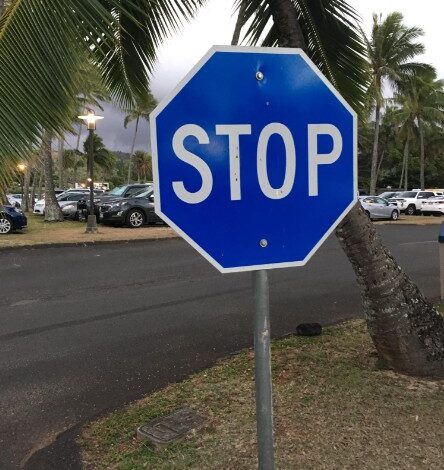
The visual landscape of the modern American roadway is governed by a strict, almost sacred geometry of colors and shapes designed to ensure immediate recognition and split-second decision-making. We are conditioned from childhood to understand that a red octagon is the ultimate symbol of authority, a non-negotiable command to halt. However, as you navigate the increasingly complex environments of 2026—from expansive tech campuses and private residential enclaves to massive industrial logistics hubs—you may encounter a jarring anomaly: the blue stop sign. This chromatic shift is far more than a simple design choice or an aesthetic flourish; it represents a fascinating intersection of psychology, civil liability, and the boundaries of federal law.
To understand the meaning behind a blue stop sign, one must first understand the rigid framework of the Manual on Uniform Traffic Control Devices (MUTCD). This federal standard dictates that for a stop sign to be legally enforceable by a government entity or law enforcement officer in the United States, it must be red with white lettering. This is not a suggestion; it is a regulatory requirement that ensures consistency across all fifty states. A blue stop sign, therefore, possesses zero official government authority. You cannot be issued a municipal traffic citation for failing to stop at one, and a police officer patrolling a public road has no jurisdiction over the “blue commands” of a private lot.
The Psychology of the Blue Command
If a blue stop sign carries no legal weight, why do property owners go to the trouble and expense of installing them? The answer lies in the psychology of risk management. In high-traffic private areas—such as crowded shopping center parking lots, tight hospital loading zones, or university campuses—the goal is to control the flow of movement without necessarily involving the heavy hand of the state.
The blue color is often chosen for “branding” or to signify that the driver has entered a private jurisdiction. For a corporate campus, a blue sign might align with a company’s color palette, projecting an image of order and proprietary control. For a residential community, it may be a way to signal to visitors that they are no longer on a public thoroughfare and should adjust their behavior accordingly. It is a test of your instincts: do you respect the function of the sign, or do you only respect the color of its authority?
The Liability Trap: When “Not Official” Isn’t Enough
While the blue stop sign might lack the power to put points on your driver’s license, it possesses a significant, invisible power in the realm of civil law. Many drivers make the mistake of assuming that because a sign is “unofficial,” it can be ignored with impunity. This is a dangerous misconception. In 2026, the legal concept of “duty of care” remains the bedrock of personal injury and property damage litigation.
If you choose to blow through a blue stop sign on a private industrial yard and collide with a pedestrian or another vehicle, your defense of “it wasn’t a real sign” will likely crumble in a courtroom. Insurance companies and civil juries do not care about federal color regulations; they care about whether you acted as a “reasonable person” would under the circumstances. If a property owner provides a clear visual cue to stop—regardless of its color—and you consciously choose to disregard it, you have effectively assumed the liability for any resulting carnage. The blue sign may not be a law, but in the eyes of an insurance adjuster, it is a definitive warning that you failed to heed.
The Safe Rule of the Road: Function Over Form
The evolution of these “branded” traffic signs highlights a growing trend in private infrastructure management. As cities become more densely packed and private developers take on more responsibility for road maintenance within their developments, the line between “public” and “private” traffic control is blurring. In some exclusive residential zones, blue stop signs are used to maintain a specific “aesthetic” while still performing the life-saving function of slowing down traffic in areas where children might be playing.
The safest rule for any driver in 2026 is simple: when in doubt, stop. The color of the sign defines its relationship with the government, but your reaction to that sign defines the physical outcome of your journey. Whether it is red, blue, or even neon green, a stop sign indicates a point of potential conflict—a crosswalk, an intersection, or a blind curve. Ignoring the sign based on a technicality of the MUTCD is a high-stakes gamble with low-stakes rewards.
Navigating the Industrial and Corporate Frontier
In industrial environments, such as the massive automated fulfillment centers that define the modern economy, blue stop signs serve a specific operational purpose. They often demarcate zones where human-driven vehicles must yield to autonomous robotic fleets or specialized heavy machinery. In these contexts, the blue sign isn’t just a suggestion; it is a critical component of a proprietary safety ecosystem. Disregarding such a sign could lead not only to a catastrophic accident but to immediate termination of employment or permanent banning from the premises.
Furthermore, as we see more 13-nation geopolitical shifts and international corporate expansions, the “standardization” of symbols is becoming a global challenge. In some international jurisdictions, blue is the standard color for mandatory instruction signs. For a traveler or a global logistics driver, seeing a blue stop sign might trigger an instinctive “stop” response based on international training, even if it feels out of place in an American context.
Conclusion: The Authority of Common Sense
The blue stop sign is a reminder that our world is divided into layers of authority. There is the broad, sweeping authority of the federal government, represented by the red octagon, and then there is the localized, situational authority of the property owner, represented by the blue. Both have a role to play in keeping us safe.
As you move through the world, let the blue stop sign serve as a reminder that the “rules of the road” are not just about avoiding tickets; they are about participating in a shared agreement to keep one another alive. The blue sign may be an anomaly, a chromatic rebellion against the law books, but the physics of a car crash remain unchanged by the color of the ink on the metal. When you see that blue octagon, don’t look for a loophole—look for the pedestrian, look for the cross-traffic, and hit the brakes. Your instincts, and your respect for the safety of others, are the only things that truly carry authority in that moment.