THE LINE IN THE SAND, Trump Bold Move to Deploy US Marines to the Florida Everglades Is Redrawing the Borders of American Authority Forever
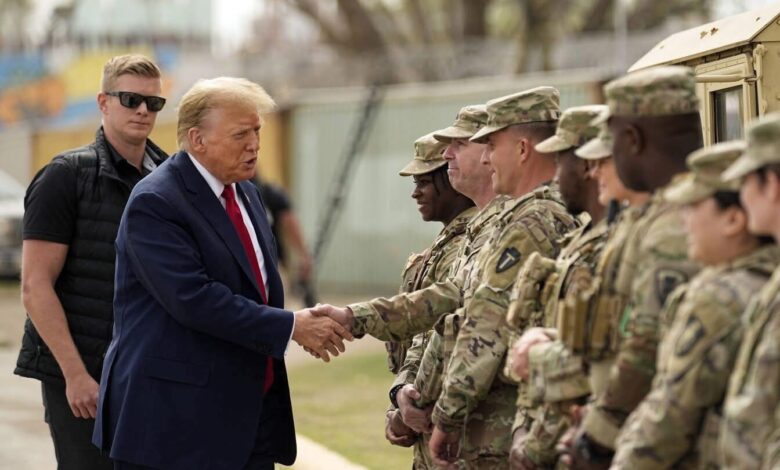
In a move that has sent shockwaves from the halls of Congress to the quiet coastal towns of the Sunshine State, the U.S. military has confirmed a deployment that many are calling a “historic escalation” of domestic policy. Under the direct order of President Donald Trump, 200 U.S. Marines are being stationed in Florida to bolster the operations of Immigration and Customs Enforcement (ICE). While the administration insists the mission is purely logistical, the sight of Marine Corps uniforms on American soil—tasked with supporting the infrastructure of the nation’s most controversial agency—has ignited a firestorm of debate over the role of the military in domestic life and the shifting boundaries of executive power in 2025.
The deployment, which primarily involves Marines from Marine Support Squadron 272 out of New River, North Carolina, is the first wave of a broader strategic mobilization. These troops are headed toward high-tension zones, specifically targeting logistical gaps in Florida, Louisiana, and Texas. However, it is the Florida mission that has captured the public’s imagination and ire. Much of the focus is centered on a massive, newly commissioned detention facility deep within the Florida Everglades—a site already being dubbed by locals and legal experts as “Alligator Alcatraz.” The presence of elite military personnel at such a remote and formidable facility has turned a standard administrative request into a national symbol of the “second Trump presidency’s” uncompromising stance on border security and mass deportation.
To be clear, the Pentagon has issued strict guidelines regarding the “rules of engagement” for these Marines. They are not authorized to make arrests, they are not to carry out law enforcement duties, and they are explicitly prohibited from having direct contact with individuals in ICE custody. Their mission is one of “phantom support”—handling the complex administrative, transportation, and supply-chain hurdles that come with operating a detention network of this scale. Yet, for critics and civil libertarians, these distinctions are a thin veil. The optics of the U.S. military—the world’s most powerful fighting force—assisting in the processing of migrants has sparked an outcry that echoes the most heated debates of the Posse Comitatus Act.
The timing of this deployment is as significant as the act itself. As we move through the latter half of 2025 and into the spring of 2026, the United States is navigating a landscape of extreme internal friction. In cities like Los Angeles and Memphis, National Guard units have already become a common sight under separate presidential authorizations aimed at “quelling civil unrest.” The addition of active-duty Marines to the ICE mission in Florida is seen by many as the final piece of a puzzle: a holistic integration of the U.S. military into the internal machinery of American governance. President Trump has framed these moves as a “war from within,” describing the state of the border and urban crime as a national security threat that necessitates the expertise and discipline of the Armed Forces.
The emotional stakes of this deployment were further heightened by the sudden and tragic events of late March 2026. As the nation watched the Marines settle into their Florida posts, the news cycle was shattered by the horrific runway collision at LaGuardia Airport. An Air Canada regional jet, arriving from Montreal, slammed into an airport fire truck in a midnight catastrophe that claimed the lives of both pilots. This tragedy, occurring amidst a month-long government shutdown and a deadlock in Congress over Department of Homeland Security funding, has only deepened the sense of a nation in crisis. In the wake of the crash, the administration used the instability of the aviation sector to justify further domestic deployments, sending enforcement officers to supplement TSA agents—a move that mirrors the Marine-ICE partnership in Florida.
Furthermore, the recent passing of beloved cultural figures like Supernatural star Carrie Anne Fleming, who succumbed to cancer at age 51, has cast a somber shadow over the national mood. In times of mourning and high-stakes political maneuvering, the public often looks for an “anchor,” yet the 200 Marines in Florida represent a sea change that offers anything but stability. For supporters, the Marines are a beacon of efficiency—a necessary force to bring order to a chaotic immigration system that has overwhelmed civilian agencies. They see the deployment as a pragmatic solution to a logistical nightmare, ensuring that “Alligator Alcatraz” and other facilities operate with military precision.
However, the “shock” of the deployment lies in what it suggests about the future of the American experiment. If the military is the only entity capable of managing the nation’s administrative crises, does that signal the failure of our civilian institutions? The creators of this policy insist that the Marines are simply there to build fences and move supplies, but the “jaw-dropping” reality is the normalization of the camouflage uniform in our backyards. The debate isn’t just about immigration; it is about the “human fascination with the future” and how far a society will go to seek security in the face of perceived threats.
As we look toward the horizon of 2026, the image of the Marine Corps emblem standing guard over the Everglades serves as a potent reminder of a nation transformed. The quiet elegance of the Florida wilderness is now home to the cold efficiency of military logistics, and the questions being raised in town halls across the country are echoing a singular concern: is this a temporary measure to fix a broken system, or is it the beginning of a “new normal” where the line between the soldier and the civil servant is permanently erased?
The viewers left “stunned” by these developments are witnessing the implementation of a vision that reduces complex social issues to logistical problems to be solved by “cold patterns” of military efficiency. Whether this deployment leads to a more secure nation or a more divided one remains the ultimate unanswered question of the year. But one thing is certain: the deployment of the 200 Marines to Florida is more than just a news headline; it is a tectonic shift in the American consciousness, a “shocking” response to a world that feels increasingly out of control, and a move that will define the legacy of the current administration for generations to come. In the Everglades, the air is thick with more than just humidity—it is thick with the weight of a country choosing its path.