The Iran Extinction Threat, A Top Psychologist Breaks Down The Hidden Mind Games In Trumps Latest Ultimatum And What He Is Secretly Telling The World
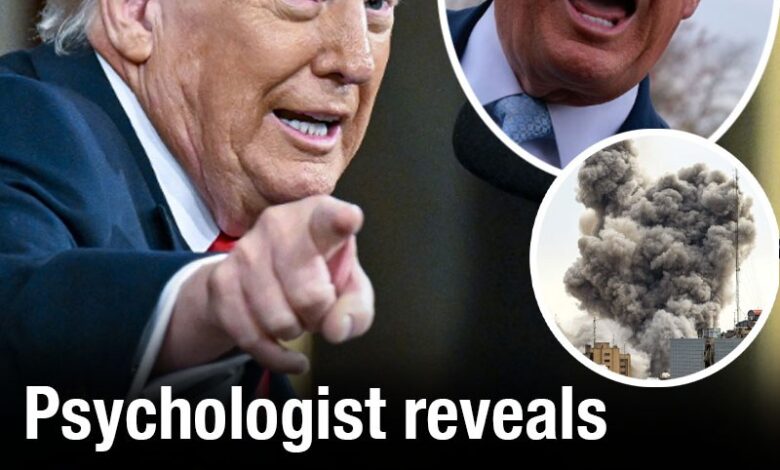
In the high-stakes arena of global geopolitics, words are often more than just communication—they are weapons. As tensions between Washington and Tehran reach a fever pitch in early 2026, the rhetoric coming from the White House has moved beyond traditional diplomacy into a realm that many experts find deeply unsettling. Donald Trump’s increasingly intense warnings toward Iran have drawn the scrutiny of clinical psychologists who suggest that his verbal escalations are serving a much broader psychological purpose than mere political posturing. By analyzing the specific language of “extinction” and “regime change,” experts are uncovering a deliberate strategy designed to manipulate both domestic perception and international fear.
The firestorm began with a series of striking social media posts and White House remarks that seemed to suggest the world was standing on the precipice of a historical turning point. Trump warned of catastrophic consequences, stating bluntly, “A whole civilization will die tonight, never to be brought back again. I don’t want that to happen, but it probably will.” He followed this by hinting at a “Complete and Total Regime Change,” suggesting that 47 years of “extortion, corruption, and death” were coming to an end. To the average observer, these are the words of a leader on the brink of war. To a psychologist, they are a masterclass in behavioral conditioning.
Clinical psychologist Dr. Tracy King has noted that this language is far from accidental. According to Dr. King, the repeated use of extreme expressions—such as “no bridges,” “no power plants,” and the death of a civilization—serves a specific cognitive function. This type of rhetoric is designed to overload the listener’s emotional processing centers. When an audience is bombarded with imagery of total annihilation, the space for measured reflection and critical thought begins to shrink. Dr. King explains that this narrowed space pushes the public toward primal emotions like awe, fear, or alarm before they have had the chance to weigh the facts calmly. It is a form of psychological dominance that ensures the leader’s voice is the only one loud enough to be heard over the rising panic.
Furthermore, Dr. King observed a consistent pattern in Trump’s communication style: the redirection of every event back to his own persona. Even when discussing the movements of the military or the bravery of troops on the ground, the narrative inevitably centers on his own perspective—what he watched, what he valued, and what he will do. This “self-centering” serves as a powerful restoration of status. If there were any lingering rumors of weakness or vulnerability, this aggressive positioning places him firmly back in the middle of power, action, and command. To the American public, the message is clear: do not see the leader as diminished; see him as the man at the center of force and retaliation.
On the international stage, this unpredictability acts as a strategic “Madman Theory” on steroids. By appearing willing to escalate to the point of total destruction, the administration creates a vacuum of uncertainty. In the theater of war, keeping an opponent guessing about your true threshold for violence is a powerful deterrent. It forces adversaries to worry not just about the military hardware at the president’s disposal, but about the psychological volatility of the man who controls the button. This “useful confusion” can freeze an opponent’s decision-making process, as they cannot accurately predict which action might trigger a disproportionate response.
The deadline-driven nature of the rhetoric—setting firm timeframes for “acceptable” agreements—also plays into this psychological warfare. It creates a “ticking clock” scenario that increases the stakes of every diplomatic interaction. However, just as the world seemed to hold its breath for an imminent strike, a surprising development emerged on Wednesday. Pakistan’s Prime Minister, Shehbaz Sharif, announced that a temporary ceasefire had been reached between the U.S. and Iran, expected to last for two weeks. This pause in escalation highlights the “push and pull” nature of the current strategy: aggressive, terrifying rhetoric followed by sudden, tactical lulls that keep the world off-balance.
While the ceasefire provides a brief moment of relief, the underlying psychological landscape remains unchanged. The use of apocalyptic language has already altered the baseline of acceptable political discourse. When the “death of a civilization” becomes a talking point on social media, the psychological barrier to actual conflict is significantly lowered. Dr. King’s analysis suggests that we are witnessing a fundamental shift in how executive power is projected—not through the quiet, measured tones of traditional statesmanship, but through the high-decibel, high-stakes language of psychological shock and awe.
As the two-week ceasefire begins, the global community remains in a state of hyper-vigilance. The “civilization” that Trump spoke of has not died tonight, but the way we process his threats has been permanently altered. Whether this is a brilliant strategic maneuver to force a better deal or a dangerous gamble with the history of the world remains to be seen. What is certain, however, is that the message hidden within the threats is not just about Iran; it is about the man at the center of the storm, reminding the world that he alone holds the power to decide who stays in the dark and who steps back into the light. In the complex history of global conflict, the battle for the mind is often just as decisive as the battle on the ground, and for now, the man at the center of the force is ensuring that everyone, friend and foe alike, is watching him.