The Hands That Built a Future, My stepfather was a construction worker for 25 years!
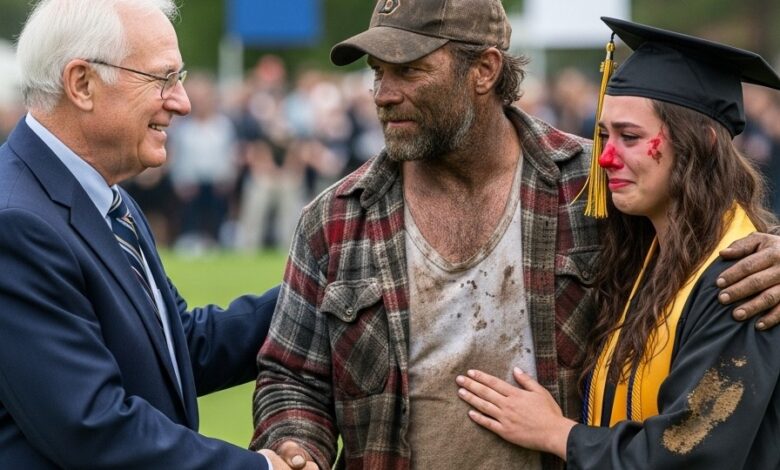
I grew up believing my life began in pieces. My parents separated before I could form memories, leaving my mother and me to start over in Nueva Ecija—a place of rice fields, slow afternoons, and long whispers that traveled faster than the wind. I don’t remember my biological father’s face, only the emptiness he left behind.
When I was four, my mother remarried. The man she chose had nothing to offer except a tired body, sunburned skin, and hands carved by decades of lifting cement and carrying steel. A construction worker. No promises, no savings—just a quiet willingness to try.
At first, I didn’t like him. He was always gone before sunrise and returned long after dark, carrying the smell of sweat, rust, and concrete dust. But slowly, I began to notice the things he never announced. He fixed my bicycle without being asked. He repaired my torn sandals with his thick, calloused fingers. When I came home crying from school because older boys pushed me around, he didn’t lecture me like my mother; he simply rode his rickety bike to fetch me and said, “I won’t force you to call me father. But Tatay will always be behind you if you need him.”
I didn’t answer. But the next day, I called him Tatay.
My childhood became a tapestry woven from his sacrifices. Mornings started with the rattle of his old bicycle and ended with the soft thud of his return, always exhausted, yet somehow smiling. Even when his eyes were half-closed from fatigue, he never forgot to ask, “How was school today?”
He didn’t understand algebra or literature, but he understood the weight of opportunity. “Study well,” he said. “People will look at your knowledge before they look at anything else.”
We were poor—my mother a farmer, my stepfather a laborer—but I was a good student. Tatay’s words stayed with me, even when the world tried to convince me that people like us weren’t meant to dream big.
The year I placed third in a district math contest, I sprinted home clutching the certificate. Tatay was peeling off his work boots, blisters forming on his feet. He held the certificate gently, as if afraid his rough hands might tear it.
“Third place,” he said softly. “That’s good, anak.”
“It’s just third,” I muttered. “First place went to the mayor’s son.”
Tatay looked at me, tired eyes still sharp. “He has everything—tutors, good food, his own room. You have dried fish and a small lamp. Third place for you is worth more than his first place.”
I didn’t fully understand then. But I kept the certificate.
When I passed the entrance exam for a university in Manila, my mother cried. Tatay didn’t. He just stepped outside, sat on the veranda, and stared into the fields until he quietly wiped his eyes. The next day, he sold his only motorbike—his lifeline to job sites. With that money and my grandmother’s savings, he paid for my first year.
“Tatay, how will you get to work?” I asked.
“I have legs,” he said. “And jeepneys.”
“But the cost—”
“The real cost,” he cut in, “is letting you miss your chance.”
He brought me to Manila with two bags and a box of hometown food. The city overwhelmed me—endless noise, crowded jeepneys, a dorm room that smelled of mold and desperation. When he climbed the stairs to my room, he stopped midway, catching his breath.
“You okay?” I asked.
He smiled, winded but proud. “Just old bones. But strong enough to carry your future.”
Before he left, he handed me a small folded note I didn’t find until later: Tatay doesn’t understand what you’re studying. But whatever it is, Tatay will work for it. Don’t worry.
I read that note every time I felt like quitting.
Through four years of college and more years of graduate school, I carried Tatay’s sacrifices like armor. My classmates talked about vacations abroad; I counted coins for jeepney fare. They breezed through English presentations; I wrestled with self-doubt and an accent that betrayed where I came from. But quitting? I couldn’t. Not after everything he had given up.
During one visit home, I saw him sitting beneath a construction scaffold, panting from hauling concrete bags all day. His shoulders sagged, but when he noticed me watching, he grinned. “When I feel tired,” he said, “I think: I’m raising a PhD. That makes me proud.”
Years later, on the morning of my thesis defense, he wore a borrowed suit, too big in the shoulders and too short in the legs. His new barong tagalog still had a faint crease from the market stall where he bought it. He rode the bus at dawn so he wouldn’t be late.
I was trembling. Tatay noticed.
“You know what I do when I’m scared on a scaffold?” he asked. “I remember why I’m up there. Someone needs the building. Someone trusts me to do my part.”
He squeezed my shoulder. “Today, anak, you do your part.”
The auditorium was full—professors, classmates, families. Tatay sat in the back, watching with fierce pride, not understanding a word of my research but understanding everything else that mattered.
When it ended, Professor Santos congratulated me warmly. But when he approached my stepfather, he froze. “You’re Mang Ben… aren’t you?”
Tatay frowned. “Yes, sir. Have we met?”
“Thirty years ago,” the professor said. “I watched you save a man who fell from scaffolding. You carried him down yourself. You were injured too, but you didn’t stop.”
Tatay blinked, embarrassed. “Just doing my job.”
“No,” the professor said, voice catching. “You were doing more than your job. You were showing the kind of character most people spend their whole lives trying to learn.”
Then he addressed the room.
“We talk about scholars as if they build themselves. But every scholar stands on someone’s shoulders. This woman’s foundation was built by a man who worked in silence, sacrificed without applause, and believed without hesitation.”
The auditorium rose in applause—not for me, but for him.
Tatay cried openly. I did too.
I later became a professor—my dream job. I now teach students who come from the same dirt roads and cramped rooms I did. Tatay is retired, living in a house I bought for him and Nanay. He grows tomatoes and peppers, naps in the afternoons, and finally rests the hands that carried our entire family forward.
Sometimes, he sits outside staring at those hands. “Strange,” he says. “I built houses for everyone else. Never thought I’d have one of my own.”
“You built more than a house, Tatay,” I tell him. “You built a life.”
He smiles quietly. “Construction workers can raise scholars after all.”
Success, they say, has many fathers. But I only needed one.
And he carried enough love for all of them.