The Grave That Never Froze, A Caretakers Discovery of Loves Endless Vigil
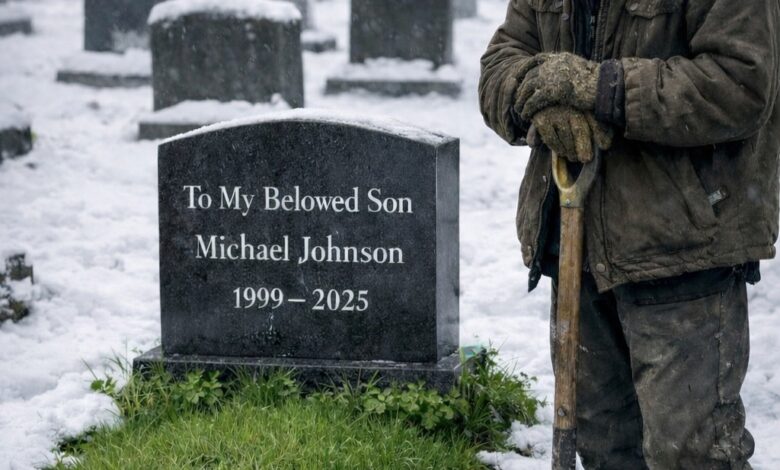
The frost in Willowbrook Cemetery didn’t just bite; it consumed. By mid-January, the ground usually turned into an iron-hard slab of permafrost, and the grass withered into a brittle, ghostly tan. Thomas Hartwell, the cemetery’s caretaker for over three decades, knew the personality of every acre. He knew where the shadows lingered too long and where the drainage failed during the spring thaw. He thought he had seen every manifestation of human sorrow—from the widows who brought fresh tea to headstones to the parents who left rotting teddy bears in the rain.
But Plot 47 in Section C was an anomaly that defied the seasons.
The headstone was a modest slab of grey granite, marked with a name that Thomas had seen etched too often in his ledger: Marcus James Whitman, 1999–2025. He was twenty-six—an age that suggests a life interrupted mid-sentence. What drew Thomas’s attention, however, wasn’t the tragedy of the age; it was the vibrant, defiant emerald rectangle surrounding the marker.
During the brutal cold snap of 2026, when temperatures plummeted to fifteen degrees below zero, the rest of Willowbrook was a wasteland of white and grey. Every other grave was buried under a foot of suffocating snow. Yet, Marcus Whitman’s plot remained clear. The grass there wasn’t just surviving; it was lush, thick, and pulsating with a spring-like vitality that felt almost predatory against the surrounding death.
Thomas stood at the edge of the plot one Tuesday morning, his heavy boots crunching on frozen snow while his eyes rested on the soft, damp turf of Section C-47. He pulled off a glove and knelt, pressing his palm to the earth. It wasn’t just thawed; it was warm. A low, subterranean heat radiated against his skin, a ghost of a fever beneath the soil.
As a man of logic and dirt, Thomas’s mind immediately went to the practical. He suspected a wealthy family had installed some sort of illicit memorial tech. He had seen solar-powered lanterns and digital frames before, but this was a feat of engineering. For four consecutive mornings, he staked out the section in the pre-dawn gloom, his flashlight beam slicing through the mist. He expected to find a maintenance crew or a grieving relative with a snowblower and a portable heater.
He found no one. No footprints disrupted the pristine snow leading to the plot. No tire tracks marred the access road. It was as if the heat were an internal property of the grave itself, a metabolic fire burning in the deep.
On the fifth day, driven by a mixture of professional duty and an itch of curiosity he couldn’t scratch, Thomas returned with a spade. He knew the legalities of disturbing a site, but the “Immaculate Green,” as he’d begun to call it, was a safety hazard and a mystery that kept him awake.
The shovel sank into the earth as if it were butter. There was no frost line here. Three feet down, the blade struck something with a sharp, resonant chime. Thomas cleared the dirt with his hands, expecting a time capsule or a buried urn. Instead, he unearthed a heavy-duty, weatherproofed black metal box. A thick, industrial-grade electrical cable snaked out from the corner of the box, buried deep and heading straight for the old stone chapel at the heart of the cemetery.
Thomas sat back on his heels, the cold air stinging his lungs. It wasn’t a miracle; it was a circuit.
He traced the line back to the chapel’s exterior, finding a hidden junction box tucked behind a screen of overgrown holly. There, a single breaker was labeled with meticulous, obsessive neatness: “Section C-47.” Someone had hired a professional to wire the afterlife.
The architect of this anomaly revealed himself three days later. In the blue light of a winter dawn, Thomas saw a silhouette standing over the grave. The man was tall and reed-thin, wrapped in a wool coat that looked older than the headstone. He wasn’t crying or praying; he was simply standing there, his eyes fixed on the grass as if waiting for it to speak.
“Mr. Whitman?” Thomas called out, his voice carrying thin in the frozen air.
The man turned. He looked seventy, though grief has a way of adding a decade to a man’s gait. His face was a map of exhaustion, but his eyes were clear. “You found the elements,” David Whitman said. It wasn’t an apology; it was an observation.
“I did. It’s a hell of a piece of work, David. But you can’t just wire a cemetery for floor heating.”
David walked to the edge of the green patch, being careful not to step on the blades. “Marcus hated the winter. Since he was a boy, he’d go quiet when the first frost hit. He called it the ‘season of bone.’ He said the world felt like it was giving up on him.”
He knelt, his fingers trembling as he brushed a stray leaf from the turf. “He died in March. Right when the crocuses were coming up. I couldn’t bear the thought of him going back into the cold. I couldn’t let him spend eternity in the one season that broke his spirit.”
David looked up at Thomas, his breath hitching. “I spent eight thousand dollars on the installation. The electricity is piped in from the chapel’s auxiliary line; I pay the church secretary sixty dollars a month to keep the bill quiet. I know it’s not rational. I know the boy I raised isn’t actually feeling the frost. But when I stand here, and I see this one spot where the world hasn’t died, I can pretend he’s still in the sun. I can pretend I’m still protecting him.”
Thomas looked at the man and then at the vast, frozen expanse of Willowbrook. He thought of the thousands of souls under his care, all surrendered to the iron grip of the North Carolina winter. He thought of the rules—the strict guidelines about “unauthorized structures” and “uniformity of landscape.”
Then he looked at the green. It was a defiant, beautiful middle finger to the inevitability of the end. It was the physical manifestation of a father’s refusal to stop being a father. In thirty-three years, Thomas had seen many monuments to the dead, but he had never seen a monument to the living impulse of love quite like this.
“The wiring,” Thomas said, clearing his throat and looking away. “Is it grounded?”
David blinked, taken aback. “Yes. Industrial grade. Weather-sealed.”
“I’ll need a copy of the schematics for my ‘private’ files,” Thomas said, his voice gruff. “And the name of the electrician, just in case a line breaks during a thaw. I can’t have a short-circuiting grave on my watch.”
David’s face crumpled, not in sorrow, but in a profound, soul-deep relief. “You’ll let it stay?”
Thomas looked at the emerald rectangle, the only living thing in a city of stone. “I’ve got fifteen years until I retire, David. As long as I’m the one holding the keys, Section C-47 stays in the spring. I’ll adjust my Sunday rounds. Give you some time to sit in the warmth.”
As the sun finally broke over the horizon, painting the snow in shades of gold and violet, the two men stood in silence. The heat rising from the grave created a faint, shimmering haze in the air—a tiny, private ecosystem of memory. Thomas realized then that his job wasn’t just to tend the grass and the stones. It was to guard the stories that refused to freeze.
The grave that never froze became a legend among the few locals who dared the cemetery in winter, a whispered miracle of “holy ground.” But for Thomas and David, it was simply the cost of a promise. In the heart of the winter of 2026, while the rest of the world turned to ice, love kept a small piece of the earth warm, one watt at a time.