The Graduation Speech! The Day I Honored the Mother Who Chose Me
My name is Sarah Mitchell, and at twenty-eight, I stand as a testament to the fact that blood is merely a biological coincidence, while family is a sacred choice. For a long time, I believed that my life was defined by the day I lost everything, but I eventually realized it was actually the day I was found. This isn’t a story about the warmth of reconciliation or the soft edges of forgiveness; it is a chronicle of justice, the weight of consequences, and the vast, unbridgeable chasm between those who merely give birth and those who truly earn the title of parent.
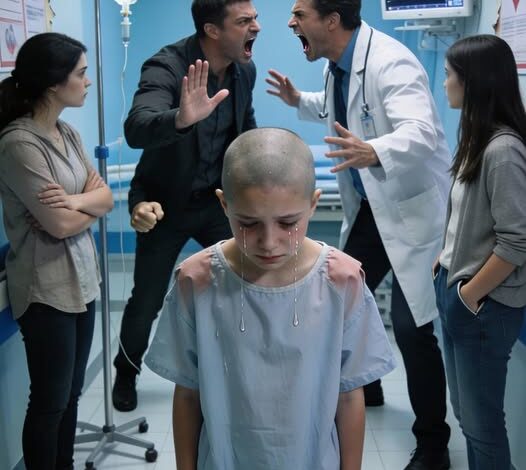
The fracture began in St. Mary’s Hospital, Room 314, on a gray October afternoon that smelled of antiseptic and fading hope. I was thirteen, a small girl in a flimsy hospital gown that offered no protection against the cold dread pooling in my stomach. Dr. Patterson had just delivered the verdict: Acute Lymphoblastic Leukemia. He spoke in percentages and survival rates, trying to paint a picture of hope, but the atmosphere in the room was already suffocating. My mother, Linda, stared at a scuff on the floor as if it held the secrets of the universe, refusing to meet my eyes. My father, Robert, stood with his arms crossed, his face reddening with a rising fury that had nothing to do with grief. Behind them, my sixteen-year-old sister, Jessica, leaned against the wall, her thumbs flying across her phone screen as if my mortality were a minor inconvenience.
The breaking point didn’t come from the diagnosis, but from the bill. When Dr. Patterson mentioned that out-of-pocket costs could reach six figures, my father’s reaction was immediate and visceral. He didn’t ask about the pain I would endure or the side effects of the chemo; he spoke of Jessica’s future. He spoke of the one hundred and eighty thousand dollars they had saved for her to attend Yale or Princeton. In a moment of chilling calculation, he looked at me—his “average” child with “average” grades—and decided that my life wasn’t worth the investment. To protect their wealth and Jessica’s pedigree, my parents proposed a solution that made the air turn to ice: they would have me emancipated and made a ward of the state. If I were no longer their legal responsibility, the state would foot the bill, and their bank accounts would remain untouched.
“We have another child to think about,” my mother had said, her voice dripping with a twisted sense of martyrdom. They saw me as a damaged asset, a liability that threatened to sink the ship of their social ambitions. When Dr. Patterson, white-faced with shock, ordered them to leave his office, they walked out without a backward glance. They signed the emergency surrender papers within hours, effectively deleting me from their lives to ensure their eldest daughter could have a prestigious dorm room.
The first night in the pediatric oncology ward felt like the end of the world. I was a thirteen-year-old girl with a death sentence, abandoned in a high-tech crib of humming monitors and fluorescent lights. Then Rachel Torres walked in. Rachel was a night-shift nurse with a practical ponytail and eyes that carried the weight of a thousand battles. She didn’t offer empty platitudes. Instead, she sat in the plastic chair my father had occupied and told me the truth: that what my parents did was monstrous, that the road ahead would be brutal, but that she would be there for every mile of it.
Rachel became my anchor during the storm of induction chemotherapy. When my hair fell out in clumps, she laughed with me over her own past fashion disasters. When the nausea made food an enemy, she distracted me with stories of her cat, Pancake. Most importantly, when the state began looking for a foster home to take a medically fragile, abandoned teen, Rachel stepped forward. She didn’t just offer me a bed; she offered me her life. She adopted me on my fourteenth birthday, giving me her name and a lavender-walled bedroom that smelled of home.
Under Rachel’s roof, “average” Sarah was reborn. She refused to let my biological parents’ cruelty define my potential. She hired tutors to bridge the two-year gap I missed during treatment and stayed up until dawn helping me master calculus. She pushed me not because she wanted a trophy, but because she wanted me to see the brilliance she had recognized the first night in Room 314. While my biological parents moved on in their pristine, debt-free house, I was fighting my way toward a scholarship at Johns Hopkins.
The culmination of this journey occurred years later at my medical school graduation. I had invited my biological parents to the ceremony—not out of a desire for reunion, but because I wanted them to witness the “average” child they had discarded. I saw them in the third row: Robert, looking older but still wearing that mask of arrogant entitlement, and Linda, fidgeting with her pearl necklace. Beside them sat Jessica, whose “brilliant” future had apparently plateaued into a mundane corporate job.
When it was my turn to speak as the class valedictorian, a silence fell over the hall. I looked directly at the third row, but I didn’t acknowledge them as my family. I began my speech by talking about the day I was told I had an 85% chance of survival and a 100% chance of being abandoned. I watched the color drain from Robert’s face as I detailed the proposal to make a sick thirteen-year-old a ward of the state to protect a college fund. I described the coldness of a mother who chose a scuff mark on the floor over her daughter’s tears. The audience gasped, a collective murmur of horror rippling through the 847 people in attendance.
Then, I turned my gaze toward the front row, where Rachel sat. Her eyes were shimmering with pride, her hand clutching the silver necklace I’d given her. “A parent isn’t the person who shares your DNA,” I told the crowd, my voice unwavering. “A parent is the person who stays when everyone else leaves. A parent is the person who sees potential in the ashes and helps you build a cathedral. Today, I am Dr. Sarah Mitchell not because of the people who gave me life, but because of the woman who taught me how to live it.”
The standing ovation that followed was thunderous, but I only had eyes for Rachel. As the ceremony ended and the crowd began to disperse, I walked past the third row. Robert tried to stand, his mouth opening as if to claim a share of my glory, but I didn’t stop. I didn’t even slow down. I walked right past the strangers who had sired me and walked straight into the arms of the mother who had chosen me.
Justice, I realized, isn’t always a courtroom verdict. Sometimes, it’s a twenty-eight-year-old woman in a doctoral hood, standing tall in the light of a truth that no amount of money could ever buy. I left the auditorium with Rachel, leaving the Mitchells to sit in the silence of their own choices, finally understanding that they hadn’t saved their future that day in the hospital—they had simply ensured they wouldn’t be part of mine.