Six-Year-Old Daughter Came Home With Blood in Her Hair and Fear in Her Eyes, at the hospital!
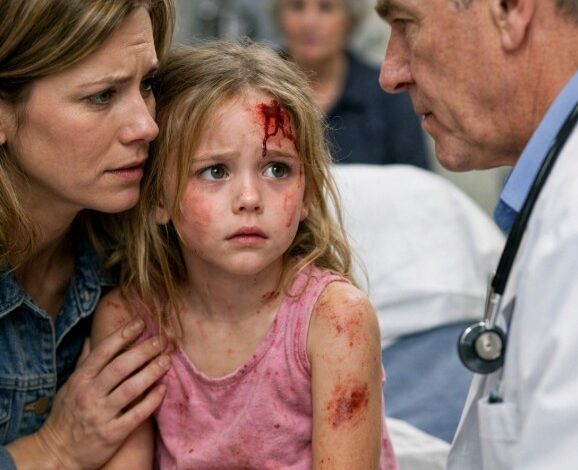
The sentence that haunts the quiet corners of my mind, the one that serves as the jagged dividing line between my former life and the reality I inhabit now, is simple yet devastating: my daughter came home with blood in her hair.
It began as a Tuesday defined by the mundane. I had returned from the office still wearing the armor of my professional life—a navy dress, pinching heels, and a mental checklist of chores. The house smelled of lavender and lemon, a fragile olfactory shield I used to convince myself that I was a woman in control of her world. Then, the front door opened, and the silence that followed was heavy with a wrongness I felt in my marrow.
When I stepped into the hallway, I found Ava standing by the door. Her pink backpack hung lopsided off one shoulder, but it was her hair that made the world tilt. Her brown curls were stiff, matted to one side with a dark, crusted substance that my brain initially refused to identify. It wasn’t glue or dirt. It was blood.
“Ava… sweetheart, what happened?” My voice sounded like it belonged to a ghost.
She didn’t meet my eyes. Her face was a mask of exhausted sorrow, her eyelids swollen from hours of crying. She looked like a child who had simply run out of tears. “I fell,” she whispered. The words were small, practiced, and devoid of the usual dramatic flair a six-year-old gives to a playground injury.
I knelt before her, my heart hammering against my ribs. Her leggings were torn, her knees scraped raw, but it was the flinch that broke me. When I reached out to gently inspect the wound near her temple, she jerked back. It wasn’t the startle of a child in pain; it was the instinctive recoil of a child who expected a blow.
“Where did you fall?” I asked, my voice trembling.
“At Grandma Carol’s,” she murmured.
For months, my mother and my older sister, Denise, had insisted on taking Ava every Tuesday. They framed it as a gift—a chance for me to breathe, a way for Ava to bond with her “village.” I had trusted that village. I had built my sense of security on the foundation of their supposed love. I moved a curl aside to find a jagged, deep laceration that was still swollen and tender. No ice had been applied. No antiseptic had been used.
When I called my mother, her voice was a jarring contrast of artificial cheer. “Lauren! Did Ava tell you about the cookies we made?”
“Why is there blood in her hair, Mom?”
The cheer evaporated instantly, replaced by a sharp, irritated sigh. “For heaven’s sake, Lauren, don’t start. She tripped outside. Kids fall. She cried for a minute and then she was fine.”
“She is not fine,” I snapped, my protective instincts finally overriding my habit of daughterly deference. “Why didn’t you call me? She has a head wound.”
“Because you’re hysterical,” my mother retorted. “I wasn’t going to deal with your theatrics over a simple scrape.”
I hung up, grabbed my keys, and took Ava to the emergency room. I realized then that my mother wasn’t just dismissing a wound; she was dismissing my daughter’s pain to protect her own convenience.
The hospital was a blur of fluorescent lights and the clinical scent of rubbing alcohol. Ava sat curled into me, her small hand clutching my sleeve. When the nurse began to clean the wound, the reality was even grimmer. The cut was deep, requiring more than just a bandage. Dr. Reynolds, a man with kind eyes and a practiced, observant stillness, stepped in to examine her.
He didn’t just look at her head. He moved with a methodical gentleness, rolling up her sleeves and checking her ankles. I watched, confused, until he paused at her upper arm. There, stark against her pale skin, were bruises. Some were the faded yellow of old injuries, but others were dark, mottled purple—distinct finger-shaped marks.
“She didn’t have those this morning,” I whispered, the air leaving my lungs.
Dr. Reynolds looked at me, then back at Ava. “Sweetie, can you tell me how your arm got hurt?”
Ava shrugged, staring at the floor. “I bump into stuff.”
The doctor asked me to step into the hallway. The air there felt thin. “Ms. Mitchell,” he said softly, “the laceration on her head has a very specific pattern. It wasn’t caused by a fall on flat ground; it was an impact with a defined, sharp edge. And those bruises on her arms… those are grip marks. They are consistent with someone holding a child with significant force to restrain them.”
He explained that by law, he had to report injuries that didn’t match the provided explanation. The word “report” felt like a physical weight. I had spent my life trying to be the “good” daughter, the one who didn’t make waves, the one who kept the family peace. But looking through the glass at my daughter, I realized that “peace” had been a lie I was forcing her to live.
A social worker named Tessa arrived soon after. She sat on the floor with Ava, speaking in a low, musical voice while I hovered in the corner, feeling like a failure. Later, in the hallway, Tessa told me the truth. Ava hadn’t just “fallen.” She had been crying because she missed me and wanted to go home. Denise had told her to “stop being a baby,” and when Ava wouldn’t stop, Denise had grabbed her by the arms and shaken her. In the struggle, Ava was shoved toward a piece of furniture with a sharp corner.
“She kept saying she didn’t want Grandma to be mad,” Tessa said. “She was more afraid of their anger than she was of the injury.”
That night, Ava slept in my bed, her small body curled into a ball of lingering tension. At 3:00 a.m., she whispered in her sleep, “Don’t tell Mommy.” Those three words were a knife to my heart. She had been taught to protect the adults who were hurting her, to keep secrets from the one person who was supposed to be her sanctuary.
By morning, my phone was a graveyard of toxic messages from my mother and Denise. They accused me of “betraying the family” and letting “strangers” into our private business. They claimed Ava was just “difficult” and that I was “overreacting.” I didn’t reply to a single one.
I sat at the breakfast table, watching Ava wince as she reached for her juice, her small head sporting a row of dark stitches. I realized that for years, I had ignored the red flags—the way Ava would go quiet before being dropped off, the subtle jabs my mother made about my parenting, the “rough” way Denise handled her own frustrations. I had chosen to see what I wanted to see: a loving family that helped a single mother.
But the blood in her hair was a truth I could no longer ignore. I understood then that some people protect family reputations at the cost of the children within them. I am no longer that person. I have chosen to be the woman who protects her child, even if it means burning the “village” to the ground to keep her safe. The peace is gone, but for the first time in years, my daughter is truly safe. I don’t know what the future looks like for our family, but I know it will be built on the absolute truth of her safety, not the convenience of their lies.