She Was Being Sold With Her 3 Kids, Until a Mountain Man Paid $100 and Changed Everything!
The auctioneer did not meet her eyes when he called the lot number.
“Lot 17. Woman, early thirties. Three children. To be sold together.”
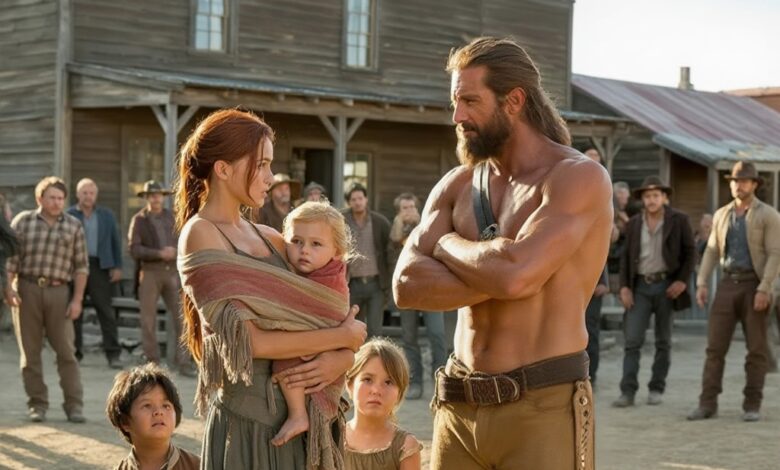
The words landed like stones, heavy and cold. Clara Whitmore tightened her grip on her youngest, little Samuel, who buried his face in the coarse fabric of her skirts. Beside her stood eight-year-old Ellie, her bottom lip trembling as she fought back tears, and eleven-year-old Thomas, who stood with a rigid, unnatural posture. They had been displayed on the splintered wooden platform for hours under a sun that felt far too bright for such a bleak afternoon.
The crowd was a sea of appraising glances and indifferent murmurs. Clara felt their eyes tracking over her and her children, weighing them not as human beings, but as overhead costs.
“Three children?” a man grumbled, leaning against a post. “That’s nothing but a burden.”
“She won’t fetch much,” another chimed in.
Clara heard every syllable. Over the years, she had mastered the grueling art of hearing everything and reacting to nothing. She focused on the horizon, keeping her spine straight.
“We’ll start low,” the auctioneer announced, wiping sweat from his brow. “Fifty dollars for the lot.”
Silence blanketed the town square. A tumble of dust swirled in the dry air. A woman in the front row shook her head, adjusted her bonnet, and turned away.
“Fifty dollars,” the auctioneer repeated, his voice straining. “Do I hear fifty?”
“Thirty.”
The bid came from a man on the left with a pinched, rodent-like face and greedy eyes. Beside Clara, she felt Thomas’s muscles coil tight with instinctive hostility.
“Thirty?” the auctioneer scoffed. “You insult me, sir.”
“That’s three mouths that don’t work,” the man countered, spitting tobacco into the dirt. “Take it or leave it.”
Clara swallowed hard, a wave of nausea crashing over her. This was their calculated worth: thirty dollars.
“Forty,” a lazy, drawling voice rang out.
It belonged to a tall man in a fine, tailored coat and polished boots. He was the sort of man who viewed the world through the lens of utility and exploitation.
“Forty it is!” the auctioneer shouted, sensing a bidding war. “Do I hear fifty?”
No one spoke. The heavy silence returned, thick and suffocating.
Ellie’s small fingers found Clara’s hand. “Mama…” she whispered, her voice a thread of pure terror.
Clara squeezed back, her thumb tracing small, rhythmic circles over her daughter’s knuckles. “I’m here,” she whispered.
“Forty going once…”
The words vibrated in Clara’s chest like a final countdown.
“Forty going twice…”
“I’ll take them all.”
The voice was deep, gravelly, and quiet, yet it sliced through the afternoon air like a blade.
Heads turned in unison. Standing at the very periphery of the crowd was a man no one had noticed. He was monumental, his broad shoulders draped in a heavy, weather-beaten coat. His beard was thick, his hair unkempt, and his heavy leather boots were caked in the dust of crossed mountain ranges. He did not possess the polished cruelty of the ranchers or the merchants. He looked like a creature sculpted by the wilderness itself.
The auctioneer blinked, lowering his gavel. “You’ll take them?”
The mountain man stepped forward, his movements slow and deliberate. His eyes—a sharp, piercing gray—swept over Clara and the children. There was no leer in his gaze, and no cold calculation.
“All of them,” he repeated.
A collective murmur rippled through the spectators.
“You sure about that, woodsman?” the thirty-dollar bidder sneered. “That’s a heavy load of trouble.”
The stranger didn’t even glance in the man’s direction. His eyes remained fixed on the platform. “Name your price.”
The auctioneer hesitated, smelling an opportunity. “Well, we were at forty dollars…”
“I will give you one hundred.”
Complete silence fell over the square. Even the dry wind seemed to hold its breath. Clara gasped, her hand flying to her throat. One hundred dollars. For them.
The auctioneer recovered instantly. “One hundred dollars! Do I hear one hundred and twenty?”
The well-dressed man frowned, looked at the mud on the stranger’s boots, and looked away. Not worth the trouble. The thin man spat in the dirt again and crossed his arms.
“Going once… going twice… Sold!” The gavel cracked against the wood.
The mountain man did not speak as he navigated the crowd to approach the platform. Up close, his sheer size was overwhelming, yet he carried himself with a strange, quiet restraint.
He stopped before Clara. “What is your name?”
“Clara,” she managed, her voice barely audible. “Clara Whitmore.”
He nodded once, his expression unreadable. “I am Jonah Hale.”
Thomas stepped forward, placing himself protectively in front of his mother. “Where are you taking us?”
Jonah looked at the young boy, holding his gaze without anger or condescension. Clara held her breath, admiring her son’s bravery while fearing its consequences. But Jonah simply looked at the boy with quiet respect.
“Home,” Jonah said.
Thomas narrowed his eyes. “Where is that?”
Jonah looked toward the jagged, snow-capped peaks painted against the distant horizon. “Far from here.”
The journey into the high country took three grueling days. They traveled by wagon, leaving the suffocating judgments of civilization behind as the roads narrowed and the air grew crisp and thin. Clara stayed awake, her exhaustion overridden by hyper-vigilance. She watched Jonah constantly, cataloging how he moved, how he spoke, and how he treated them.
He gave them the freshest food first. He stopped frequently so the children could rest and stretch their legs. He spoke very little, but when he did, his voice was never harsh or demanding. Yet, Clara refused to trust him. She knew that men did not part with a hundred dollars out of pure, unadulterated benevolence.
On their second evening, huddled around a crackling campfire, Ellie finally voiced the question that paralyzed Clara. “Why did you buy us?”
Jonah did not answer immediately. He stared into the dancing flames, the amber light casting long, dancing shadows across his weathered face.
“Because no one else would,” he finally said.
Clara felt a sharp tightening in her chest.
“That isn’t an answer,” Thomas challenged, his young voice ringing in the wilderness.
Jonah looked at the boy, his gray eyes softening. “It is the only answer that matters.”
On the evening of the third day, the cabin emerged from the timberline. It was built directly into the granite slope of the mountain, framed by ancient pines. Smoke curled lazily from a stone chimney. It was sturdy and beautiful, a fortress of timber and stone.
Jonah set the brake and jumped down. “We’re here.”
Inside, the cabin was warm and spotlessly clean. A heavy oak table sat in the center of the room, and thick, woolen blankets were folded neatly over handmade beds. The pantry was stocked with flour, cured meats, and jars of preserves.
Ellie gasped, running her hands over the smooth wood of the table. Clara turned to Jonah, her eyes wide. “What is this place?”
“It is yours,” Jonah said, setting down a crate of supplies.
Clara shook her head, a desperate laugh escaping her. “That doesn’t make sense. Men do not spend that kind of money for nothing.”
Jonah met her gaze squarely. “Not for nothing, Clara. For something better.”
As autumn bled into winter, Clara waited for the other shoe to drop—for the moment Jonah would reveal a hidden, cruel agenda. But it never arrived. Jonah kept a respectful distance, allowing them time to heal. He worked tireless hours hunting, chopping wood, and insulating the barn for the impending freeze.
Slowly, the ice around the family began to thaw. Thomas began shadowing Jonah, learning the quiet arts of the mountain. Ellie’s laughter echoed through the pines, and Samuel finally slept through the night. Clara felt a weight lifting from her shoulders that she didn’t know she had been carrying.
One evening, as the first heavy snow began to blanket the peaks, Clara found Jonah outside, sharpening his axe.
“Why?” she asked softly. “You never truly explained.”
Jonah stopped, the steel blade gleaming in the twilight. He sighed, the breath fogging in the frigid air.
“I had a sister once,” he began, his voice thick with a dormant sorrow. “She had three children. Just like you. There was trouble in the valley… a sickness and a fire. I was in the high country. By the time I made it down, they were gone. I couldn’t fix it. I couldn’t save them.” He looked up, his eyes glassy. “But when I saw you on that platform, I knew I could do this.”
Clara stepped closer, her heart aching for the heavy grief this quiet man carried. “You didn’t just save us, Jonah.”
Jonah shook his head slowly. “You saved yourselves. I just gave you a place to land.”
That night, as a blizzard raged outside, Clara watched her children sleeping in their warm beds. She looked at Jonah sitting by the hearth, the firelight washing over his broad shoulders. He was no longer the mountain man who had bought them. He was their foundation. He had not just secured their safety; he had gifted them a future. Looking out at the snow, Clara realized she was no longer afraid of the wilderness. She was home.