She pointed at me and screamed, You are useless! Before I could breathe, my husband roared, How dare you disrespect my mother!
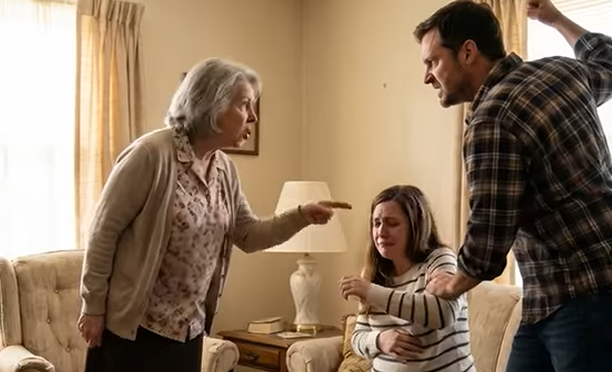
The kitchen was bathed in the warm, deceptive glow of a normal Tuesday evening when the foundation of my life finally crumbled. I was eight months pregnant, my body heavy with the weight of a daughter I already loved, and the simple act of standing at the sink felt like a marathon. My name is Hannah Miller, and for three years, I had lived in a house of eggshells and shadows.
The catalyst was nothing more than a wet plate. It slipped from my soapy fingers, clattering into the porcelain basin with a sharp, resonant ring. It didn’t break, but the sound triggered something primal in my mother-in-law, Carol. She sat at the kitchen table like a queen on a moth-eaten throne, her eyes snapping toward me with a familiar, predatory gleam. She didn’t see a pregnant woman struggling; she saw a target.
“You’re useless!” she shrieked, her voice cutting through the quiet of the house.
I felt the familiar heat of shame crawl up my neck. “I’m sorry, Carol. It just slipped. I’m a bit tired.”
Before the apology could even hang in the air, the heavy scrape of a chair against the tile floor signaled the end of the peace. My husband, Ryan, was on his feet. In the early days of our marriage, I had mistaken his volatility for passion and his possessiveness for protection. But as he stormed toward me, his face contorted into a mask of righteous fury, I saw him for exactly what he was: a man who used his hands because he couldn’t control his heart.
“How dare you disrespect my mother!” he roared.
The logic was non-existent—a dropped plate was not an insult—but in the twisted ecosystem of the Miller household, any perceived imperfection was an act of war. I backed away, my hands instinctively flying to the high curve of my belly, shielding the only thing in the world that mattered.
The first blow caught me across the face, sending me sideways into the edge of the granite counter. The world tilted, and the metallic tang of blood filled my mouth. I looked at Carol, expecting a flicker of horror, perhaps a plea for him to stop. Instead, she folded her arms across her chest, a thin, satisfied smile playing on her lips. “Maybe now you’ll learn your place,” she muttered.
Pain is a strange thing; when it’s sharp enough, it becomes white noise. As Ryan’s fists fell again, targeting my shoulders and ribs as I curled into a fetal ball on the floor, I felt a different kind of sensation. It was a sudden, terrifying warmth spreading down my legs, soaking into my maternity leggings. I looked down and saw the red stain blooming across the white tile like a macabre flower.
“Ryan,” I gasped, the air thin in my lungs. “I’m bleeding. The baby—something is wrong.”
The sight of the blood did something to him. It wasn’t remorse that crossed his face, but a calculating panic. He grabbed a kitchen towel and pressed it against me, his voice a frantic, low hiss. “You fell, Hannah. Do you hear me? You tripped over the rug. If you say anything else, I swear to God, you’ll never see this kid.”
The ride to the hospital was a blur of siren wails and Ryan’s hand crushing mine, a physical reminder of the silence he demanded. In the ER, the world became a series of bright, clinical lights and the frantic movements of people who didn’t know our secrets. Or so I thought.
A nurse named Mia was assigned to my intake. She was a woman with kind eyes and a spine made of tempered steel. As she moved the gown to examine the dark, mottled bruises on my ribs and the swelling on my jaw, I saw her hands pause. She looked at the pattern of the injuries—the distinct shape of knuckles, the impact points that no fall could ever produce.
Ryan stood at the foot of the bed, his “concerned husband” persona wrapped around him like a cheap suit. “She’s so clumsy lately,” he told the room at large. “The pregnancy has her off-balance.”
Mia didn’t look at him. She leaned down, her face inches from mine, and whispered with a terrifying clarity, “Ma’am, this injury isn’t from a fall.”
Ryan stiffened, his voice dropping into a growl. “What are you implying?”
Mia straightened her back, her gaze locking onto his with an intensity that made him flinch. “I’m implying,” she said, her voice echoing in the small curtained cubicle, “that we have already called hospital security and the police. They are in the hallway, and they will be speaking with you now.”
The silence that followed was the loudest thing I had ever heard. Ryan’s face went a sickly shade of gray. For the first time in our marriage, the air left his lungs before it left mine. Security escorted him out, and as the curtain swished shut, the vacuum of fear I had lived in for years finally began to fill with hope.
The medical reality was grim: a partial placental abruption. The trauma had begun to tear the life support away from my daughter. Dr. Lewis and the neonatal team worked with a quiet, fierce urgency, monitoring the flickering rhythm of a heartbeat that was trying so hard to stay. I lay there, tears carving tracks through the dried blood on my cheeks, and for the first time, I told the truth. I told the doctors, the social workers, and a detective named Martinez everything. I told them about the doors I had “walked into” and the “clumsiness” that had defined my life.
“He hurt us,” I whispered. It was the hardest sentence I had ever spoken, but once it was out, it couldn’t be taken back.
The recovery was long. My daughter, Lily, was born via emergency induction two weeks later. She was small, but she was a fighter. Every time I held her, I felt the weight of the responsibility to ensure she never, ever heard the sound of a chair scraping back in anger.
Leaving Ryan wasn’t a single event; it was a campaign. There were restraining orders, the vitriolic text messages from Carol accusing me of being a “homewrecker,” and the terrifying days in court where I had to look at Ryan across a mahogany table. But the system, sparked by a nurse who refused to look away, finally worked. Ryan was convicted of domestic assault and child endangerment.
Today, Lily is a toddler with a laugh that fills our small, sunlit apartment. I still have the scars—some on my ribs, some deeper in my psyche—but they are no longer secrets. They are medals. I remember that night in the ER not as the night I almost died, but as the night I was finally seen. The moment Mia refused to pretend was the moment I realized I didn’t have to pretend either. We are no longer victims of a “fall”; we are survivors who stood back up.