Public Reaction Grows Around a Message From a Local Business!
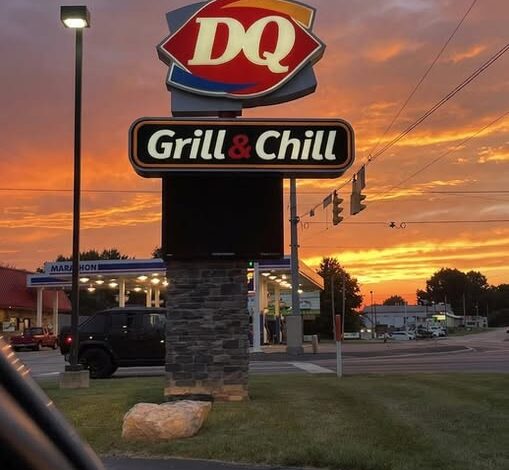
The intersection of small-town commerce and the expansive, often volatile arena of social media recently found a new epicenter in Kewaskum, Wisconsin. What began as a hand-painted sign outside a local Dairy Queen evolved into a national lightning rod for debates surrounding free speech, cultural tradition, and the evolving expectations of inclusivity in the American marketplace. This incident underscores a growing tension in 2026: the reality that no message is truly local in a hyper-connected world, and that a business owner’s personal “expression of values” can be interpreted as either a comforting embrace of tradition or an exclusionary gatekeeping of public space.
The sign in question, prominently displayed at the franchise location owned by Kevin Scheunemann, featured a series of messages that have become increasingly loaded in the modern political climate. It included traditional holiday greetings—specifically the use of “Merry Christmas”—alongside expressions of national pride and an announcement that veterans would receive free sundaes. The most provocative element, however, was a self-applied label describing the establishment as “politically incorrect.” While the owner intended this as a badge of honor—a signal that his store would adhere to traditional norms regardless of shifting social pressures—the phrase served as the primary catalyst for the digital firestorm that followed.
For many in the Kewaskum community, the sign was a familiar and welcome sight. Local residents often viewed the restaurant not just as a place to purchase ice cream, but as a community anchor that reflected the town’s prevailing cultural and patriotic values. To these supporters, the sign was a heartfelt expression of gratitude toward the military and a defense of long-standing customs that they feel are being marginalized in a rapidly changing world. They saw the message as an act of courage—a refusal to “sanitize” public discourse for the sake of corporate neutrality.
However, once a photograph of the sign was uploaded to social media, the context of a small Wisconsin town evaporated. In the digital town square, the message was stripped of its local familiarity and viewed through a national lens of identity politics. Critics argued that labeling a business “politically incorrect” is a coded signal that some customers may be more welcome than others. They contended that in a diverse society, public-facing businesses have an implicit responsibility to use inclusive language that acknowledges the varied backgrounds of their clientele. For these individuals, the sign transformed a simple trip for a sundae into a political statement, potentially alienating those who do not share the owner’s specific religious or patriotic frameworks.
Kevin Scheunemann, the franchise owner, found himself at the center of a controversy he claims he never sought to provoke. In subsequent statements, Scheunemann emphasized that the sign had been displayed for several years without incident, only becoming a “problem” once it was fed into the viral machinery of the internet. He defended the message as a reflection of his personal convictions, particularly his desire to honor veterans, and maintained that his restaurant remains a welcoming environment for everyone, regardless of their personal beliefs. His defense touched on a fundamental American debate: to what extent does a business owner’s right to free expression extend to the public-facing signage of a global franchise?
This question placed Dairy Queen’s corporate headquarters in a delicate position. As a global brand that prides itself on being a family-friendly destination for all demographics, the company was forced to distance itself from the individual owner’s messaging while respecting the independence afforded to its franchisees. The corporate office issued a clarification stating that signage decisions are made at the local level and do not reflect the values or policies of the parent company. This response highlights the “fractured brand” phenomenon of the mid-2020s, where the consistency of a national chain is often at odds with the personal politics of its independent operators.
The debate in Kewaskum is a microcosm of a larger national struggle over the concept of the “neutral” public square. For decades, the prevailing wisdom for businesses was to avoid “religion and politics” to maximize their customer base. However, the rise of “conscious consumerism” and the polarities of 2026 have made such neutrality increasingly difficult to maintain. Today, many consumers actively seek out businesses that align with their values, while others view any deviation from inclusive neutrality as a personal affront. The Dairy Queen sign became a Rorschach test for these two competing philosophies: is a business a private entity with a right to a voice, or is it a public utility with an obligation to be a “blank slate” for everyone?
Furthermore, the role of veterans in this discourse adds a layer of complexity. Honoring military service is one of the few remaining areas of broad American consensus, yet when coupled with the phrase “politically incorrect,” the gesture becomes politicized. Supporters argued that the focus should remain on the generosity of the free sundaes, while critics lamented that a gesture of gratitude was being used as a shield for a broader cultural critique. This tension reflects a society that is struggling to separate genuine civic appreciation from the ongoing “culture wars.”
As the public reaction grew, the Kewaskum Dairy Queen saw both an influx of “solidarity” customers traveling from other states to support the owner and a surge of online “review bombing” from those who found the messaging offensive. This duality is a hallmark of the 2026 economic landscape, where a business’s bottom line can be significantly impacted by its perceived role in a social controversy. For small-town owners, the lesson of the Wisconsin sign is one of scale; in the age of the smartphone, there is no such thing as a “local” sign. Every hand-painted message is a potential global broadcast.
Ultimately, the story of the Kewaskum ice cream shop is not really about ice cream at all. It is about the search for identity in a divided nation. It is about the friction between the traditional values of the “heartland” and the inclusive aspirations of a modern, pluralistic society. As the discussion continues, it serves as a reminder that the spaces where we gather—even the simplest ones, like an ice cream shop on a summer afternoon—are never truly neutral. They are reflections of who we are, what we value, and who we are still learning to become. The sign in Kewaskum may eventually be taken down or painted over, but the conversation it started about the limits of expression and the meaning of community will resonate long after the sundaes have melted.