PART 1, THE MAN THEY HAD ALREADY CONDEMNED!
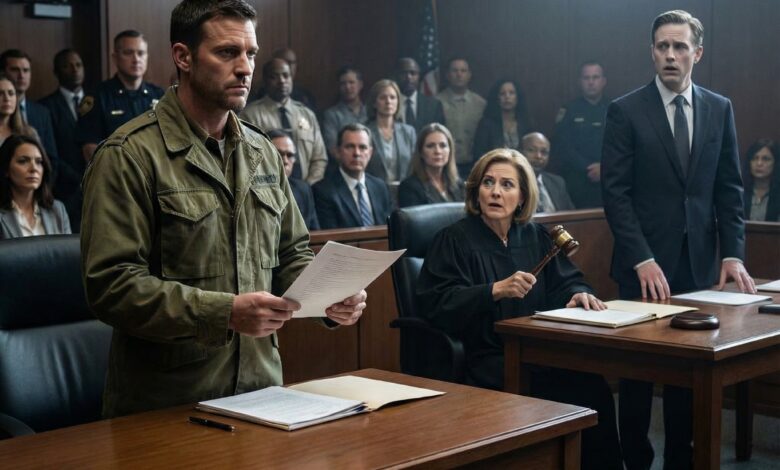
They laughed before I said a word.
Not loud enough for the bailiff to glare. Not cruel enough to be punished. Just that soft, confident amusement people give themselves when they think the outcome is guaranteed. A couple of whispers. A few smirks. The kind of laughter reserved for someone they’ve already filed under “lost cause.”
I stood alone before the bench with my hands clasped, shoulders squared by habit more than comfort. The Army jacket I wore was clean but worn at the elbows, and under the fluorescent courtroom lights it looked like an admission of guilt. The polished floor reflected every crease, every scuff, every assumption people had already decided about me.
My name is Daniel Harper.
I’m a combat veteran. A single father. And in that moment, to most of the room, I was just another unstable man begging for mercy in a place he didn’t belong.
Judge Melissa Grant leaned forward, fingers resting on the gavel like it was a loaded weapon. Late forties, sharp eyes, reputation for efficient rulings and little patience. She’d read my file. I could tell by the way she looked at me—like a conclusion, not a question.
“Mr. Harper,” she said, voice measured and faintly condescending, “do you understand what is happening in this court today?”
The emphasis wasn’t really on what. It was on this court. Status. Belonging. The invisible line between people who speak here and people who get spoken about.
“I understand perfectly, Your Honor,” I said.
She raised an eyebrow. “Then you understand why this court has concerns about your financial instability, your lack of legal representation, and your… background.”
Background landed like a polite slap.
Across the aisle, Brian Collins stood with effortless confidence in a tailored suit that probably cost more than my car. He adjusted his cufflinks as if the case was already won and now he just had to watch the clock run out.
“Your Honor,” Collins said smoothly, “Mr. Harper is clearly overwhelmed. He has no counsel, limited resources, and a documented history of prolonged absences. The court should seriously consider whether he can provide a stable, emotionally secure environment for a young child.”
He didn’t look at me when he said it. He didn’t need to. Men like him speak about you, not to you.
I kept my face still. Anger is easy. Control is harder.
In my head, I heard my daughter Emily’s voice from that morning, small but steady as she hugged me before school.
Dad… don’t let them scare you.
I lifted my hand slightly. “Permission to speak, Your Honor?”
Judge Grant exhaled, the smallest hint of amusement touching her mouth. “Make it brief, Mr. Harper.”
I stepped forward.
“I don’t have a lawyer today,” I said, “because I chose not to.”
The quiet laughter turned louder. Someone in the back whispered something that ended with “unbelievable.”
Judge Grant repeated it slowly like she couldn’t decide whether to be insulted or entertained. “You chose not to.”
“Yes.”
“Mr. Harper,” she said, “this is family court. This isn’t a parking ticket.”
“I know,” I replied. “That’s exactly why I made that decision.”
The air changed just a little. Not silence yet, but attention.
I opened my folder, hands steady, and placed a document on the clerk’s table.
“Before we continue,” I said, “I’d like to enter this motion into the record.”
Judge Grant frowned at it. “Who prepared that?”
“I did.”
A tighter silence hit the room.
Her gaze lifted from the paper to my face, then back again. “Mr. Harper,” she said carefully, “where did you study law?”
I met her eyes for the first time, directly.
“Harvard Law School,” I said.
The courtroom went still in a way that felt physical. The smirks vanished. Brian Collins’ expression erased itself in real time. My ex-wife’s head snapped toward me, eyes wide, like she was seeing a stranger.
“Harvard,” Judge Grant repeated.
“Yes, Your Honor. Class of 2010.”
Her posture shifted. Not friendly. Not warm. But cautious now. The kind of caution a professional has when they realize the person they dismissed might understand the rules better than they do.
“And yet you’re here without representation,” she said.
“Correct.”
“Why?”
I didn’t rush the answer. I never rush answers that matter.
“Because after my wife died,” I said, “and after I came home, I chose my daughter over my career. I stepped away from practice to raise her.”
Brian Collins shot to his feet. “Your Honor, this is irregular. If Mr. Harper is an attorney, the court should have been notified—”
“It was,” I said calmly.
Judge Grant’s eyes flicked. “Explain.”
“Preliminary filings,” I replied. “Page three. Footnote two.”
She flipped faster, sharper now, then stopped. Her jaw tightened.
“I see it,” she said quietly.
The room wasn’t laughing anymore.
“Proceed,” she said.
I nodded once.
“I’m not here to intimidate the court with credentials,” I began. “I’m here because my daughter’s life is being decided based on assumptions instead of facts.”
Brian shifted, recalculating. He was good at reading rooms. He could feel the ground move under him.
“The claim that I’m financially unstable,” I continued, “ignores the income streams already disclosed.”
I laid out the documents, one by one. Veteran benefits. Consulting work with a nonprofit legal group. A trust my late wife established for our child.
Brian tried to interrupt. Judge Grant raised her hand and cut him off.
“Let him finish,” she said.
“As for my background,” I said, “my service record is being treated like a defect.”
Judge Grant’s expression tightened. “Explain.”
“I served two tours overseas,” I said. “I led teams under sustained pressure. Managed logistics with lives at stake. Made decisions where mistakes don’t get corrected later. I returned home, passed every required evaluation, and have been my daughter’s sole caregiver for five years.”
Brian tried again. “Combat exposure—”
“—is not evidence of parental unfitness,” I finished, steady. “And appellate courts have said as much.”
I cited cases. Not loosely. Precisely. Names, dates, holdings. I referenced decisions Judge Grant authored early in her career.
I watched recognition flicker across her face. She knew the language because she’d written it.
Brian’s objections started to sound weaker each time he spoke. Every argument he raised, I met with documentation and precedent. Eventually, he turned to my ex-wife, trying to shift the narrative into emotion.
She stood, smoothing her blouse, voice trembling in that practiced way that sounded sincere to strangers.
“I just want what’s best for Emily,” she said. “Daniel is distant. Rigid. He doesn’t communicate the way a child needs.”
I listened without flinching.
Judge Grant looked at me. “Response?”
“Yes,” I said quietly.
“My daughter lost her mother,” I said. “She lost her normal. I didn’t respond by chasing distraction or handing her grief to someone else. I responded by being present.”
I swallowed once.
“She knows where I am. She knows her routines. She knows that if she wakes up from a nightmare, someone will come.”
I looked toward my ex-wife, then back to the judge.
“She also knows love isn’t loud,” I said. “It’s consistent.”
Judge Grant called a recess.
In the hallway, the buzz was different now—confused, recalculating. Brian Collins avoided my eyes entirely. I stayed seated, hands resting on my knees, breathing evenly.
I wasn’t winning yet. But I wasn’t being dismissed either.
When court resumed, Brian called his final card: a court-approved psychologist, Dr. Elaine Moore. He tried to shape her testimony into a warning about my “emotional restraint.”
But Dr. Moore didn’t cooperate.
“Mr. Harper is structured,” she said. “Disciplined.”
“And that’s harmful?” Brian pressed.
“No,” she replied, firm. “It’s stabilizing.”
Judge Grant leaned forward. “Does Mr. Harper pose any psychological risk to his child?”
“None,” Dr. Moore answered. “He appears protective, attuned, and consistent.”
Then I asked one question I’d held back for the right moment.
“Doctor,” I said, “when you asked Emily how she feels at home, what did she say?”
Dr. Moore’s gaze softened. “She said, ‘At Dad’s house, I feel safe enough to be quiet.’”
The room didn’t breathe.
“That indicates,” Dr. Moore added, “a child who doesn’t feel responsible for managing an adult’s emotions. That’s emotional security.”
The next morning, the courtroom was packed.
Judge Grant entered with no performance, no theatrics. Just seriousness.
“This court has completed its review,” she said. “This case was not about income. Not about appearances. And not about assumptions dressed up as concern.”
Brian sat rigid. My ex-wife stared straight ahead.
“The court finds Mr. Harper financially stable, emotionally competent, and consistently present in his child’s life,” Judge Grant continued. “Attempts to frame military service as a liability were inappropriate and unsupported.”
She paused.
“This court has seen too many parents who speak beautifully and disappear quietly. Mr. Harper does neither.”
Then she looked at me.
“Full physical and legal custody of Emily Harper is awarded to her father. Effective immediately.”
The gavel struck once.
Final.
Outside, people tried to turn it into a story for cameras. I didn’t give them one. I drove home.
Emily was at the kitchen table coloring when I walked in. She looked up and read my face like she always could.
“Did they listen?” she asked.
I knelt in front of her. “Yes,” I said. “They listened.”
She wrapped her arms around my neck, tight and unshakable.
“I told you,” she whispered. “Don’t give up.”
Months later, Judge Grant issued a written addendum about bias against veterans in family court. It wasn’t an apology, not exactly, but it was something close: acknowledgement. It became a reference other attorneys started citing.
I never returned to corporate law.
I opened a small practice for veterans and single parents who walk into court already condemned by the way they look, talk, or carry themselves.
Because I learned something worth keeping.
People confuse quiet with weakness.
They confuse restraint with emptiness.
They confuse scars with instability.
But strength doesn’t announce itself.
It shows up. It holds steady. It wins when it has to.
And sometimes, when the room finally stops laughing, it listens.