Opened Doors! A Woman Found a Family in the Cold and Made a Touching Decision
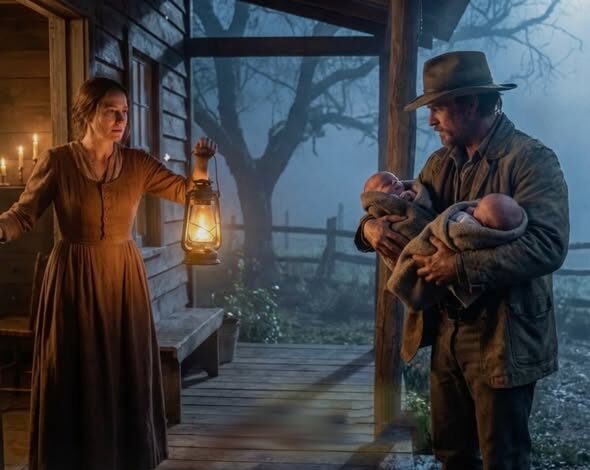
The wind cut across the plains like a blade, scraping frost from the earth and driving fog low against the land. Abigail Monroe stood alone in her kitchen, the wood stove ticking softly as it fought the cold. She had learned to read nights like this. Nights that carried trouble in their breath.
When the knock came, it wasn’t polite. It was urgent. Heavy. Desperate.
Abby reached for the shotgun before she reached for the door. No one traveled these roads after dark in late November unless they were lost, fleeing, or had nothing left to lose. She opened the door a crack, lamp raised, barrel steady.
A man stood in the fog, tall and hollow-eyed, holding two small bundles against his chest. Infants. Their cries were thin and weak, barely cutting through the wind.
“Ma’am,” he said, voice rough with exhaustion, “I don’t mean trouble. We just need warmth. A barn. A shed. Somewhere they won’t freeze.”
That word—they—settled into her bones.
His name was Caleb Walker. The twins were Luke and Levi. Six months old. Their mother was gone. He didn’t say how, and Abby didn’t ask. Grief had a look. She recognized it.
Abby had lived alone on the Monroe ranch since burying her parents two winters apart. She knew the cost of isolation, the price of independence, the danger of mercy. People in town already whispered about her—too stubborn, too proud, too alone. Letting a stranger stay could cost her everything. Her land. Her safety. Her reputation.
She sent him to the barn first. Dry straw. Old blankets. Distance enough to think.
But the sound of the babies crying through the fog broke her resolve. Ten minutes later, Abby was crossing the frozen yard with a lamp and her coat thrown over her nightdress. What she saw in the barn undid her completely: Caleb sitting on the ground, rocking the twins beneath his coat, humming like a man trying to keep the world from ending.
“Bring them inside,” she said. “All of you.”
That was the moment the ranch changed.
By morning, the fire was warm, the babies were sleeping, and Caleb was fixing fence posts like a man who needed to prove he was worth the air he breathed. Abby put him to work because work tells you who someone really is. He didn’t complain. He didn’t rest. He just built.
Word spread fast. Small towns always notice strangers. Miss Ethel Sanderson rode out first, sharp-eyed and sharper-tongued, bringing bread and warnings. Others followed with looks, questions, judgment dressed as concern. Abby ignored them all.
Then her uncle came.
Virgil Monroe wanted the land. He always had. Armed with a dusty clause in her father’s deed and the confidence of a man who believed women were temporary caretakers, he threatened court action. Said she needed a man or the land would be reassigned.
Caleb heard every word.
He didn’t posture. He didn’t threaten. He simply said, “I’ll stand with her.”
The courthouse was cold and unforgiving, but Abby came prepared. Records. Ledgers. Proof of agricultural productivity, livestock counts, water rights. She stood tall while Virgil tried to paint her as reckless and immoral. Caleb spoke once, plainly, without drama. The judge ruled in her favor.
They walked out still unsure of what they were to each other, but certain of one thing: they were not backing down.
That certainty was tested days later.
A man named Royce Keller arrived from Missouri, polished boots and empty eyes. A private investigator hired by a wealthy family with old money and long memories. Caleb told Abby the truth that night—about a man who’d hurt the twins’ mother, about violence born of protection, about running to survive. He hadn’t murdered anyone. But power didn’t care about truth. It cared about silence.
The barn burned three nights later.
It wasn’t an accident. It was a message.
Smoke rose into the sky like a warning flare, and Abby felt something inside her harden. This was no longer about land ownership or rural survival stories. This was about intimidation, coercion, and standing ground when retreat would be easier.
Threats followed. Letters. Riders. Men who didn’t wear badges but acted like they owned the law. Abby and Caleb prepared. Sheriff Thorne took their side. Miss Ethel rallied the town. When the men came at dawn with guns and arrogance, they found resistance instead of fear.
Shots were fired. Blood was spilled. One deputy died protecting the house. But the attackers fled, exposed and hunted by daylight and witnesses. Royce disappeared, discarded by the very people who’d hired him.
The ranch survived.
Spring came slow but honest. They rebuilt stronger. The twins grew loud and healthy. Caleb stayed. Not because he had to, but because he chose to. Abby chose him too, not out of desperation, but resolve.
People later called it a story of rural resilience, of frontier justice, of a woman who opened her door and found a family. Newspapers used words like inspirational true story, unexpected kindness, standing your ground, modern homesteading, family found not inherited. But Abby never cared about the headlines.
Years later, when asked why she fought so hard, she answered simply.
“Because home isn’t real estate. It’s where you decide to stop running.”
The Monroe ranch still stands. Stronger fences. Deeper roots. And every winter night, when the wind howls across the plains, there’s light in the windows, children’s laughter in the air, and a door that opens—not to fear—but to choice.