On Thanksgiving The Doorbell Rang, It Was A Man Who Looked Like He Had Nowhere To Go
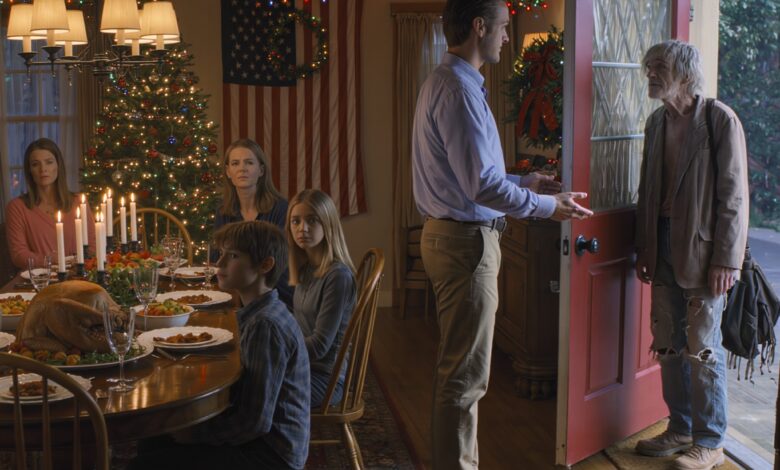
Thanksgiving was supposed to be simple that year—just the four of us, a small dinner, no drama. I was setting the table with my grandmother’s china when the doorbell rang. Mom shouted for someone else to get it. Charlie ignored her. Dad came in from the garage, wiped his hands on a rag, and opened the door.
Silence. Then a low, tired voice.
“Sorry to bother you. Do you have any food you could spare?”
I froze. Mom appeared beside me, stiff as a statue. A homeless man on Thanksgiving—exactly the kind of moment you hope never happens because you don’t know how to handle it.
Dad stepped back inside, conflicted. “There’s a man out there. He’s starving.”
Mom didn’t hesitate. “Give him money or leftovers. Do not invite him inside.”
Dad looked at her like she’d just suggested drowning puppies. “Jen, he’s alone. On Thanksgiving.”
I hated where this was going. I already knew Dad was about to do something we’d all be forced to deal with.
“Rob, no.” Mom folded her arms. “We don’t know him. He could be dangerous.”
“He isn’t,” Dad insisted.
She raised an eyebrow. “How do you know?”
“I talked to him.”
“For two minutes,” she snapped.
“He apologized three times for knocking. He asked for food, not money. He backed away when I opened the door. He’s wearing a wedding ring, Jen. He’s not some threat—he’s someone who had a life before this.”
Mom turned to me for backup. “Tell your father this is irresponsible.”
I agreed with her. I also didn’t want some stranger sitting at our table while we tried to pretend everything was normal.
“Dad… maybe just pack a plate for him?” I said. “He doesn’t have to come inside.”
Dad stared at me like I’d disappointed him on a spiritual level. “When did you start thinking like that?”
That hit hard. “I’m not selfish. I’m realistic.”
“No,” he said quietly. “You’re comfortable. And that’s different.”
He walked to the door. Mom muttered that he was insane. I felt embarrassed, annoyed, and weirdly guilty all at once.
Dad opened the door again. “Sir, you’re welcome to join us for Thanksgiving dinner.”
The man hesitated. “I don’t want to disturb—”
“You’re not disturbing anyone,” Dad said. “Come in.”
And just like that, our Thanksgiving cracked open.
The man’s name was David. He looked older than he probably was—thin, worn down, hair gray and messy, beard unkempt. His eyes, though… soft. Not the eyes of someone dangerous. More like someone who’s been stepped on by life so many times he no longer expects anything good.
Mom’s smile was tight. Mine was worse. Charlie just stared like he was watching a zoo animal.
Dad showed David the bathroom to wash up and brought him a clean shirt. When David finally sat at the table—between Dad and Charlie—it felt surreal. Mom served turkey like she was handling hazardous waste.
We went around the table sharing what we were grateful for. Dad used the moment to hammer home his point about kindness. Mom said she was grateful for safety. Charlie said pizza. I said something shallow about “family and stuff,” because I didn’t want to share anything real with a stranger.
Then David spoke.
“I’m thankful for being treated like a person,” he said quietly. “It’s been a long time since anyone looked at me that way.”
The room went still. Even Mom looked shaken.
As we ate, Dad asked where he was from. David said Ohio originally, then Oregon for 30 years. He mentioned he’d been a teacher.
Dad perked up. “Where?”
“Hamilton Elementary.”
Dad froze. “What years?”
“Until 2019.”
Dad’s face went pale. “What’s your last name?”
“Anderson.”
Dad put his fork down slowly. “Mr. Anderson… you were my fifth-grade teacher.”
David blinked, then broke into a stunned smile. “Robbie Mitchell. The kid who never stopped asking questions.”
My jaw practically hit the table. Mom’s hands flew to her mouth. Dad looked like he’d just seen a ghost from his childhood—one he’d loved.
That night changed everything.
David told us his story—not for pity, just because Dad asked. His wife had developed early-onset Alzheimer’s. He spent everything trying to care for her. Lost the house. Lost his job. Lost her. When she died, he had nothing left, not even the energy to start again.
He’d been homeless for two years.
We all sat in silence, ashamed of how quickly we’d judged him.
Dad insisted he stay the night. Mom agreed eventually. I apologized, awkwardly. David smiled and told me I wasn’t wrong for being afraid—only for stopping there.
He stayed for three months. Dad helped him get an apartment. Word spread that he was excellent at tutoring, and soon he had more clients than he could handle. Hamilton Elementary hired him as a substitute. Then part-time. The kids adored him.
I wrote my college essay about the moment I nearly turned him away. I didn’t sugarcoat anything. I sent it to my school—and to him. He replied with one line:
You found your voice. Use it.
That essay helped me get into college.
Years passed. David became part of our family. We ate together every Thanksgiving. I visited his classroom. He mentored me. When I became a teacher, I knew exactly who had guided me there.
Then came the call: a heart attack during a school assembly. Mild, they said, but the word barely helped.
He recovered—slower this time, gentler, more careful. He cut down his hours. He walked more. He helped kids with math. He sent me emails every Sunday.
He told me about a box in his closet, full of letters, drawings, and memories from decades of teaching. “Someday,” he said, “I want you to have it.”
I told him “Someday” would be far away.
It wasn’t.
Eleven years after the day he knocked on our door, he died in his sleep. Peacefully. Quietly. The way gentle people often leave.
When I opened the box, his letter was on top.
“If you’re reading this, my heart finally gave up. Don’t be sad too long. Use the stories in this box. Pass them on. Remind someone out there that they matter. You did that for me.”
That Thanksgiving, we set a place for him anyway. Not with a meal—Mom couldn’t bring herself to do that—but with a framed photo. Dad cried halfway through saying what he was grateful for. Charlie did too. I just held the letter in my hands and felt the weight of everything he’d given us.
The knock on the door that day wasn’t a burden. It wasn’t an inconvenience. It was the beginning of a story that changed all of us.
A man needed help.
A family almost said no.
One person said yes.
And nothing was ever the same.