My Son Threw Me Out With Only a Garage, Inside Was a Secret He Never Imagined
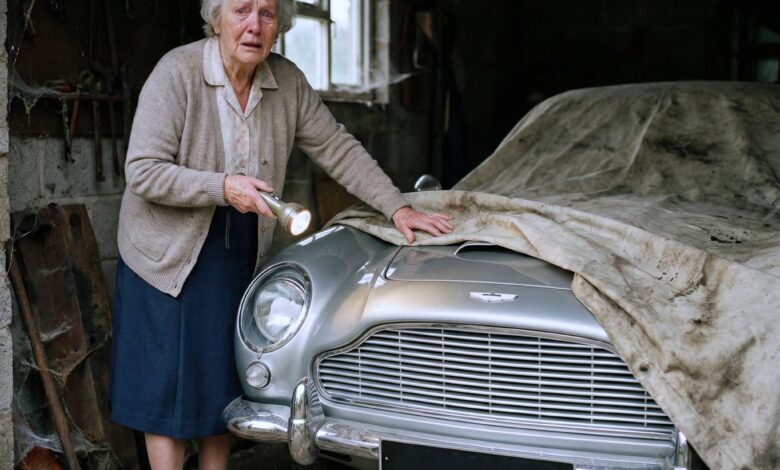
The smell was a suffocating blend of stagnant motor oil and the dry, metallic tang of undisturbed dust. I stood in the dark, my fingers fumbling with a jagged, unfamiliar key while the echo of my son’s final words played on a loop in my mind.
“You’re just a useless old woman, Mom. What would you even do with a real inheritance? Dad knew that.”
The lock yielded with a heavy, industrial thunk. As I pushed the door open, the hinges screamed in protest, a fitting soundtrack for the wreckage of my forty-two-year marriage. I clicked on my flashlight, expecting to see a graveyard of rusted lawnmowers and forgotten junk. Instead, the weak beam caught a glimmer of silver—a polished, chrome-toothed snarl that froze the air in my lungs.
Before I can tell you what I found, you have to understand how I ended up homeless on my birthday, clutching a single suitcase and a brass key that felt like a mockery of a life spent in service to my family.
The nightmare began that morning in the mahogany-shrouded office of Mr. Hoffman, our family attorney. My son, Jonathan, sat across from me, looking every bit the corporate predator in a tailored Italian suit. I felt small in the black dress I’d worn to my husband Robert’s funeral only three weeks prior.
Mr. Hoffman looked pained as he adjusted his glasses. “Before I read the last will and testament,” he began, “I must state that these instructions were drafted with absolute clarity by Mr. Campbell.”
The reading was a blur of legal jargon until the hammer fell. “To my son, Jonathan Campbell, I leave the penthouse residence and my primary investment portfolio. To my beloved wife, Susan, I leave the property at 1420 Industrial Parkway—the garage and its contents.”
The silence that followed was broken by Jonathan’s smug chuckle. He leaned over, his hand squeezing my shoulder with a pressure that felt more like a threat than a comfort. “Don’t worry, Mom,” he whispered. “I’ll make sure you’re taken care of.”
But “taken care of” meant being shown the door that very evening. Jonathan had dropped my suitcase in the marble foyer of the penthouse we had called home for fifteen years. “I’m turning Dad’s study into a home office. I need you out by tonight. You can go to Aunt Helen’s, or,” he sneered, “there’s always that dump of a garage.”
Driven by a mix of shock and a sudden, burning spark of defiance, I didn’t go to Helen’s. I drove to the industrial district. I drove to the “dump.”
As I stepped further into the structure, my flashlight swept over three shapes draped in custom-fitted cloth. I reached for the first one, my hand trembling as I pulled back the fabric. It slid away like silk to reveal a 1964 Aston Martin DB5 in pristine Silver Birch. It was a masterpiece of rolling sculpture.
I moved to the second: a 1956 Mercedes-Benz 300SL Gullwing, its deep blue paint reflecting my light like a dark ocean. The third was a 1967 Ferrari 275 GTB/4, glowing in a shade of red so deep it looked like a heartbeat.
I found a light switch and the space was suddenly flooded with brilliant, recessed LED lighting. This wasn’t a garage; it was a climate-controlled vault with epoxy floors and high-end security. Taped to the wall was a white envelope with my name scrawled in Robert’s looping hand.
“My Dearest Susan,” the letter began. “If you are reading this, I am gone. Six years ago, when I received my diagnosis, I knew I had to protect you. Not just from the world, but from our own son.”
The letter explained that Robert had watched Jonathan grow into a man who valued assets over people. He knew that if he left everything to me openly, Jonathan would have bullied me into “managing” it until I had nothing left.
“The cars are worth twelve million dollars,” the letter continued. “But they are just the beginning.”
Behind a framed photograph of us in Venice lay a digital safe. Using our anniversary—0614—I opened it to find a leather portfolio that made my head spin. It contained deeds to apartment buildings in Seattle, commercial retail spaces in Chicago, and a boutique vineyard in Northern California. All held in a Living Trust that transferred solely to me the moment Robert passed.
The most poignant discovery was a deed to a small, fully furnished cottage in Carmel-by-the-Sea—the town where we had spent our happiest summers.
I spent that first night in a small, hidden office within the garage complex. Robert had even stocked a closet with clothes in my size, tags still attached. He hadn’t just left me money; he had left me a fortress of dignity.
The next morning, I met with Marcus Weatherby, the curator Robert had hired to maintain the collection. “Robert was methodical,” Marcus told me over coffee. “He wanted to leave you something tangible, something beautiful that increased in value every second it sat in the dark. He called it your ‘Independence Fund.'”
As Marcus walked me through the provenance of the Ferrari, my phone rang. It was Jonathan.
“Mom? Why haven’t you called Aunt Helen? Anyway, I need you at the penthouse by nine to clear out your junk. The designers are arriving.”
“I’ll be there, Jonathan,” I said, my voice steadier than it had been in years.
I arrived at the penthouse precisely at nine. Jonathan was already there, pacing the marble floors and barking orders into his headset. He looked at me with a mixture of pity and annoyance. “Did you sleep in your car, Mom? Honestly, if you’d just listen to me—”
“I’m not here to listen, Jonathan,” I interrupted. I handed him a small, elegant folder.
“What’s this? An invoice for a moving van?”
“It’s a copy of the deed to the property in Carmel,” I said. “And a summary of the Living Trust your father set up. It turns out the ‘garage’ contained more than just stale oil.”
Jonathan flicked through the pages, his face draining of color as he saw the valuations. Twelve million in cars. Forty million in real estate. A dividend income that dwarfed his corporate salary.
“This… this has to be a mistake,” he stammered, his bravado collapsing. “Dad wouldn’t… we need to consolidate this. I can help you manage these properties, Mom. We should move you back in here and—”
“No,” I said, reaching for my suitcase. “You were right, Jonathan. This penthouse is yours. It’s exactly what you deserve—a high-rise box of glass and cold stone. But as for me, I think I’ll go to the coast. I have a cottage to open.”
I walked toward the elevator, but paused at the door. “Your father gave you exactly what you wanted, Jonathan. He gave you the status. But he gave me the life. And just so you know, I’ve already instructed Mr. Hoffman to ensure my estate bypasses you entirely. Since I’m just a ‘useless old woman,’ I wouldn’t want to burden you with the responsibility.”
The doors slid shut on his stunned silence. As I drove my old Toyota out of the city, headed toward the salt air of Carmel, I looked at the brass key on the passenger seat. Robert had played a long game, a masterpiece of foresight fueled by a love I was only beginning to truly measure. I wasn’t just surviving; I was finally starting, with twelve million dollars of vintage steel in my rearview mirror and a horizon that belonged entirely to me.