My Neighbor Kept Stealing My Sprinkler Water, So I Taught Her a Lesson!
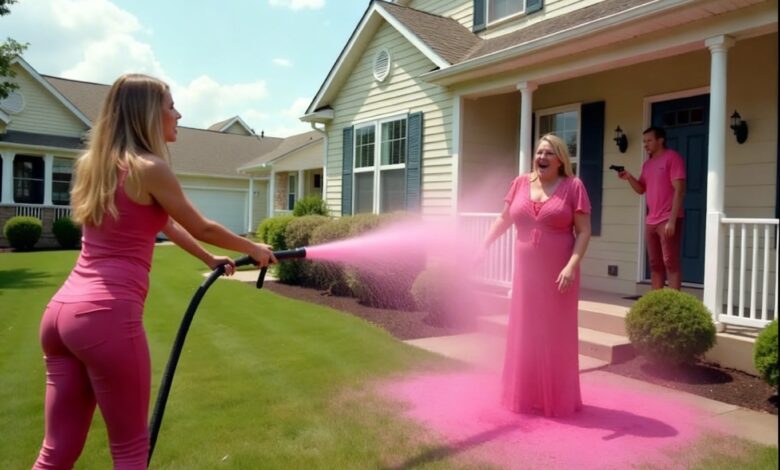
The moment I stepped outside and saw my neighbor’s rose garden thriving like it belonged in a luxury landscaping catalog while my own lawn looked like it had been dragged through a desert, I knew something was off. Not mildly suspicious. Not slightly odd. Completely wrong.
I live in a neighborhood where lawns are treated like status symbols. Every blade of grass is curated, every hedge trimmed with precision. It’s a place where people compete quietly through their landscaping. So when my yard—maintained by a custom irrigation system I had designed myself—started drying out while Karen’s garden next door flourished beyond reason, the discrepancy wasn’t subtle. It was glaring.
Then came the bill.
My water usage had nearly doubled, and I live alone. No kids, no pool, no excessive usage that could explain it. That’s when the suspicion shifted from curiosity to certainty. Something was siphoning water, and it wasn’t a leak.
I started with the basics. Checked for underground pipe issues, inspected valves, reviewed system logs. Everything was functioning exactly as programmed. The irrigation cycles were normal, the timing consistent. But the soil readings didn’t match. Water was disappearing faster than it should have.
That’s when I installed a camera.
For three days, nothing happened. Then on the fourth morning, just before sunrise, I got my answer.
There she was.
Karen.
Wearing a bright pink tracksuit that made the idea of “stealth” almost comical. She walked straight across the side boundary like it was hers, crouched near my connection point, and began adjusting the hose line. Within seconds, she had attached a splitter and ran a secondary hose under her fence.
Then she looked directly at the camera.
Smiled.
And waved.
No hesitation. No attempt to hide it. She was taking my water like it was her right.
Now, Karen wasn’t just any neighbor. She was the HOA president—the kind of person who enforced rules with obsessive precision. She fined people over minor violations, monitored properties like a watchdog, and had built a reputation for making everyone’s life just a little more difficult.
And now she was stealing from me.
Confronting her directly would have been pointless. I’d seen how she handled conflict. People who challenged her didn’t win—they got buried in complaints, inspections, and fines. If I went at her head-on, she’d just turn it into a bureaucratic nightmare.
So I decided to handle it differently.
If she wanted water, I’d give her water.
Just not the kind she expected.
I designed a secondary system—something subtle, controllable, and precise. A hidden valve that I could activate remotely. Then I prepared the mixture: concentrated cleaning vinegar, a vivid but harmless landscaping dye, and a small amount of sulfur-based scent enhancer. Nothing toxic, nothing illegal. But for delicate plants like roses, it would be devastating.
I set the timing carefully. Karen had a routine. She always tapped into my system just before 7 a.m.
So I programmed the switch for 6:55.
The next morning, I didn’t even need to check the camera.
I heard it.
A sharp, panicked scream, followed by chaos.
I stepped outside with my coffee and saw the result.
Karen’s pristine garden had transformed into something surreal. Her white roses were streaked with deep purple. The pathway was stained like spilled paint. Water sprayed unevenly, splattering everything in sight.
Her guests—because of course she had guests—stood frozen, watching the scene unfold. Some had already pulled out their phones.
Karen stood in the middle of it, trying to shut off the hose, her expression somewhere between rage and disbelief.
Then she saw me.
She stormed over, holding up a purple-stained glove like evidence in a trial.
“What did you do?” she demanded.
I took a sip of coffee and shrugged. “Looks like a plumbing issue. Could be backflow contamination. Happens when someone taps into a system they shouldn’t.”
She froze for a second, then narrowed her eyes.
“I’ll report you,” she snapped.
“I’m counting on it,” I said calmly, and walked back inside.
That should have been the end of it.
It wasn’t.
The next day, she filed a formal complaint with the HOA, accusing me of sabotage. The language was dramatic enough to qualify as performance art. A meeting was scheduled.
I showed up prepared.
Laptop in hand, footage ready.
The moment I played the clip of her connecting the hose to my system, the room shifted. One of the board members let out a low whistle. Another shook his head.
Karen didn’t deny it.
She pivoted.
Claimed it was a temporary “resource-sharing initiative” and that I had approved it verbally. I asked when this supposed conversation had taken place. She said at a neighborhood potluck.
I reminded her that she had banned me from that event.
The room went quiet.
That was the end of her argument.
But Karen wasn’t done.
A couple of days later, I noticed something new. The connection point I had secured was tampered with. The lock was gone. In its place was a more discreet setup, partially hidden under gravel.
She had escalated.
Unfortunately for her, so had I.
My system now included pressure sensors, flow monitors, and automated alerts. When the system detected unauthorized access at 6:52 the next morning, I was already awake.
The valve switched.
The mixture flowed.
And once again, her garden erupted in purple chaos.
This time, she tried to shut it off mid-stream, but the pressure kicked back, soaking her completely. It would have been funny if it weren’t so predictable.
Her landscaper showed up shortly after, took one look at the situation, and walked away. No negotiation. No hesitation.
Just left.
That afternoon, Karen launched a new strategy. Flyers appeared around the neighborhood promoting “community resource sharing,” conveniently ignoring her previous actions. She even proposed a shared irrigation monitoring system—run by her, of course.
I didn’t engage publicly.
Instead, I filed a complaint with the city—not about theft, but about safety. Specifically, the risk of backflow contamination from unauthorized connections.
Within a week, an inspector arrived.
I showed him everything.
He followed the line straight to her property, documented it, and issued a report.
The city took it seriously.
At the next HOA meeting, Karen arrived looking like she’d rather be anywhere else. The board issued a formal warning and a no-trespassing order against her.
But that wasn’t what really ended it.
Other neighbors started speaking up.
Small complaints surfaced—unauthorized fees, questionable charges, services that were billed but never delivered. Patterns emerged. Questions were asked.
Karen’s authority started to crack.
I stayed out of it.
My lawn recovered. My system returned to normal. My plants thrived.
Karen, on the other hand, became known for something else entirely.
Not control. Not authority.
Just the woman who turned her own garden purple trying to steal water she didn’t own.