My Kids Tried To Take My Secret Montana Cabin With a Locksmith – So I Called the Law and a Lawyer Instead!
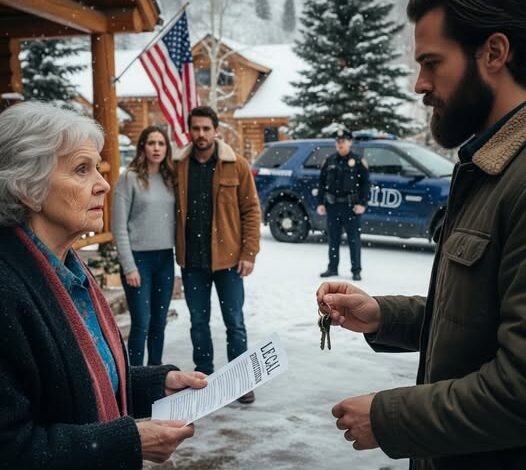
The crunch of tires on frozen gravel cut through the stillness like a warning shot.
I was standing in the kitchen of my Montana cabin, hands dusted with flour, a loaf of bread rising beside the window, when I heard it. Snow drifted past the glass, slow and quiet, the pine trees standing guard under a pale winter sky. The cabin smelled of yeast, wood smoke, and fresh coffee—peaceful, earned, mine.
Then I saw my son’s SUV pull into the driveway.
Michael stepped out first, jaw tight, shoulders rigid, already irritated. He didn’t take in the mountain view or the clean alpine air. He stared at the cabin the way investors look at undeveloped land.
A second car followed. A stranger climbed out wearing a heavy jacket and carrying a metal toolbox.
A locksmith.
My chest tightened.
Then came the third car—my daughter Laura’s. Polished, silver, carefully chosen, just like everything else in her life. She stood in the snow, arms folded, eyes down, not waving.
Two of my children. And a man hired to open my door.
I wiped my hands, stepped outside, and felt the cold snap against my face.
“What’s going on?” I asked, already knowing.
Michael didn’t hesitate. “We’re getting the cabin opened up. You shouldn’t be alone out here. And honestly, Mom, this land should have stayed in the family.”
The locksmith shifted uncomfortably. “Ma’am, I was told you lost your keys.”
“They’re in my pocket,” I said. “And I didn’t call you.”
Laura stepped forward, voice calm but rehearsed. “We’re worried about you. This place is isolated. You don’t need all this space. And Mark needs somewhere to stay after the divorce. This would help him.”
There it was. The truth underneath the concern.
I folded my arms. “This is my property. I bought it. And I’m not giving it away.”
Michael turned to the locksmith. “Go ahead. We’re her kids.”
The locksmith didn’t move.
That’s when the fourth vehicle arrived.
A county SUV rolled into the driveway, tires crunching over snow. Deputy Henry Collins stepped out, calm, professional, already reading the situation.
“Afternoon, Mrs. Harper,” he said. “You called.”
My children froze.
He addressed them evenly. “This property belongs to your mother. Any attempt to enter without permission is trespassing. Family status doesn’t override property law.”
Laura flushed. “She’s being unreasonable.”
“You don’t get to decide that,” I said quietly. “Not anymore.”
The locksmith backed away. Deputy Collins confirmed what I already knew: my name was the only one on the deed. Full ownership. No shared title. No loopholes.
Michael stared at me like I’d betrayed him. “You bought a mountain cabin without telling us?”
“I expected my children wouldn’t show up with a locksmith to take it from me,” I replied.
They left without another word. Tires carved tracks through the snow and disappeared around the bend.
When the silence returned, it felt different—lighter.
Deputy Collins stayed a moment. “If you want extra patrols or a no-trespass order, call me.”
“I might,” I said. “This is the first thing I’ve had in a long time that’s just mine.”
That cabin wasn’t an impulse. It was the result of a realization that hit me last Christmas.
My children celebrated without me.
I saw it online. Photos. Smiles. Grandkids. The same china from my old hutch, the same traditions I built, now happening somewhere else. No invitation. No call. Just my absence staring back at me from a screen.
That night, alone in my rental, I understood something painful and freeing: I had slowly become invisible.
So when I saw a real estate listing for a small off-grid Montana cabin—mountain property for sale, three acres, fireplace, quiet—I clicked. Then I flew out. Then I bought it outright with money I’d saved my entire life.
Not for them.
For me.
The cabin became my reset. My retirement haven. My personal independence in physical form. It wasn’t luxury real estate; it was emotional survival.
In town, I met Deputy Collins by chance at a diner. He warned me gently that adult children sometimes confuse future inheritance with present ownership. He gave me his card.
That card saved me weeks later.
After the locksmith incident, I hired an attorney. Evelyn Hart. Elder law. Estate planning. Asset protection. She didn’t sugarcoat anything.
“Your children see you as a steward of assets, not an autonomous adult,” she said. “We’re going to fix that.”
We set title alerts, surveillance, and updated legal documents. Powers of attorney. A will that reflected intention, not guilt. A trust that would protect the cabin from becoming a family battlefield after I’m gone.
Boundaries, I learned, are a form of love that starts with self-respect.
Eventually, I faced my children—one by one. Hard conversations. Admissions. Apologies. Tears. They weren’t monsters. They were entitled, stressed, and used to me bending.
I stopped bending.
I invited all three to the cabin months later and told them the truth. The cabin would never be theirs. When I’m gone, it will become a retreat for women who need space after giving too much for too long. Widows. Caregivers. Women reclaiming their lives.
“This isn’t your inheritance,” I told them. “It’s my peace.”
They didn’t all like it. But they heard me.
That winter, I spent Christmas in the cabin again. This time, my children called. Early. Awkwardly. But they called.
I stood on the porch afterward, snow glittering under a wide Montana sky, and felt something settle in my bones.
Aging doesn’t mean surrendering your autonomy. Retirement doesn’t mean handing over your keys while you’re still breathing. Financial independence after 60 isn’t selfish. It’s necessary.
This cabin is my declaration.
I am still here.
I still decide.
And I intend to keep it.