My brother claimed he was taking care of our father, but something never felt right
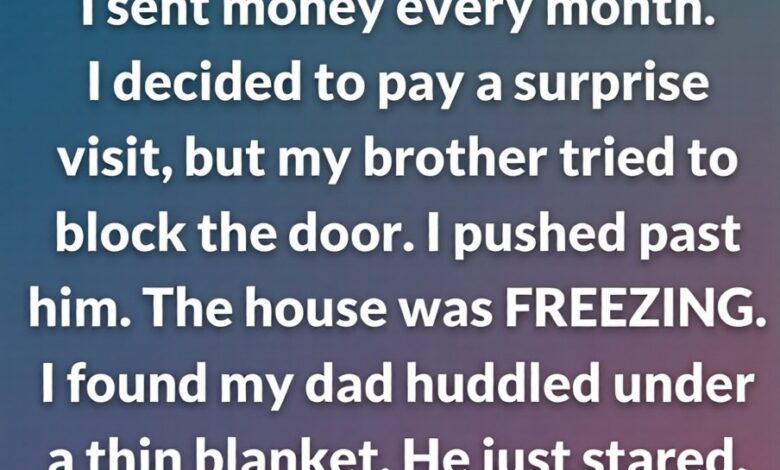
Trust is a fragile architecture, built over decades and dismantled in a single afternoon. For years, I believed that my brother, Mark, was the steady hand guiding our father through the twilight of his life. After Dad’s stroke, the roles within our family shifted with a quiet, mutual understanding: I would provide the financial engine, and Mark would provide the presence. From my apartment three states away, I sent five hundred dollars every week—grocery money, heating oil funds, medication stipends. Every Sunday, Mark’s voice on the phone was a soothing balm. “He’s doing great, Sarah. We had stew tonight. He’s sleeping like a baby.”
But intuition is a persistent ghost. It started with the small things—a certain hollow resonance in my father’s voice when I could get him on the phone, the way Mark would suddenly lose reception whenever I asked about specific bills. On a Tuesday in February, I stopped listening to the excuses. I didn’t call. I didn’t pack a bag. I simply got into my car and drove until I reached the driveway of the house that had once been a sanctuary of warmth and cedar-smoke.
When I stepped out of the car, the silence of the property felt heavy. I didn’t knock; I turned the knob and pushed. Mark was there in an instant, his face a frantic mask of surprise. “Sarah! What are you—you should have called. The place is a mess, the pipes are—”
I didn’t wait for him to finish the script. I pushed past him, and the first thing that hit me wasn’t the mess, but the cold. It was a biting, predatory chill that seemed to have its own weight. It was the kind of cold that doesn’t just sit on your skin but leaches into your lungs, making every breath a sharp, stinging reminder of a failing system.
In the living room, my father was a shadow of the man who had raised me. He was curled into a tight knot on the sofa, wrapped in a thin, grey blanket that felt damp to the touch. He wasn’t watching the television, which sat dark and silent, nor was he sleeping. He was simply staring at the wall with a hollow, silver gaze. When he saw me, his lips didn’t curve into a smile; instead, his hand lifted with agonizing slowness, his finger trembling as it pointed toward the kitchen.
“Box,” he rasped. The word sounded like dry leaves skittering across pavement.
“He’s just confused, Sarah,” Mark muttered, grabbing my elbow. His grip was too tight, fueled by a desperate sort of adrenaline. “The breaker tripped ten minutes ago. I was just about to fix the heat. He’s fine.”
I wrenched my arm free. “I can see his breath, Mark. You’re telling me the house froze to thirty degrees in ten minutes?”
I knelt by Dad, taking his hands in mine. They felt like carved ice, the joints stiff and unyielding. The smell of the room was sour—the scent of neglect and unwashed linens. I forced a steady warmth into my voice, though my heart was beginning to shatter. “Dad, it’s me. It’s Sarah. What box? What are you trying to tell me?”
His eyes remained locked on the kitchen doorway. “Box.”
I marched into the kitchen, the linoleum burning through my boots with a frigid intensity. I expected piles of trash or the chaos of a lazy caregiver. What I found was worse: a surgical kind of emptiness. The counters were stripped bare. No kettle, no toaster, not even a stray loaf of bread. I yanked open the refrigerator, and the light flickered over a single, half-empty bottle of ketchup and a shriveled lime. The pantry was a cavern of dust and crumbs.
“Where is the food, Mark?” I screamed, the sound echoing off the empty walls. “I sent two thousand dollars this month alone! Where is the money?”
“The oil company has minimums now… and his special diet is expensive,” Mark stammered, his eyes darting toward the floor. “I keep the pre-packaged meals in my room so he doesn’t get confused and eat the wrong thing.”
It was a lie so clumsy it was insulting. I ran back to the living room, where Dad was still pointing. His focus wasn’t on the kitchen anymore, but on the mantelpiece above the cold fireplace. There sat a small wooden box—my mother’s old recipe box, once filled with handwritten cards for lemon bars and Sunday roasts.
“That’s just junk, Sarah,” Mark said, his voice rising in panic. “Don’t touch that.”
I reached for it and flipped the lid. Inside, there were no recipes. There were stacks of pawn tickets. My mother’s gold locket. Dad’s wedding ring. My own graduation watch. The silver candlesticks that had been in our family for three generations.
“What did you do?” I whispered, the gravity of the betrayal finally sinking in.
“I needed cash,” he hissed. “Just for a while. I had a streak of bad luck.”
The “bad luck,” as I would later discover from the neighbors and a frantic search of the house, was a black car that arrived every Friday—a courier for a debt that could never be settled. Mark hadn’t just spent the grocery money; he had pawned the very history of our family to feed a gambling addiction that had turned him into a monster.
I didn’t argue anymore. There was no point in debating with a man who could watch his own father freeze in silence. I went to the closet and found Dad’s heavy wool coat, buried under a pile of Mark’s discarded laundry. I dressed him as if he were a child, my hands shaking with a cocktail of rage and grief. He was so light—frail in a way that suggested his body had been consuming itself for weeks.
“Shoes,” I snapped at Mark. He scrambled to obey, the bravado finally draining out of him.
As I buttoned the coat, Dad leaned in close to my ear, his voice a fragile thread. “Hungry.”
That one word broke the last of my restraint. I got him to the car, cranked the heat to its maximum setting, and drove. I took him to a diner three blocks away and watched him eat a bowl of vegetable soup with a ferocity that made me weep. He told me, in his broken, post-stroke shorthand, about the “black car man” and the “papers” Mark had made him sign—a reverse mortgage that had effectively stolen the roof from over his head.
The aftermath was a whirlwind of legal and emotional wreckage. I called a lawyer, a nurse, and a locksmith. The next morning, we found the house ransacked; Mark had fled, taking whatever remained of value. A neighbor came by with a pot of soup, her eyes wide with pity. She told me the narrative Mark had spun: that I had abandoned them, that I had cut off the funding, and that he was a martyr struggling to keep the lights on.
I didn’t pursue Mark with the police—not yet. I pursued him at the one place I knew he’d go: a local dive bar where he was trying to liquidate the last of his pride. I didn’t budge when he cried. I didn’t soften when he begged for “one more chance.” I took my father to my home, far away from the cold house on the hill.
Months later, Dad sat in my sun-drenched kitchen, his weight restored and his hands no longer shaking. He spent his afternoons painting. One day, he showed me a canvas of a bright yellow house with thick, white smoke curling from a chimney. He pointed at the painting and said, “Home.” Then he pointed at me and said, “You.”
I realized then that while I had been sending checks, I had forgotten the most vital currency of care. Care isn’t a wire transfer or a balanced ledger. It is the heat in the radiators, the bread in the pantry, and the physical presence of someone who refuses to let you be erased. Sometimes, the only thing that saves a life is the decision to finally show up.