Mar-a-Lago Gunman Shot Dead, Identity and Photos Released!
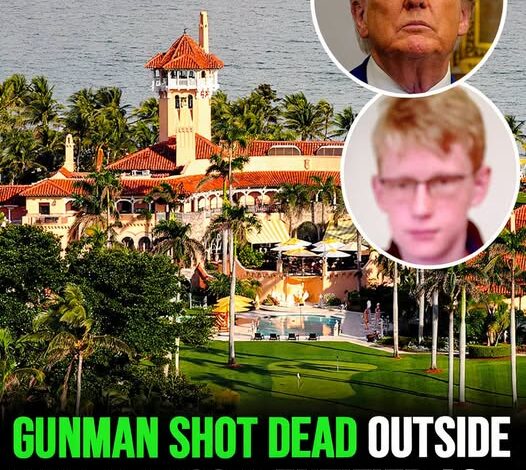
The serenity of the Palm Beach coastline was shattered in the early hours of Sunday morning when a high-stakes security breach at Mar-a-Lago, the private club and residence of Donald Trump, ended in a fatal confrontation. At approximately 1:30 a.m. ET, a 21-year-old intruder, later identified as Austin Tucker Martin, was neutralized by law enforcement after infiltrating the perimeter of the historic estate. The incident has sent shockwaves through the national security community, raising fresh questions about the vulnerabilities of high-profile political residences and the motivations of those who seek to breach them.
The sequence of events began when a sophisticated security alert triggered within the Mar-a-Lago complex, indicating an unauthorized entry near the north gate. Palm Beach County Sheriff Ric Bradshaw, speaking during a press conference later that morning, detailed the rapid response that followed. Two United States Secret Service agents and one sheriff’s deputy immediately converged on the location. There, they encountered a young white male whose equipment suggested a deeply troubling intent: he was armed with a shotgun and carrying a gasoline canister.
The standoff was brief but decisive. According to Sheriff Bradshaw, law enforcement officers issued clear commands for the suspect to drop his gear. While the intruder initially complied by setting down the gasoline can, the situation escalated instantly when he raised the shotgun into a firing position, leveling it toward the officers. Faced with an immediate and lethal threat, the two Secret Service agents and the deputy discharged their service weapons. The suspect was “neutralized” on the spot and pronounced deceased at the scene.
At the time of the breach, the property’s primary resident was not in Florida. Donald Trump was in Washington, D.C., staying at the White House with First Lady Melania Trump. Despite his absence, the breach is being treated with the utmost gravity, given that Mar-a-Lago serves as a “Winter White House” and a hub for international political activity. The estate is not merely a home; it is a sprawling club where wealthy members and global dignitaries often gather, making its security a matter of national interest.
In the hours following the shooting, the identity of the gunman remained a mystery to the public until the Associated Press, citing an anonymous investigative source, identified him as Austin Tucker Martin. Martin, a 21-year-old resident of North Carolina, had recently been the subject of a missing person’s report filed by his family. His journey from the mid-Atlantic to the southern tip of Florida appears to have been a calculated trek. Anthony Guglielmi, a spokesperson for the Secret Service, noted that investigators believe Martin traveled south specifically for this purpose, acquiring the shotgun during his journey. A box for the firearm was subsequently recovered from his vehicle, which was parked near the estate.
The investigation has now shifted from the immediate tactical response to a deep-dive forensic analysis of Martin’s life. The Federal Bureau of Investigation (FBI) has taken a lead role in the inquiry, conducting a comprehensive review of the young man’s digital footprint, recent movements, and personal background. Authorities are scouring his social media accounts, hardware, and personal correspondences to determine what might have driven a 21-year-old with no apparent prior criminal record to storm a fortified political landmark with a shotgun and accelerants.
Currently, Sheriff Bradshaw has stated that there is no definitive evidence suggesting Martin intended to target a specific individual. However, the combination of a firearm and gasoline suggests an intent for significant violence or property destruction. The gasoline canister, in particular, has led to speculation about whether the suspect intended to commit arson within the club’s quarters or the private living areas, which are housed in a separate structure on the grounds.
The White House released a formal statement on Sunday afternoon, extending its gratitude to the Secret Service and the Palm Beach County Sheriff’s Office for their “decisive and professional” actions in preventing further harm. The administration confirmed that all relevant federal agencies are “fully engaged” in a review of the security protocols at Mar-a-Lago. This review is likely to examine how an armed individual was able to gain such significant proximity to the inner perimeter before being intercepted.
This incident is the latest in a series of high-profile security challenges at Mar-a-Lago, a property that presents unique difficulties for the Secret Service due to its dual function as a private home and a public-facing social club. Unlike the White House, which is a government-controlled fortress, Mar-a-Lago’s membership model means there is a constant flow of guests, staff, and vendors. This latest breach by a lone actor from out of state highlights the persistent threat of “lone wolf” style incursions, where individuals may act on personal grievances or radicalized ideologies without being part of a larger, detectable conspiracy.
For the community of Palm Beach, the shooting is a jarring reminder of the geopolitical weight the town carries. Usually known for its quiet luxury and pristine beaches, the area has become a focal point for political protests and heightened surveillance over the last decade. Local residents reported a massive law enforcement presence in the hours following the 1:30 a.m. shooting, with dive teams checking the adjacent Intracoastal Waterway and the Atlantic shoreline to ensure no other intruders were involved.
As the FBI continues its “full review,” the family of Austin Tucker Martin remains at the center of a tragic and confusing narrative. Having reported him missing just days earlier, they are now left to reconcile the person they knew with the armed man who met a violent end at the gates of a presidential estate. Such cases often reveal a pattern of deteriorating mental health or sudden radicalization, though authorities have cautioned against drawing early conclusions until the digital analysis is complete.
The investigation remains highly active. While the immediate threat was “neutralized,” the broader implications for domestic security and the protection of political figures remain a top priority for federal law enforcement. The Secret Service is expected to provide further updates as they trace Martin’s exact route from North Carolina to Florida and determine if he had any contact with other individuals who may have encouraged his actions.
In the meantime, the gates of Mar-a-Lago remain heavily guarded, and the quiet of the Florida night has returned—though it is now shadowed by the memory of a 21-year-old who traveled across state lines to find a final, fatal confrontation in the dark. The incident serves as a stark testament to the vigilance required to protect the nation’s leadership and the unpredictable nature of those who choose to challenge the boundaries of that protection.