Jeep plows into Amish buggy near Berne, father airlifted, multiple children!
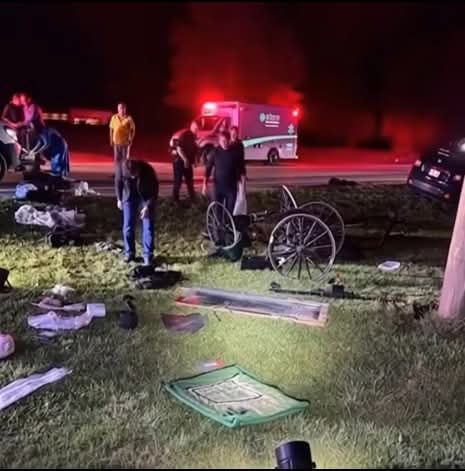
On a desolate stretch of State Road 218 near the outskirts of Berne, Indiana, the profound quiet of the rural landscape was shattered by a collision that serves as a grim metaphor for the friction between tradition and modernity. Late at night, under a sky devoid of urban light, a way of life that has remained steadfast for centuries collided with the high-velocity realities of the 21st century. A Jeep, traveling at highway speeds, plowed into the rear of an Amish buggy carrying nine occupants. The impact was not merely a vehicular accident; it was a violent disintegration of wood, glass, and bone. In an instant, a family’s rhythmic ride home was transformed into a chaotic scene of wreckage, where the steady clip-clop of horse hooves was replaced by the deafening roar of helicopter rotors and the harsh, artificial glare of emergency floodlights cutting through the Indiana dark.
The aftermath of the crash revealed a heartbreaking census of the vulnerable. Of the nine passengers huddled within the fragile wooden carriage, seven were injured. The majority were children, whose lives are now defined by a “before” and an “after” marked by this singular moment of trauma. The father, the pillar of the household, had to be airlifted from the scene, his condition a focal point of anxiety for a community that measures its strength through its interconnected families. As first responders worked to stabilize the wounded, the wreckage of the buggy lay strewn across the asphalt—shards of timber and twisted metal standing as a testament to the lopsided physics of a collision between a two-ton SUV and a horse-drawn vehicle.
The Forensic Search for Answers
As investigators from the local sheriff’s department began the somber task of reconstructing the event, the focus turned toward the driver of the Jeep. In 2026, even in the most remote corners of the country, the legal protocols following such a catastrophe are rigid. Blood tests were ordered to determine if impairment played a role in the driver’s failure to perceive the slow-moving vehicle ahead. While the results of those tests are pending, the broader question of “why” lingers over the community like a heavy fog. Was it a moment of distracted driving, a blink of an eye lost to a smartphone screen, or simply the inherent danger of a road designed for steel and speed being shared by flesh and wood?
The investigation will likely delve into the visibility of the buggy. State laws frequently require Amish carriages to be equipped with lanterns, battery-operated flashing lights, and reflective tape. However, at sixty miles per hour, the closing speed between a car and a horse-drawn carriage is so rapid that a driver has only seconds to react once a buggy enters their headlights’ reach. This “recognition gap” is a lethal reality of rural infrastructure where the 19th and 21st centuries occupy the same lane.
A Community Under Pressure
For the Amish community of Berne, this tragedy is far more than a headline or a police report; it is a visceral reminder of the daily gamble they take to maintain their religious and cultural identity. The Amish do not shun technology because they believe it is evil, but because they prioritize “Ordnung”—a set of rules designed to keep the community together and prevent the outside world from eroding their social fabric. Foregoing the automobile is a central tenet of this belief, a way to ensure that life remains local, slow, and centered on the church and the farm.
However, as the “English” (the Amish term for the non-Amish population) continue to expand into rural areas, the roads that once felt like quiet country lanes have become high-speed arteries for commuters and freight. Every trip to the market, every visit to a neighbor, and every journey home from a church gathering is now shadowed by the memory of this crash. The community must now navigate the agonizing tension between their desire for separation and the physical reality of a world that is moving faster every year. The “violent moment” on State Road 218 has forced a fresh conversation about safety, visibility, and the right to the road.
The Logistics of Survival: Modern Medicine and Traditional Faith
The irony of such accidents is often found in the rescue. While the Amish live a life largely detached from modern technology, they are frequently saved by its most advanced iterations. The sight of a father being airlifted by a sophisticated medical helicopter highlights the complex relationship the Amish have with the modern world. They are a people who value self-sufficiency, yet in the face of such overwhelming trauma, they rely on the skill of trauma surgeons and the speed of flight nurses.
The recovery process for the seven injured individuals will be a long and arduous journey, supported by a community that is uniquely equipped for such trials. In Berne, the concept of “bearing one another’s burdens” is not a metaphor. While the children heal from their physical wounds, the community will rally to manage their farms, provide meals, and cover the staggering costs of modern intensive care. This collective resilience is the Amish answer to the unpredictability of life, a social safety net that remains one of the most robust in the modern world.
Re-evaluating the Shared Roadway
As we look toward the remainder of 2026, the collision near Berne serves as a call for a re-evaluation of rural road safety. In states with high Amish populations, such as Indiana, Ohio, and Pennsylvania, there is an ongoing struggle to modernize infrastructure without alienating the traditional communities that define the landscape. Some counties have experimented with wider shoulders specifically for buggy traffic or increased signage to alert drivers to the presence of horse-drawn vehicles.
Yet, infrastructure can only do so much. The ultimate factor remains the awareness and empathy of the driver behind the wheel of the modern machine. The Jeep plowing into the buggy is a tragedy of perception—the modern world moving so fast and with such distraction that it fails to see the ancient world right in front of it. It is a reminder that the privilege of speed carries with it the heavy responsibility of vigilance.
A Legacy of Resilience
In the end, the wreckage on State Road 218 will be cleared. The timber will be hauled away, and the glass will be swept from the asphalt. But the psychological impact on the Berne community will endure for generations. The children who survived will grow up with a heightened sense of the road’s danger, their quiet lives forever changed by the night the sirens came.
The story of the Berne crash is a story of a collision between two incompatible speeds of life. It is a somber reflection on the cost of maintaining a traditional identity in a world that prizes velocity above all else. As the father fights for his life and his children begin the slow process of healing, the Amish community continues to move forward, one clip-clop at a time, refusing to let the violence of the modern world diminish their commitment to a life of faith, family, and extraordinary, rooted love.