In the courtroom, my mother-in-law attacked me, certain victory was hers, She never noticed the judges cold stare – not until the gavel dropped and she realized he was my father, Too late to take back a single word
They say you don’t just marry a man—you marry his family. For me, that wasn’t a cliché. It was a sentence, stamped and sealed by a woman who believed the world rotated around her mink-covered shoulders.
The hallway outside Courtroom 402 reeked of floor wax, wet coats, and stress. Chicago’s sleet hammered the windows in cold, miserable sheets. I sat on the wooden bench, hands clasped together so tightly my knuckles went white, trying to look smaller than I felt.
Janice, my overworked, underpaid public defender, rifled through her files with a sigh that had decades of burnout behind it. “Judge Henderson usually handles these cases,” she muttered. “He’s decent. He likes stability, though—so we need to lean hard into you being the constant in Leo’s life. Not the money. The mother.”
I nodded, swallowing the anxiety rising in my throat. My thrift-store navy blazer felt too tight. My heels were scuffed. I wasn’t dressed for war, but war didn’t care.
The elevator doors opened with a cheery ding that felt like an insult. The air shifted. Everyone felt the pressure drop.
Patricia Vanderhovven walked out.
She moved like royalty inspecting her kingdom—black mink coat, diamonds that could blind a small city, sunglasses still on indoors. Beside her stood my estranged husband, Richard, chin tucked, gaze glued to the floor. And then came Arthur Pearson, “The Butcher,” a lawyer who didn’t just win—he obliterated.
Patricia stopped in front of me, peeled off her sunglasses, and gave me the kind of look you reserve for something stuck to your shoe.
“You still have time to sign the papers,” she said sweetly. “Spare yourself the humiliation, dear. You look exhausted.”
“I’m not giving up my son,” I whispered.
“Have it your way.”
The bailiff opened the courtroom doors. We filed in, sat down, braced ourselves.
Then the bailiff’s voice shifted.
“Presiding today… the Honorable Justice William Sterling.”
My heart slammed against my ribs.
No. Impossible.
But the door behind the bench opened, and there he was—my father. Older, grayer, harder. The Chief Justice of the Illinois Supreme Court. A man who never touched family court. A man I hadn’t spoken to in seven years.
He took his seat with slow, deliberate authority. “Please be seated.”
He opened the case file.
“Petitioner: Richard Vanderhovven. Respondent: Sarah Jenkins.”
His hand paused on my name.
Our eyes met across the courtroom.
No expression. No recognition. Just the steel gaze of a man who had buried the idea of a daughter long ago.
“Proceed,” he said.
Pearson strutted forward like he owned the room. “Your Honor, we are here to rescue a child. My client provides comfort, safety, stability. Ms. Jenkins, on the other hand, is financially unstable, emotionally unpredictable, and raising the child in… frankly, squalor.”
He slammed oversized photographs onto an easel—a messy kitchen mid-dinner prep, a blown-up shot of me sitting at a park bench while Leo played three feet away.
“Neglect,” Pearson declared. “Depression. Dangerous conditions.”
Janice objected. Sterling sustained it without emotion.
Then came Patricia. She painted herself as a saint, me as an ungrateful, uncultured burden. She lied easily, confidently—about me screaming, me isolating her son, me sabotaging the Vanderhovven legacy.
When it was my turn, Pearson tore into me like he’d waited his whole life.
“You changed your last name. You cut off your family. You cut off your husband. You have no one. Isn’t that the pattern? Isolation. Instability. You can’t maintain relationships. Why would motherhood be any different?”
Each word landed like a blow.
“And your father?” he pressed. “Alive, local, and absent. Why? Unless you are the problem.”
I felt myself cracking.
“That’s enough,” Sterling said sharply. “Move to your point.”
Pearson smirked, knowing he’d planted the seed.
Finally, Sterling turned to me. “Ms. Jenkins, if you faced a crisis, do you have family you could rely on?”
The question wasn’t procedural. It was personal.
I looked at him and answered honestly.
“Yes. I have a father. A good man. A man of principle. We haven’t spoken in years… because of pride. His and mine. But if my son needed him—he would come. Because he hates injustice.”
A flicker crossed his eyes. Pain. Regret. Something old and broken.
He dismissed me quietly.
Both sides rested.
Sterling closed the file. “I’ve heard enough.”
Patricia leaned back with a victorious smirk.
“The court finds the petitioner financially capable, yet utterly lacking in spine.” Richard shrank. “The court finds the paternal grandmother to be the driving force behind this toxic litigation.”
Patricia’s smirk faltered.
“Custody will remain with Ms. Jenkins pending conditions—”
“What?!” Patricia burst out.
Sterling ignored her. “She will have thirty days to secure stable employment and housing. If she does, she will receive full custody.”
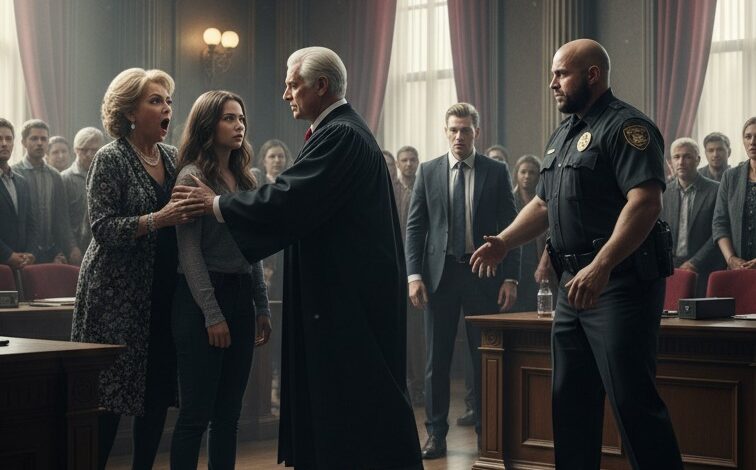
Patricia stood and pointed at him. “Do you know who we ARE? My husband funds half this courthouse! This is biased—this is emotional—this is corruption—did she SLEEP with you?”
The courtroom inhaled sharply.
Sterling rose from the bench like a storm.
“Bailiff,” he said, voice like ice cracking. “Take her into custody.”
Patricia scoffed. “You can’t arrest me. It’s a family court!”
She turned toward me, eyes wild. “You little parasite. You manipulated him—”
She struck me across the face so hard my vision blurred.
Silence. Absolute silence.
Then—
Sterling’s chair scraped back. Every hair on my arms rose.
He descended the steps.
He wasn’t the Chief Justice.
He was a father.
“Arrest. That. Woman.”
Patricia stumbled backward. “I didn’t know! I didn’t know who she—who she—”
Sterling stepped between us, towering, trembling with fury.
“You assaulted a litigant,” he said. “You assaulted a woman under court protection.”
“She’s nothing!” Patricia screamed.
He leaned down, eyes burning.
“She is my daughter.”
The room collapsed into chaos.
Bailiffs swarmed her. Cameras rolled. Richard went pale. Pearson nearly dropped his briefcase.
And my father—my impossible, unreachable father—stood in front of me like a wall of iron, breathing hard, shaking with the effort of not tearing Patricia apart himself.
He cupped my bruised cheek with one shaking hand.
“Sarah,” he whispered. “My God. I’m so sorry.”
Later, in his private chambers, after medics iced my face and the courtroom emptied, he sat across from me—older, smaller, human.
“I watched you fight for your son today,” he said quietly. “You’re stronger than I ever was. I was proud. And ashamed. All at once.”
I swallowed the lump in my throat. “I thought you didn’t want me anymore.”
He blinked hard. “There was never a day I didn’t.” He pulled a photograph from his wallet—me with Leo in the park, taken years ago. “I checked on you often. I just didn’t know how to come back without admitting I was wrong.”
I laughed through tears. “You? Wrong? Impossible.”
He smiled sadly. “I’m wrong constantly. But I hope I’m not too late.”
Three months later, Leo sat in his high chair at my father’s long dining table, smashing peas into his face while the Chief Justice of Illinois wiped pea mush off his tie.
We’d rebuilt slowly—no grand speeches, no dramatic reconciliations. Just dinners. Visits. Laughs. Healing in the small, imperfect ways that matter.
I had a new job. A new home. Full custody. Stability.
And a father.
Leo hurled another pea. It bounced off my dad’s forehead.
My father gasped theatrically. “Assaulting a judge?” he muttered. “Jail time.”
Leo giggled.
And for the first time in a long time, I felt safe.
I walked into that courtroom a woman outnumbered, outspent, and underestimated.
I walked out a Sterling.
And Patricia Vanderhovven learned the hard way: you never slap a stranger in court—because you never know who her father is.