If You Permit, I Will Fix It, No One Could Fix Billionaires Jet Engine Until A Homeless Girl Did!
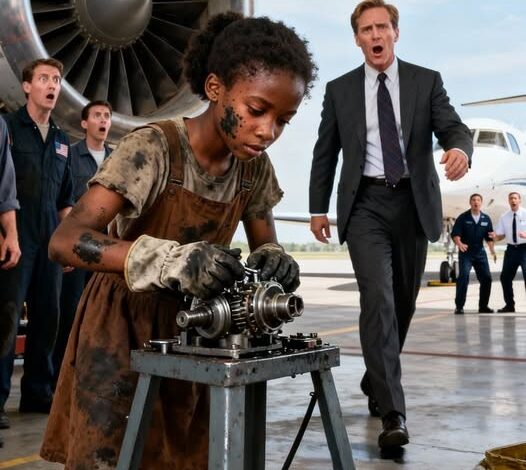
Inside the vast hangar at Lagos Airport, tension hung thicker than jet fuel. A crowd of engineers circled a massive silver jet engine that refused to behave. Tools lay scattered, brows dripped with sweat, and frustration pulsed through the room. Andrew Jacobs, billionaire CEO and owner of the grounded Bombardier Challenger parked outside, checked his watch for the fiftieth time. The engine had failed during landing with a strange whistling sound, and after six hours of work, his best team still couldn’t diagnose the issue. The clock on the wall ticked like a taunt.
Then a voice sliced through the noise, clear and steady:
“If you permit, I will fix it.”
The hangar turned as one. A young woman stood framed in the doorway—thin, dirt-streaked, wearing a torn dress, hair wild from wind and heat. Her feet were bare. Her hands were smudged with grease. She looked like someone who hadn’t eaten properly in days. But her eyes—sharp, bright—locked onto the engine like it was a puzzle she’d already begun solving.
Laughter bubbled from one of the engineers.
“You must be joking,” Sam, the lead technician, said. “We’ve been at this for six hours. Who let her in?”
Security started toward her. But Andrew lifted his hand.
“Let her speak,” he said quietly.
The guards froze. The girl stepped forward.
“I heard your team mention a whistle during landing,” she said, eyes never leaving the engine. “And rough spool-up after shutdown.”
Sam stiffened. “That is what happened.”
“May I look?” she asked.
Her voice wasn’t timid—it was focused. It was the voice of someone who understood metal the way others understood music.
Andrew nodded. “Give her gloves.”
A ripple of shock moved through the hangar, but someone handed her a fresh pair of gray gloves. Her hands trembled for a moment as she pulled them on, then steadied completely as she approached the engine.
She inspected the intake, brushed her fingertips lightly across the wiring harness, listened to the metal as if expecting it to whisper back. Then she crouched by a small panel near the compressor and tapped it gently.
“There,” she murmured. “This clamp is in the wrong groove. Tight—but wrong. It causes a tiny air leak. Under load, the leak sings like a whistle.”
The engineers blinked.
“And here—” she traced a wire “—the insulation has a hairline crack. It’s been rubbing on the bracket. When it heats up, it sends false signals. The system tries to correct, and the engine runs rough.”
Sam’s jaw dropped. “How did we miss that?”
“Because each problem hides the other,” she said. “Fix only one, and trouble remains.”
Andrew stepped closer. “Can you fix it?”
She looked up at him, then at the tools. “If you permit.”
“Do it,” he said.
The room shifted. Doubt turned into curiosity. The girl’s hands moved confidently—resetting the clamp, trimming and rewrapping the wire, securing everything with precise, practiced motions. She checked her work twice, then a third time.
“I’m done,” she said at last.
The hangar fell silent. Sam swallowed hard. “We’ll test it.”
“Roll it out,” Andrew commanded.
The engine was moved onto the tarmac. Wires were connected. Safety cones placed. Warning lights spun. The air felt electric.
Andrew stood at the control panel, glanced back at the girl, then pressed the starter.
The engine whined, spinning faster, louder—until a sharp alarm beeped and a red warning light flashed.
“It’s overheating!” Sam shouted. “Shut it—”
“Don’t!” the girl called out, stepping forward. “Let it run!”
Sam gaped at her. “Are you crazy? That signal means—”
“It’s the sensor recalibrating,” she said firmly. “I rewired it. The system needs a moment.”
Andrew held the switch. The whine steadied. The red light blinked… blinked… then faded to green. The engine’s roar smoothed into flawless power.
Gasps swept the hangar.
Sam stared at her in disbelief. “Impossible.”
Andrew turned toward her. “What is your name?”
Tears glistened in her eyes as she whispered, “Olivia Williams.”
Recognition rippled through the engineers.
“Williams… from Nigeria Aerospace University?”
“The prodigy?”
“The top of her class—then disappeared?”
Andrew’s gaze softened. “Explain.”
And Olivia told her story—her parents’ deaths, the shock that shattered her life, the job she abandoned, the dreams she buried, and how she ended up on the streets. She spoke quietly, but her honesty shook the room.
“I lost everything,” she said. “But I never stopped loving engines.”
The hangar remained still, humbled.
Andrew placed a firm hand on her shoulder.
“You didn’t just fix my engine,” he said. “You reminded me why second chances matter.”
He turned to his staff. “Remember this moment. Greatness doesn’t wear a suit. Greatness walks in when you don’t expect it.”
Then he faced her again.
“Olivia Williams—from today forward, you will never go hungry, never sleep on the streets, never be dismissed again. You fly with me to London. I will introduce you to every executive I know.”
The engineers erupted in applause. Olivia covered her mouth, overwhelmed.
Hours later, she boarded the private jet she had restored. Andrew watched her from across the cabin—her torn dress replaced by a gold gown, her hair clean and neatly tied, her eyes shining with a hope she had almost forgotten.
“You look like destiny,” he murmured.
In London, she stunned the JJ Jet Maintenance board with her knowledge. She diagnosed a random engine failure on the spot, leaving seasoned executives speechless. When they offered her the head role of their largest African branch, she accepted with tears in her eyes.
Returning to Lagos, she faced skepticism, especially from Regional Director Adawale. But after diagnosing and fixing a major client’s Gulfstream engine in record time, even her critics were forced to respect her.
And something else began—something unexpected.
Andrew’s son, Jerry, recently back from London, took one look at Olivia and saw more than genius. He saw strength. He saw heart. He saw the woman who had pulled herself out of the ashes.
Their late-night talks grew into something deeper.
Their teamwork into something stronger.
Their admiration into love.
One night, on a balcony overlooking the Lagos skyline, Jerry knelt.
“Olivia… you fixed more than engines. You fixed us. Marry me.”
Her yes came through tears.
Their wedding stopped Lagos in its tracks—engineers, executives, and even presidents attended. Andrew walked her down the aisle, whispering, “You’re my daughter now. You saved my family.”
A year later, she held her newborn son—Jonathan—in her arms. Andrew cried as he cradled his grandson.
“You were once a girl in rags,” he whispered. “Now you’re the woman who changed all our lives.”
Olivia looked at the baby, then at the man who had given her a second chance, and smiled.
She had fixed an engine.
Then she fixed a company.
Then she fixed a family.
And in the process, she rebuilt herself.