I Helped a Lost Grandmother on My Night Shift – the Next Morning, Her Daughter Handed Me a Shoebox and Said, This Is Going to Change Your Life
For over a decade, my life has been defined by the sharp contrast of the night shift. As a police officer, you learn to navigate the city when it is at its most vulnerable, responding to the “weird” and the “suspicious” while the rest of the world sleeps. But one 3:00 a.m. call pulled a thread that unraveled my entire identity. I was thirty-seven years old, a seasoned cop with thirteen years on the force, yet I was still the same boy who had been shuffled through the foster care system in a series of anonymous trash bags. I was adopted at the age of eight by Mark and Lisa, a couple who achieved the impossible: they loved me with a fierce, uncomplicated devotion that never felt like a charity project. Mark taught me to be a man of integrity, and Lisa was the constant presence in the front row of every school play. Despite their love, my origin story was a ledger of missing pages and “agency dissolved” notices. I became a cop to be the person who shows up, mostly because, in my own history, someone hadn’t.
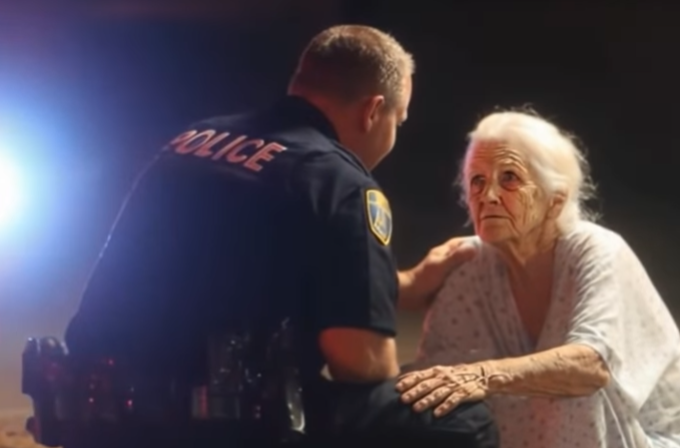
The call was routine: a “suspicious person” wandering a quiet, affluent neighborhood. I rolled up in my cruiser expecting a prowler or a trespasser. Instead, the pool of light from a buzzing streetlamp revealed an elderly woman standing barefoot in a thin cotton nightgown. She was shivering so violently her knees were buckling. When my lights hit her, she flinched as if the glare were a physical blow. She looked through me with eyes clouded by time and terror, whispering, “Please don’t take me. I didn’t mean to.”
I killed the strobes immediately. I stepped out, sat on the curb to diminish my silhouette, and wrapped my jacket around her frail shoulders. Her hands were like ice, gripping my sleeve as if it were the only anchor left in a world that had turned to fog. She cried about a home she couldn’t find—a home that likely hadn’t existed for forty years. Through her tears, she kept repeating one name like a frantic prayer: “Cal… Cal… I’m sorry, Cal.” My name isn’t Cal, but the way she said it felt like a ghost touching my skin.
Her daughter, Tara, arrived shortly after, looking like a woman held together by adrenaline and sheer panic. As they guided the old woman, Evelyn, toward the ambulance, the fog in her mind seemed to lift for one crystalline second. She locked her eyes onto mine and said with heartbreaking clarity, “Don’t leave him. Not again.” Then she was gone, disappearing into the dark of the ambulance.
I went home, but the encounter wouldn’t let me sleep. It felt less like a police report and more like a collision. At 10:00 a.m., a knock at my door revealed Tara. She was clutching a shoebox to her chest, her eyes rimmed with red. “This is going to sound insane,” she said, “but my mother spent all morning crying for you. And then I found this.” She set the box on my kitchen table and pulled out a thin, yellowed folder—records she had received by mistake while trying to organize her mother’s memory care paperwork.
Inside was a hospital intake sheet from 1988. It listed a mother, Evelyn B., and a male infant named Caleb. It was my birth year. Tara then pulled out a stack of envelopes addressed to “Caleb B.” with “Return to Sender” stamped across them in fading red ink. My breath hitched. Tara looked at me with a mixture of hope and terror. “My mother had a son before me,” she whispered. “Nobody talks about him. I thought he died. But last night, she called you ‘Cal’ before you even said your name.”
I tried to be the rational officer. I denied it. I called it a coincidence, a clerical error, a trick of the mind. But when Tara left the box with me, the silence in my apartment felt heavy with the weight of thirty lost years. I called Lisa, my adoptive mother, and asked the question I had long ago stopped asking. “We were told your mother signed the papers,” she said softly, her voice trembling. “We were told she didn’t want you, that there was no one left.”
Tara and I didn’t want to live in the shadows of “maybe.” We ordered DNA tests. For a week, I stood in front of my bathroom mirror, looking for Evelyn’s eyes in my own reflection. I began to remember fragments I had suppressed: the scent of cigarette smoke, a door slamming, and a woman humming a melody that had lived in the back of my mind like a half-remembered dream. When the notification finally buzzed on my phone, the world went still. The report sat at the top of the “Close Family” list: Tara B. – Sister.
We met in a park on neutral ground. Tara was already crying when she handed me her phone to see the match. I sat on a bench and felt my legs turn to rubber. I had been a foster kid, a son, and a cop—but suddenly, I was Caleb. We went to see Evelyn that same afternoon. She was in her recliner, the afternoon sun casting long shadows across her lap. Tara knelt beside her and asked, “Mom, remember Cal?”
Evelyn turned her head slowly. For a long moment, there was no recognition. Then, her face folded in on itself, and the tears that had been dammed up for three decades finally broke. “Caleb?” she whispered. I took her hand—the same cold, thin hand I had held under the streetlamp. “I’m here,” I said, my own voice cracking. “I’m right here.”
She began to apologize, her words a jumble of bureaucracy and heartbreak. She told me how she had gone to the offices, how she had signed things she didn’t understand, how they told her I was safe and that she couldn’t see me. I realized then that it wasn’t a story of abandonment, but a story of a system that had found it easier to erase a mother than to help her. As I held her, she began to hum. It was the exact melody from my dreams—the low, rhythmic lullaby of my infancy.
The aftermath was a beautiful, awkward collision of worlds. Mark and Lisa met Tara and Evelyn. There were apologies that nobody quite owed but everyone felt compelled to give. I didn’t replace one family with another; it felt more like my life had been written on two separate pages that were finally taped together. Evelyn’s dementia didn’t vanish, but the sharp, jagged guilt that had defined her illness softened. She stopped being the “suspicious person” wandering the night looking for a lost child. She had found him.
Months later, I was back on the 3:00 a.m. shift. Another call came in: “suspicious person” wandering an alleyway. I pulled up, but this time, I shut off my strobes a block away. I stepped out into the dark, not as an officer looking for a criminal, but as a man who knew that sometimes, the person in the shadows is just someone’s whole world falling apart. I realized that the greatest service I could provide wasn’t just to protect and serve, but to listen for the humming in the dark, making sure no one else gets lost in the spaces between the pages of their own story.