I Found a Lost Wallet at a Mechanics Shop and Returned It, the Next Day, a Sheriff Showed Up at My Door
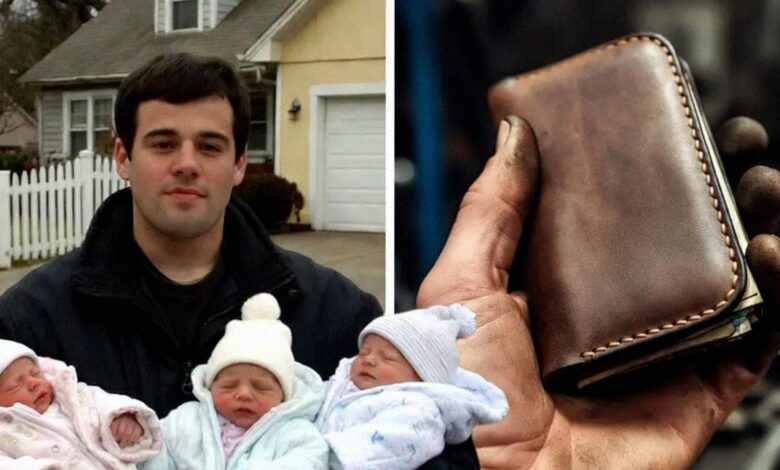
My name is Evan, and my life is defined by the grit under my fingernails and the constant, low-humming anxiety of a man trying to keep a sinking ship afloat. I’ve been a mechanic for as long as I’ve been an adult, working out of a dilapidated shop where the oil stains are permanent and the air smells of exhaust and old coffee. At thirty-six, I’m also a single father to six-year-old triplets. Their mother walked out when they were still in diapers, leaving me with a suitcase of heartache and three tiny lives to protect. My seventy-two-year-old mother moved in to help, and between her wisdom and my long hours at the bay, we manage to survive—barely.
Last Tuesday was a gauntlet. The shop was overbooked, my joints ached, and a customer had spent ten minutes jabbing a finger into my chest, blaming me for an emissions failure he hadn’t authorized me to fix. By the time closing rolled around, I was physically and mentally spent. As I was pushing a broom under one of the hydraulic lifts, the bristles snagged on something heavy. I reached down and pulled out a worn black leather wallet. When I flipped it open, the breath left my lungs. It wasn’t just a few cards; it was stuffed with thick, crisp stacks of hundred-dollar bills.
In that silence, the numbers began to run through my head like a fever dream. Rent was due in forty-eight hours. The electric company had already sent the second notice. My daughter was currently walking on the cardboard inserts I’d put in her shoes because the soles had worn through. That money was a lifeline. It was a year of breathing room. But then I saw the ID: an elderly man named Gary, his face etched with the kind of lines only seven decades of life can produce. Tucked behind the license was a handwritten emergency contact note.
I locked the wallet in my toolbox, finished my shift, and drove home in a daze. After a dinner of spaghetti and putting the kids to bed, the weight of the wallet in my garage felt like a lead weight on my soul. I told my mom I had an errand to run, grabbed the leather pouch, and drove to the outskirts of town. I found a small, modest home with a flickering television visible through the curtains. My heart hammered against my ribs as I walked to the porch—not because I was afraid of Gary, but because I was afraid of the part of me that had considered keeping it.
When Gary opened the door, leaning heavily on a wooden cane, I simply held the wallet out. His reaction was immediate; his shoulders sagged, and his eyes filled with a watery relief. He explained it was his entire pension, a sum he’d withdrawn for a specific purpose and thought was lost to the grease and shadows of the shop. He tried to press a hundred-dollar bill into my hand, but I couldn’t take it. Returning it wasn’t about a transaction; it was about being able to look my children in the eye the next morning. I told him I was just a dad doing his best, mentioned my “dull yellow house” near the main road when he asked where I lived, and drove home feeling a lightness I hadn’t felt in months.
The next morning, the peace was shattered by a thunderous knocking at 7:30 A.M. When I opened the door, my heart plummeted. Standing on my porch was a sheriff in full uniform, his badge glinting in the morning sun. Behind me, my mother gasped, her hand flying to her throat. My immediate thought wasn’t that I’d done something wrong, but a primal fear for my children’s stability. If I was being taken away, who would take care of them?
The officer, Sheriff Matt, asked to come inside. He was stern, his eyes scanning our humble living room. He asked if I had found a wallet and if I had returned it to a man named Gary. I confirmed everything, my voice shaking as I explained I’d refused the reward. Matt’s expression finally softened, though he remained professional. He stepped to the door and signaled his colleagues. “Yeah, it’s him,” he said into his radio. “Bring it all in.”
To my bewilderment, three more officers entered, hauling massive, heavy boxes. Matt explained that Gary was his father. When the Sheriff had come home from his night shift, he found his father moved to tears by the honesty of a “greasy-handed mechanic” who refused a reward despite clearly struggling. Gary had insisted his son use his resources to find the yellow house and return the favor in a way I couldn’t refuse.
As the officers opened the boxes, my living room was transformed. There were brand-new winter coats in three different sizes, sturdy shoes, backpacks filled with school supplies, and bags upon bags of high-quality groceries. Matt handed me an envelope containing gift cards for gas and more food—a year’s worth of security for my family. My mother began to sob as she touched the soft fabric of the new clothes, realizing that for the first time in years, she wouldn’t have to choose between a full pantry and warm jackets for the children.
I tried to protest, the pride of a working man prickling at the back of my neck, but Matt stopped me with a firm hand on my shoulder. He told me that most people wouldn’t have driven across town in the dark to return a fortune. He told me my kids were lucky to have a father who valued integrity over a quick fix. After they left, I sat on the sofa amidst the boxes and finally let the tears fall. The crushing weight that had been sitting on my chest since my wife left seemed to lift, replaced by a profound realization that honesty is a currency that never devalues.
Later that day, I returned to Gary’s house. I didn’t go to ask for more; I went to tell him that his son had gone overboard. Gary just smiled, a knowing glint in his tired eyes. He told me that by returning his pension, I had given him something much more valuable than money: I had given him proof that the world was still a place worth living in. I shook his hand, feeling the callouses on his palms matching the ones on mine.
That night, as I watched my daughter spin around the kitchen in her new pink coat, I realized that the sheriff’s knock wasn’t a threat to my family—it was the answer to a prayer I’d been too tired to even speak. My hands are still greasy, and the shop is still falling apart, but the “dull yellow house” is now filled with the warmth of a community that looks out for its own. Kindness, I’ve learned, has a way of navigating its way back to you, often through the very doors you were once afraid to open.