I Adopted Four Siblings So They Would Not Be Split Up, A Year Later, a Stranger Showed Up and Revealed the Truth About Their Biological Parents!
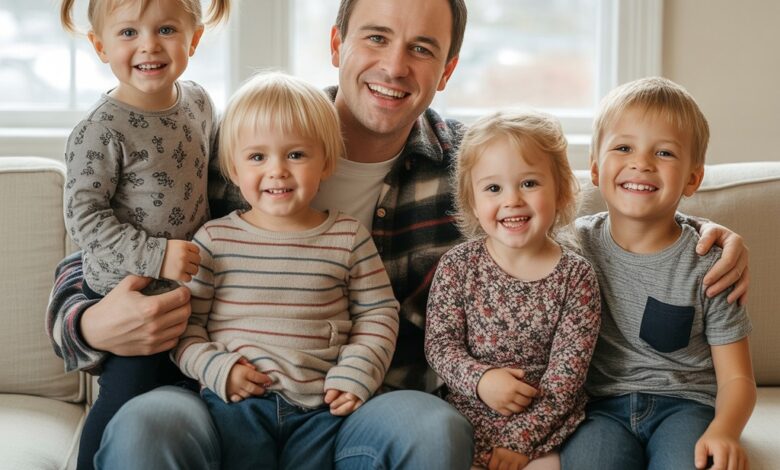
My name is Michael Ross, and for a long time, I believed my life had ended in a sterile hospital corridor at 11:47 PM on a Tuesday night. The doctor’s scrubs were still stained with the blood of my wife, Lauren, and my six-year-old son, Caleb. A drunk driver had obliterated my world in an instant, turning my future into a collection of “what-ifs” and a house that felt more like a museum than a home. For eighteen months, I existed in a state of suspended animation, moving through the motions of an accounting career and coming back to a silence so heavy it felt physical.
Everything changed on a sleepless night in March. While scrolling through a local child services page, I saw a photo that pierced through my numbness. Four siblings—ages three, five, seven, and nine—clung to one another on a wooden bench. Their parents were gone, and the system was preparing to do the unthinkable: split them up because no one would take all four. I saw the protectiveness in the oldest boy’s eyes and the terror in the youngest girl’s grip on her stuffed elephant. I knew that look. It was the look of someone waiting for the world to take the last thing they had left.
The following morning, I called child services. Despite the skepticism of social workers and therapists who wondered if a grieving widower could handle four traumatized children, I stood firm. I didn’t want to replace Lauren and Caleb; I wanted to ensure these children didn’t lose their only remaining anchors. After months of grueling home studies and psychological evaluations, I was granted the adoption. Owen, Tessa, Cole, and Ruby moved into the house that had once been a tomb.
The first year was a chaotic symphony of healing and friction. There were nights when three-year-old Ruby cried for a mother who would never come, and I’d sit on the floor beside her bed until dawn. There were outbursts from five-year-old Cole, who would scream that I wasn’t his “real dad” as a way to test if I would stay. Tessa, seven, remained a wary sentinel, and Owen, nine, carried the weight of the world on his small shoulders. Gradually, the house filled with the sounds of life again—spilled juice boxes, arguments over Legos, and the quiet, nightly “Goodnight, Dad” that Owen eventually began to whisper.
We had been a family for nearly a year when the doorbell rang on a mundane Wednesday morning. Standing on my porch was a woman named Elena Vance, a private investigator with a leather briefcase and an expression that made my pulse skyrocket. I immediately feared a legal loophole or a biological relative coming to undo our progress.
“Mr. Ross, I’m here regarding the biological parents of your children,” she said, her voice grave. “There is information you were never given during the adoption process—information their own parents may not have even known.”
She sat at my kitchen table and opened a file that began to unravel everything I thought I knew about the children’s history. The official story was that the parents, Sarah and David, were ordinary people who had died in a tragic accident. But Elena revealed a darker, more complex truth. Sarah had been the estranged daughter of a tech mogul who had disinherited her years ago for choosing a life of normalcy over the family’s cutthroat business empire.
“The accident that killed them?” Elena leaned in. “The police report called it a mechanical failure leading to a crash. My investigation suggests it was intentional. There was a dormant trust fund worth tens of millions of dollars that was set to vest the moment the children reached adulthood—or, if they died, it would revert to Sarah’s step-siblings.”
I felt a cold shiver. The children I had taken in weren’t just orphans; they were survivors of a conspiracy they didn’t even understand. Elena explained that David and Sarah had gone into hiding, changing their names and cutting off all contact with the outside world to protect their children from the predatory nature of the family they left behind.
“I was hired by Sarah’s mother before she passed away,” Elena continued. “She wanted the truth found, and she wanted the children protected. The people Sarah ran from are still out there, and they’ve been looking for these kids. They didn’t realize an accountant in a quiet suburb had legally bound them to himself before they could interfere.”
The revelation was staggering. I realized that my impulsive decision to keep the siblings together had inadvertently saved them from more than just emotional trauma; I had pulled them out of the path of people who viewed them as obstacles to a fortune.
“What do I do?” I asked, looking at the photos of the children taped to my fridge.
“You keep doing what you’re doing,” Elena replied. “But now we have the resources to fight back. This file contains the evidence to secure the trust in a way that Sarah’s step-family can never touch it. It also includes the names of the people who may have tampered with that car.”
Over the next few months, the “truth” Elena brought changed our lives again, but not in the way I feared. With the legal weight of the trust behind us, I was able to hire the best security and legal counsel to ensure the children’s safety was permanent. The people responsible for Sarah and David’s “accident” were eventually brought to justice through a high-profile investigation that the trust’s resources finally made possible.
But the most important change wasn’t the money or the justice; it was the peace that settled over the kids. When Owen turned ten, I told him the truth about his parents—that they hadn’t just died, they had died protecting them. I told him that they loved their children more than any amount of gold.
A year after the stranger appeared on my porch, I sat in the backyard watching the four of them play. Cole was chasing Ruby through the sprinklers, and Tessa was actually laughing as she helped Owen build a birdhouse. The grief of losing Lauren and Caleb would never fully leave me, but it had transformed into something else—a shared language of survival that I spoke with four children who had also lost everything.
I had set out to save four siblings from being split up, but in the end, the truth of their past revealed that they were the ones who had saved me. I had given them a home, and they had given me a reason to keep the lights on. We were no longer two separate tragedies living under one roof; we were a family, built not on blood or money, but on the stubborn, beautiful choice to stay together.