Homeless boy climbs mansion to save a girl who was freezing to death, her billionaire father saw it all!
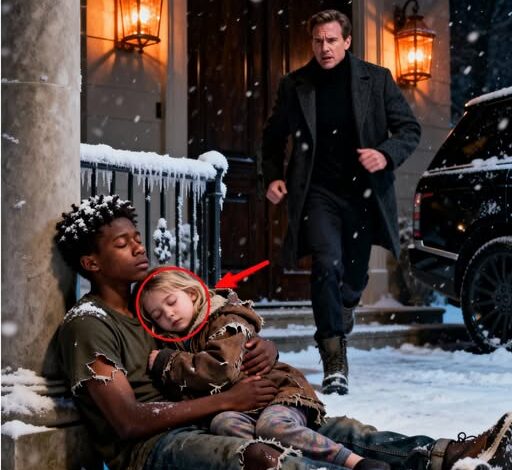
The night Ashford froze was the night everything changed.
Snow fell without pause, thick and heavy, smothering streets, cars, and sidewalks beneath a white silence. The wind howled through alleyways and between buildings, sharp enough to sting bare skin in seconds. People stayed indoors, fires lit, heaters humming, curtains drawn tight against the cold.
Everyone except Leo.
Leo was twelve years old and homeless. He had been that way since his mother died two winters earlier, taken by an illness that came fast and left nothing behind but hospital debt and silence. The foster homes that followed never lasted. He was labeled difficult, withdrawn, ungrateful. Eventually, he stopped trying to stay. The streets, at least, were honest.
That night, Leo walked with his hands shoved deep into the pockets of a jacket far too thin for the weather. His shoes were soaked, his toes numb, his stomach aching with hunger. Every breath burned. He told himself the same thing he told himself every night: just get through this one.
As he passed a quiet, wealthy part of town—iron gates, long driveways, houses half-hidden behind trees—he heard something that didn’t belong in the storm.
A sound. Small. Fragile.
A cry.
Leo stopped. The wind tried to steal it away, but he heard it again—soft sobbing, broken by shivers. He followed the sound along the fence line until he saw her.
A little girl, no older than six, curled against the stone wall of a massive mansion’s garden. She was barefoot. Her pajamas were soaked through, thin cotton clinging to her small frame. Snow dusted her hair and lashes. Her lips were pale blue.
Leo’s heart dropped.
He approached slowly, lowering himself so he wouldn’t scare her. “Hey,” he said gently. “It’s okay. I’m not going to hurt you.”
She looked up at him, eyes glassy, unfocused. “I’m so cold,” she whispered.
“What’s your name?” he asked.
“Emma.”
“I’m Leo.” He swallowed, glancing at the glowing windows of the mansion just a few yards away. “Do you live here?”
She nodded weakly. “Daddy’s inside. I tried to follow the cat. The door closed. I couldn’t open it.”
Leo didn’t hesitate.
He shrugged off his jacket immediately and wrapped it around her, pulling her against his chest. The cold bit into him instantly, sharp and unforgiving, but he ignored it.
“You have to stay awake,” he told her, forcing calm into his voice. “Talk to me, okay?”
She nodded, teeth chattering violently. He rubbed her arms, his fingers stiff and slow. He knew the signs. He’d seen people fall asleep in the cold and not wake up. He wasn’t going to let that happen to her.
The iron fence loomed between them and the house. Leo glanced at it, then back at Emma. He couldn’t leave her. He couldn’t carry her far. And he couldn’t climb with her in his arms.
“I’m going to get help,” he said. “I’ll be right back. I promise.”
She clutched his sleeve. “Don’t leave me.”
“I won’t,” he said, and meant it.
Leo climbed.
The fence scraped his palms and tore at his skin. His fingers barely obeyed him, numb and clumsy. He slipped once, slammed hard against the ground, pain flashing through his knees. He bit down on a cry and pushed himself up.
Inside the garden, he ran to the back door and pounded on it with everything he had.
Nothing.
He ran along the house, banging on windows, shouting hoarsely until his throat burned. Still nothing. Whoever was inside didn’t hear him over the storm.
So Leo ran back.
He knelt beside Emma again, pulled her closer, wrapped himself around her to block the wind. His teeth chattered now too. His vision blurred at the edges. He whispered to her, asking about her favorite cartoons, her school, her toys—anything to keep her talking, anything to keep her awake.
Time stretched, cruel and slow.
Then headlights cut through the snow.
A car turned into the driveway, tires crunching loudly. A man jumped out before the engine fully stopped, panic written across his face.
“Emma!”
Leo tried to stand. His legs buckled.
The man rushed forward and froze when he saw them—a nearly frozen boy clutching his daughter, his own jacket gone, his hands red and raw.
“Oh my God,” the man breathed.
He scooped Emma into his arms, yelling into his phone for emergency services, then turned back to Leo just as the boy collapsed into the snow.
Sirens came fast.
Emma survived.
Leo barely did.
He woke up days later in a hospital bed, wrapped in warmth he didn’t remember earning. His hands were bandaged. His body ached. Machines beeped softly around him.
A man sat beside the bed, eyes red, holding a little girl’s hand.
“Hi,” the man said quietly. “I’m Nathaniel. Emma’s father.”
Emma smiled at Leo, small and bright. “He saved me.”
Nathaniel nodded. “You saved my daughter’s life.”
Leo didn’t know what to say. No one had ever said something like that to him before.
Nathaniel didn’t ask questions right away. He didn’t interrogate. He just stayed. When he did speak again, his voice was steady but emotional.
“You don’t have anywhere to go, do you?”
Leo hesitated, then shook his head.
“Then you do now,” Nathaniel said. “If you want.”
The adjustment wasn’t easy.
Leo flinched at raised voices. He hoarded food. He slept with the light on. He waited for the kindness to disappear. It didn’t.
Nathaniel and his wife, Camille, moved slowly, patiently. Emma never left his side. She laughed easily, loudly, like the world had never taught her to be careful. Slowly, Leo learned to breathe without counting exits.
Spring came. Snow melted. The garden bloomed again.
Leo went to school. He gained weight. He smiled more. At night, he sometimes dreamed of the cold, but when he woke up, there were blankets and a home and people who said his name like it mattered.
The story spread. People called him brave. A hero. The boy who climbed a fence and gave up his coat to save a stranger.
Leo didn’t think of it that way.
He thought of his mother’s voice, soft and firm in his memory.
Life will take a lot from you. But never let it steal your heart.
That night, in the freezing snow, he hadn’t saved Emma because he was fearless or noble. He’d saved her because he knew what it felt like to be cold and alone—and he refused to let someone else feel that way if he could stop it.
Years later, when people asked him how he survived the streets, Leo always said the same thing.
“I didn’t survive them,” he said. “I survived because one night, I chose not to turn away.”
And that choice changed everything.