HOA President Kept Climbing My Fence, So I Installed 10,000 VOLTS!
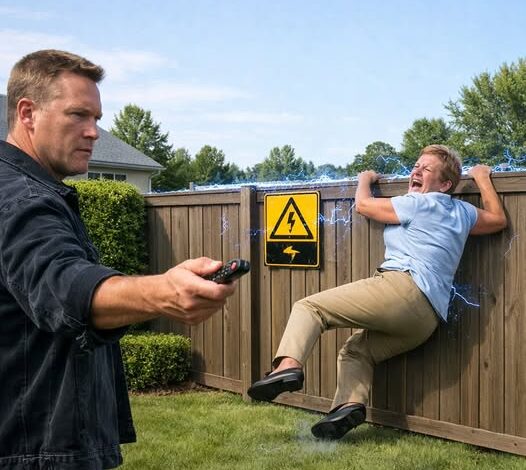
I moved into the neighborhood believing I had finally found peace. A modest house, a clean yard, and the promise of quiet suburban living felt like a reward after years of saving and compromise. The HOA brochure spoke about community values, shared standards, and harmony. What it didn’t mention was how power, when left unchecked, can turn neighbors into adversaries and rules into weapons.
Her name was Linda, and she was the HOA president. From the outside, she looked like efficiency personified—clipboard always in hand, smile sharpened by authority, confidence bordering on entitlement. At first, her attention seemed harmless. A friendly reminder about trash day. A suggestion about lawn height. I ignored the subtle discomfort because I didn’t want conflict. That was my first mistake.
It escalated quickly.
She began appearing on my property without notice, stepping over my fence as if it didn’t exist, inspecting my garden, measuring my lawn, photographing my backyard. She removed my “No Trespassing” signs, claiming they were “unsightly.” When I confronted her, she laughed and reminded me she was the HOA president, as if that title placed her above property law.
I called the police. They told me it was a civil issue. I documented everything. Dates, times, photos, security footage. Still, nothing stopped her. The harassment became psychological. Notices for imaginary violations appeared on my car. Emails flooded my inbox. I stopped feeling safe in my own home.
I realized something critical: politeness was being interpreted as permission.
So I did what any rational person pushed into a corner does. I studied the rules. Not HOA rules—the actual law. State property statutes. Trespassing regulations. Agricultural and livestock protections. That’s when I found it. A legal provision allowing electric livestock fencing for animal protection, provided it met safety and signage requirements.
I didn’t have livestock. Yet.
The next morning, I bought a chicken.
It sounds absurd until you understand the principle. The law doesn’t care about aesthetics or power trips. It cares about definitions. A chicken qualifies as livestock. Livestock qualifies for protective fencing. And protective fencing, when installed correctly, is legal.
I didn’t cut corners. I purchased a professionally rated electric livestock fence energizer, clearly within non-lethal regulatory limits. I installed insulated wiring, grounding rods, and bright warning signs every few feet. “DANGER: ELECTRIC FENCE.” Impossible to miss. Fully compliant. Documented.
The fence didn’t look aggressive. It looked ordinary. Quiet. But it carried a message stronger than any argument I had ever made: boundaries matter.
That night, I waited.
Linda couldn’t help herself. Around eleven, my security cameras picked up movement. There she was, flashlight in hand, climbing toward my fence like she had so many times before. She saw the signs. She ignored them. Authority had made her careless.
The moment her hand touched the wire, the night cracked with sound. A flash. A scream. She was thrown backward, shocked not just by electricity, but by consequence. I didn’t touch her. I didn’t confront her. I stayed inside and called emergency services to report an injured trespasser.
When the police arrived, the scene spoke for itself. Warning signs. Legal installation. Security footage of repeated trespassing. Linda’s hysteria collapsed under evidence. The officers cited her for trespassing and made it clear that her HOA position gave her zero immunity.
The story spread fast. Neighborhood group chats exploded. Videos circulated. The bully had been exposed, not by aggression, but by preparation.
But it didn’t end there.
Days later, another HOA representative arrived, attempting intimidation under the guise of “community safety.” He hinted at fines, permits, and legal pressure. I smiled and handed him my attorney’s card. I had already retained a property rights lawyer specializing in HOA overreach and homeowner legal protection.
The HOA filed a complaint anyway, claiming the fence was a public nuisance. We went to a zoning hearing. I brought documentation, video evidence, police reports, and statutory references. Linda tried to interrupt. She was shut down. The board ruled in my favor unanimously. The HOA was formally warned against further harassment.
The aftermath was quiet in the best possible way.
Linda stopped showing up. The HOA notices vanished. Neighbors who had quietly suffered similar treatment began thanking me. Some admitted they had felt trapped for years, afraid of fines, retaliation, or social exclusion. Standing up once shifted the entire balance.
The fence remained, humming softly, a symbol not of hostility, but of reclaimed autonomy. My chicken—Cluckers—scratched happily in the yard, blissfully unaware she had become the most unlikely legal safeguard in the neighborhood.
This was never about revenge. It was about personal sovereignty, homeowner rights, and the legal reality that power collapses when challenged with facts. HOA abuse thrives on intimidation and ignorance. It fails under scrutiny.
I learned that peace doesn’t come from compliance with bullies. It comes from understanding your rights and enforcing them calmly, legally, and without apology. Boundaries are not aggressive. They are essential.
In the end, the electric fence didn’t change my neighborhood. It revealed it.
And that made all the difference.