Her Husband Froze to Death, So She Hid 600 Pounds of Food Beneath Her Floorboards!
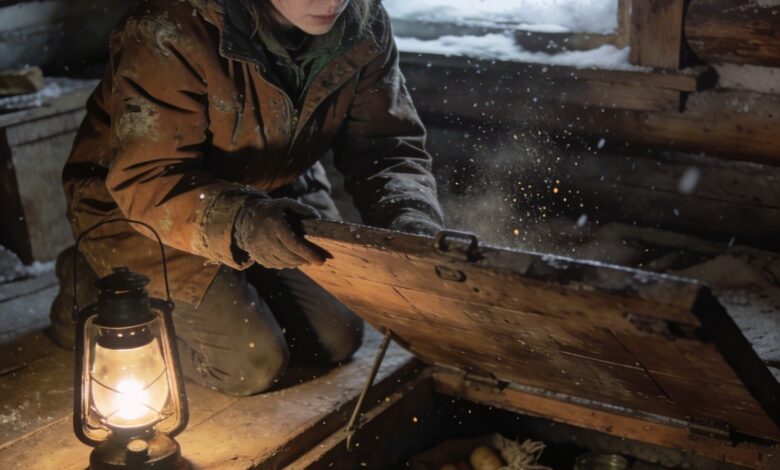
The winter arrives early the year your husband dies.
It doesn’t come like a season slipping quietly into place. It comes like a judgment, sudden and absolute. One week, the valley still smells of damp earth and pine resin, the ground soft beneath your boots. The next, everything is buried under a silence so complete it feels like the world itself has been sealed shut.
You live in a small cabin at the edge of the northern woods, where the trees stand tall and dark like silent witnesses. The floor creaks with every step. The iron stove complains when the wind turns against it. At night, the roof groans under the growing weight of snow.
For years, that life was enough.
It was enough because Tomás was there.
He had the kind of hands that could fix anything—leather, wood, metal, even moods. He could split wood in half a dozen strokes, calm a restless animal with a word, and still touch your face like it was something fragile and worth protecting. He believed a home wasn’t measured in walls, but in what lived inside them—food stored away, fire burning steady, and two people stubborn enough to face winter together.
Then one afternoon in November, he prepares the sled.
You stand in the doorway, shawl wrapped tight, watching him secure the empty sacks. The sky is low, heavy, pressing down over the valley. Even the horse shifts uneasily.
“You can wait,” you say. “Go in the morning.”
He smiles, that calm, steady smile that always made you feel like everything would work out.
“If I wait,” he says, “we’ll be left with whatever’s picked over. No flour worth buying. No medicine.”
“The storm feels wrong.”
He steps closer, brushing frost from his beard, his gloved hand warm against your cheek.
“Every storm feels wrong if you stare at it too long.”
You grab his wrist before he can step away.
“Stay.”
For a second, something changes in his expression. A hesitation. A possibility.
Then it’s gone.
“I’ll be back before dark,” he says.
He kisses your forehead, climbs onto the sled, and disappears into the trees.
You stand there longer than you should, hand on the doorframe, as if staying still might somehow call him back.
But he doesn’t come back.
The storm arrives fast and without mercy.
By midday, the valley is swallowed. By night, the wind is hammering against the cabin like something alive, clawing at the walls, trying to break in. You feed the stove constantly, watching your wood supply shrink, listening for any sign of him outside.
You don’t sleep. Not really.
Every sound becomes something else. Every gust of wind becomes a sled. Every creak becomes a voice.
Morning comes, but there’s no path outside. Another day passes. Then another.
When the storm finally breaks, the world is still—but wrong.
The men from town go out to search.
They find the sled first. Then they find him.
Half-covered in snow. Too far from home.
The cold took him before he could make it back.
When they come to your door, you already know.
You don’t cry.
You just stand there, looking past them, waiting for something that doesn’t happen.
The burial is quick. It has to be.
The ground is too hard. The air too cold. Words don’t carry far in that kind of silence. You watch the pine box disappear into the earth and think about how a man who once filled every space now fits into something so small.
Afterward, people bring food. Kind words. Promises they don’t know how to keep.
If you need anything.
We’re just down the road.
You thank them.
Because that’s what you’re supposed to do.
That night, alone in the cabin, you sit by the stove and think.
Not about grief.
About survival.
You count what’s left. Flour. Meat. Potatoes. Preserved jars. Enough for one person, maybe. Not enough for a long winter. Not enough if you plan to help the others who depended on Tomás.
Because you know something they don’t.
This winter isn’t normal.
It’s going to last.
And it’s going to break people.
Your eyes move to the floor.
You remember something Tomás said months ago, kneeling by a loose board.
“If things go bad,” he said, “remember—what’s above ground can be taken.”
At the time, it sounded like a passing thought.
Now it feels like instruction.
By morning, you begin.
You dig beneath your own home.
The ground is frozen, stubborn, refusing to give way. You work anyway. With shovel, with pick, with bare hands when nothing else fits. The cold cuts through your sleeves. Your skin splits. Your muscles burn.
You don’t stop.
For three days, you dig.
When the pit is ready, you line it carefully, protecting it from damp and rot. Then you start moving the food.
One sack at a time.
Potatoes. Beans. Flour. Meat.
You leave just enough upstairs to look ordinary. Just enough that no one would think twice.
When you’re done, you seal it all beneath the floorboards.
Hidden.
Protected.
Yours—and not yours.
Because survival isn’t just about you.
Five days later, there’s a knock.
Ezra Pike stands at your door, smiling like he’s doing you a favor.
“Heard you might need help,” he says, eyes scanning past you.
You don’t open the door wider.
“I’m managing.”
His smile doesn’t reach his eyes.
“Winter’s dangerous,” he says.
“So are doorways,” you reply.
He leaves.
But you know he’ll be back.
That night, the shotgun moves from the wall to beside your bed.
The next morning, you take supplies to the Carters. Then to Mrs. Bledsoe. Then to another family further down.
Not enough to draw attention.
Just enough to keep them alive.
The days settle into a rhythm. Work. Cold. Silence.
Then you see the tracks.
Boots.
Not yours.
Not an animal.
They circle your house. Pause near the window. Move toward the shed.
Someone is watching.
That night, you sleep with the shotgun in your hands.
On the third night, you hear it.
A scrape.
Then another.
From below.
The floor shifts slightly.
Someone is under your house.
Something inside you hardens instantly.
You raise the shotgun and pull the trigger mechanism back.
The sound fills the room.
“Move,” you say, your voice steady, “and I’ll end it right here.”
Silence.
Then panic.
Movement below. Scrambling. Escape.
By the time you reach the door, whoever it was is gone.
But they left something behind.
A pry bar.
You take it to town the next day.
Set it on the counter.
The room goes quiet.
Ezra smiles, but it’s thinner now.
“Strange thing to carry,” he says.
“Stranger thing to find under my floor,” you answer.
The sheriff listens. Looks. Understands more than he says.
That night, he helps you reinforce the cabin.
Boards. Traps. Warnings.
Because the truth is simple now.
People are getting desperate.
And they know—or suspect—you have something worth taking.
But they’re wrong about one thing.
You’re not alone.
Not anymore.
Grief didn’t make you weaker.
It made you sharper.
More aware.
More prepared.
Winter still howls outside.
But beneath your floor, beneath your grief, beneath everything you lost—
there is something stronger growing.
And this time, when winter comes hard again,
you won’t just survive it.
You’ll be ready.