He Was Just a Construction Worker, Years Later, His Son Became a PhD, and Learned the Truth Too Late
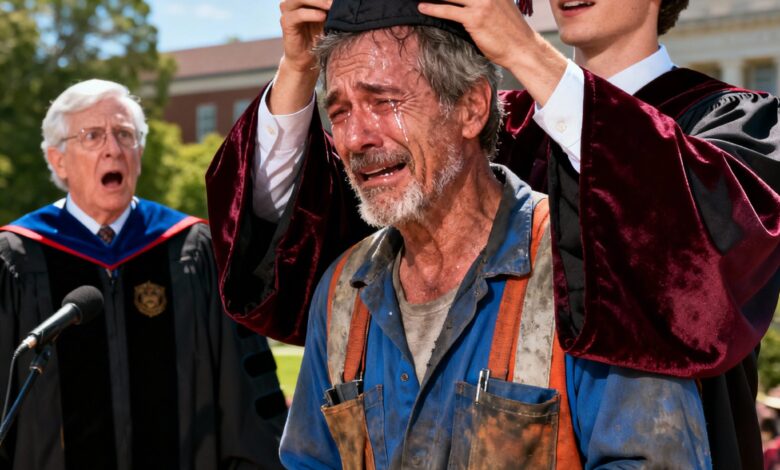
When Professor Santos shook the hands of everyone after my PhD defense, he paused in front of my father. His eyes narrowed in recognition, face softening with a memory that had clearly survived decades. That brief moment—barely a few seconds—was built on years of sweat, hunger, sacrifices, and love I didn’t understand until it was too late.
I grew up in a broken home. My earliest memories weren’t of toys or birthday cakes but of shouting, slammed doors, and my mother packing clothes into a plastic bag while wiping tears with the back of her hand. She brought me to Nueva Ecija, to a quiet barangay surrounded by rice fields and rumors. Our home was a patched-together wooden box with a tin roof that rattled during storms. Privacy didn’t exist. Poverty did.
My biological father existed in my memory only as a shadow—tall, distant, always halfway out the door. We didn’t say “Papa.” We said “siya.” He left a void, and life went on around it.
My mother tried to soften the blow of poverty by calling it “simple living,” but the empty plates and threadbare clothes were honest. Some days we ate tuyo and rice. Some days, just rice. Some days, even that was a stretch.
When I was four, she remarried. A man named Ben entered our world quietly, carrying nothing but calloused hands, a shy smile, and the exhaustion of a construction worker who knew how to persist, not how to rest. He slept under our roof, sat at our table, and laughed with my mother in a way that made me angry at first. He wasn’t my father. He was a stranger who smelled of wet cement and steel. I hid behind my mother when he tried to speak to me. He left a cheap toy car on the table for me. I ignored it.
But it was the small things that made him impossible to hate.
One evening, as the sky turned gray and the cicadas screamed, I saw him fixing my broken bicycle in the yard. No announcement, no request—just quiet work. He wiped the chain clean, straightened the bent wheel, tightened every bolt. My biological father had promised to buy me a new bike once. He never did. But this man, who barely knew me, spent an hour repairing what another man had abandoned.
The next day, I rode that bike like it was new. He pretended not to watch me from the doorway. I pretended not to know who fixed it.
Another night, I found him bent over my broken sandals under the dim kitchen light. He stitched the torn strap with old rubber and thread while everyone else slept. He placed them by my bed when he finished. I wore them carefully for months.
When I was bullied at school for not having a father, I walked home with torn notebooks and bruised knees. My mother panicked and scolded me. Tatay simply gathered my scattered things, dusted them off, and asked where the school was. The next day he waited outside the gate on his old bicycle. When my bullies asked if he was my father, I hesitated—but then I said yes. I climbed onto his bike, arms around him, and we rode home with the wind at our backs. That night I whispered, “Good night, Tatay.” He answered softly, “Good night, anak.”
Life settled into a rhythm of quiet sacrifices.
He came home each evening tired, dust in his hair, pain in his joints, but always asked, “Kamusta ang school?” He couldn’t help me with my homework—his reading was slow, his English unsure—but he insisted on one rule: “Study properly. Maybe not the best, but properly. Respect follows knowledge.”
When a university acceptance letter arrived years later, my mother panicked at the cost. I said I could stay home; we couldn’t afford my dreams. But Tatay disappeared the next morning and returned with enough money for my first months in Manila. He had sold his only motorbike—his one luxury, earned with years of sweat.
He took me to Manila himself, carrying my boxes up the dorm stairs, arranging my books on the desk like they were treasures. Before leaving, he handed me a crumpled envelope with a few bills and tucked a small note into my lunch box. The handwriting was crooked, each letter forced into shape.
“Kaya mo ’yan. Huwag kang matakot sa hirap. Kaya natin ’to.”
I kept that note for years.
School was brutal. Hunger, fatigue, doubt—companions I never fully shook. During breaks, I’d visit home and see him grow older, slower, yet still lifting hollow blocks and climbing scaffolds. Once, I found him trembling from exhaustion, breathing hard as he tried to smile at me.
“When I’m tired,” he joked, “I think, ‘My son will be a PhD.’ Suddenly I’m not tired.”
Graduate school was harder. But every time I felt overwhelmed, I remembered his hands—the roughest hands I had ever known—building futures he would never enjoy.
Years passed. Then came the day of my PhD defense. My parents arrived wearing their best clothes. Tatay was in a borrowed suit that didn’t quite fit, shoes a size too small. He sat in the auditorium, hands on his knees, gaze locked on me.
He didn’t understand my slides, but he understood what they meant.
When the panel finally declared, “Congratulations, you have successfully defended,” my mother cried. Tatay froze—then smiled as if the world cracked open just for him.
When Professor Santos approached us, he turned to Tatay and said, “I know you. You once carried an injured worker down a scaffold, even though you were bleeding yourself.”
Tatay blinked, shy. “Marami na pong napuntahan si Tatay noon.”
“It’s an honor to meet you again,” the professor said. “And to see you here as the father of a PhD.”
Tatay’s voice cracked. “Salamat po.”
For the first time in his life, the world saw him—not as a construction worker, but as a father who built something extraordinary.
But life steals quietly.
He retired soon after, tending vegetables and calling me often. I always promised to visit “next month.” Deadlines, conferences, my new job—everything felt urgent. Until one night, my mother called, voice broken. He had collapsed while watering his plants. A heart attack. Instant.
I went home not to visit but to bury him.
At the wake, I learned who he’d been to others: a man who fixed roofs, lent money he didn’t have, defended coworkers, fed hungry neighbors. He had built more than structures—he had built people.
At the coffin, I touched his cold hands—hands that once stitched sandals, fixed bicycles, wiped my tears without asking questions. I whispered apologies for every visit I postponed, every call I ended too quickly.
We buried him under a painfully blue sky. As the soil fell onto his coffin, regret settled into my bones.
Months later, my son broke a toy car. I fixed it clumsily, and he looked at me like I’d performed magic.
“You’re so good, Daddy.”
“No,” I whispered. “I had a good teacher.”
People assume a PhD comes from privilege. They imagine wealth, comfort, inherited success.
I correct them.
“My father was a construction worker,” I say. “He didn’t leave me land or money.”
I pause—because the truth still hurts and heals at the same time.
“He didn’t build a house. He built me.”
And the tragedy is simple: I spent my life trying to build a future worthy of him, only to realize—too late—that he had been the masterpiece all along.