He Wanted a Family of 7, Then They Said Marry Their Mother First!
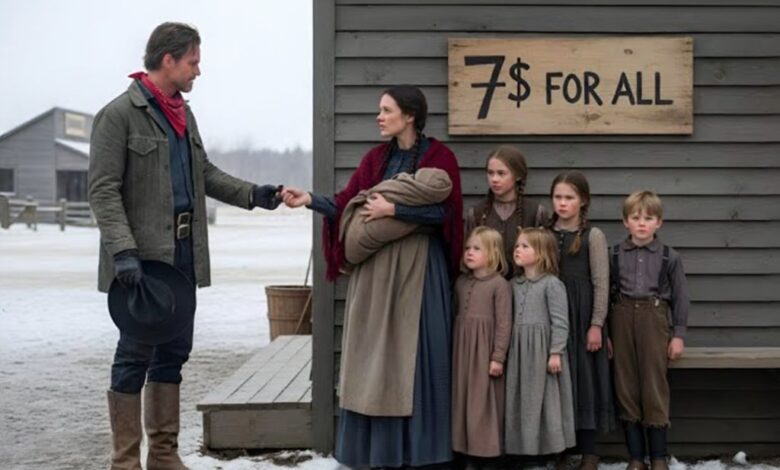
The first time Caleb Dawson heard the number, he thought he’d misheard it.
“Seven?” he repeated, squinting into the harsh afternoon light as he leaned against a weathered fence post. “You’re telling me there are seven kids?”
Old Mr. Wilkins didn’t flinch. He spat into the dust and nodded like it was nothing unusual. “Seven. Youngest still needs help getting dressed. Oldest… she looks like she’s already lived a full life.”
Caleb stood there for a moment, staring out over his land—rolling hills, open sky, horses grazing in the distance. It was everything a man was supposed to want. Land, stability, independence.
And yet, when night came, the silence pressed in.
No voices. No footsteps. No life inside the walls of his house.
“I’ve been thinking,” Caleb said slowly, almost like he was testing the idea out loud. “I want a family.”
Wilkins gave a dry, humorless chuckle. “Most men start with a wife.”
Caleb’s jaw tightened slightly. “I’m not most men.”
That much was obvious. At thirty-five, Caleb had built everything himself. No parents, no inheritance, no safety net. Just years of hard work and long, quiet nights. He didn’t fear effort. He feared emptiness—the kind that doesn’t go away no matter how much land you own.
So when he heard about the widow and her seven children, living under the control of relatives who treated them like a burden instead of a family, something shifted inside him.
“Where are they?” he asked.
The town of Dry Creek wasn’t far, but it might as well have been another world.
By the time Caleb rode in, the sun was dipping low, casting long shadows across the dusty streets. People noticed him, but he didn’t return their looks. His attention was locked on a worn-down house at the edge of town.
Something about it felt wrong before he even got close.
The shutters hung crooked. The yard was bare. And for a brief second, he caught a glimpse of a child’s face at the window—watching, then disappearing.
He stepped up to the door and knocked.
It opened slowly.
A girl stood there, maybe sixteen. Her posture was stiff, her expression guarded in a way no teenager should have to learn.
“Yes?” she asked.
“I’m here to see Mrs. Harper,” Caleb said.
The girl hesitated, then nodded slightly. “She’s inside.”
Before she could say anything else, a man pushed past her. Thickset, sharp-eyed, with the kind of presence that made it clear he was used to being obeyed.
“What do you want?” he snapped.
Caleb didn’t step back. “I heard Mrs. Harper and her children might need help.”
The man laughed, harsh and short. “They’re fine where they are.”
Behind him, Caleb could see movement—small figures clustered together, watching without speaking.
“And you are?” Caleb asked.
“Her brother-in-law,” the man said, with a hint of pride. “This house is mine. They stay here on my terms.”
Caleb’s expression didn’t change. “And the children?”
“They earn their keep,” the man said coldly. “Or they don’t eat.”
Silence stretched between them.
Then Caleb said it.
“I want to take them.”
The man blinked. “You what?”
“All seven,” Caleb said evenly. “I’ll take them. Give them a home.”
For a moment, the man just stared at him.
Then he laughed. Loud, mocking. “You think you can just walk in here and take seven kids?”
Caleb didn’t react. “I’m not joking.”
The laughter faded. Something sharper replaced it.
“Well,” the man said slowly, “there’s a condition.”
Caleb’s voice stayed steady. “Say it.”
“You don’t just take the kids,” he said. “You take her too.”
Caleb frowned. “The mother?”
“That’s right,” the man said, a smirk forming. “You marry her. Otherwise, they stay.”
The room went quiet.
From the shadows, a woman stepped forward.
She looked exhausted, worn down in a way that wasn’t just physical. But there was something in her eyes—something that hadn’t been broken.
“No,” she said softly. “You don’t have to do this.”
Caleb looked at her.
Then at the children.
Then back at the man.
“Fine,” he said.
The air shifted.
“I’ll marry her.”
The wedding was simple. No celebration, no music, no joy in the usual sense. Just a preacher, a handful of witnesses, and seven children standing quietly, unsure of what came next.
Caleb didn’t hesitate when it was his turn. “I do.”
Anna’s voice was barely audible. “I do.”
And just like that, everything changed.
The journey back to Caleb’s ranch was long and quiet. The children stayed close together in the wagon, watching him carefully. The younger ones clung to Anna. The older ones kept their distance, their eyes filled with caution.
Caleb didn’t push. He didn’t try to win them over with words.
He just drove.
When they arrived, the sky had already darkened.
“This is home,” he said simply.
The house wasn’t grand. But it was solid. Warm. Alive in a way the other place had never been.
Inside, a fire burned in the hearth.
The children hesitated at the door.
“Go on,” Caleb said gently.
One by one, they stepped inside.
Anna lingered behind.
“You didn’t have to do this,” she said quietly.
Caleb looked at her. “Yeah, I did.”
She studied him. “Why?”
He took a breath. “Because I was tired of being alone. And you were tired of doing everything alone.”
That was enough.
The first weeks weren’t easy.
The children didn’t trust him. They ate quickly, like the food might disappear. They slept lightly, waking at every sound. The oldest, Emily, watched him constantly.
One night, he found her sitting by the window.
“You should get some rest,” he said.
“I’m making sure,” she replied.
“Of what?”
“That this is real.”
Caleb nodded. “Fair enough.”
He didn’t argue.
He just kept showing up.
Every morning, breakfast was ready. Every evening, there was food on the table. No conditions. No demands.
Slowly, things changed.
The tension eased. The silence broke.
First, small laughter. Then more. Until one day, it filled the entire yard.
Caleb stepped outside to see the younger children running, playing, free in a way they hadn’t been before.
He stood there, taking it in.
Then a small voice called out.
“Papa!”
He turned.
A little boy ran toward him, holding a crooked drawing.
Caleb froze for a second.
Then he knelt down. “Did you make this?”
The boy nodded.
Caleb smiled. “It’s perfect.”
From the porch, Anna watched, her hand over her mouth.
Things weren’t perfect.
There were arguments. Hard days. Old fears that didn’t disappear overnight.
But Caleb never backed away.
He worked harder than ever, expanding the ranch, making sure there was enough—for everyone.
And Anna changed too.
The fear faded. The weight lifted. She started to smile more, laugh more, breathe easier.
One evening, she found Caleb sitting on the fence, watching the sunset.
“You gave them everything,” she said.
He shook his head. “Not everything.”
“You gave them a home,” she said. “That’s everything.”
He looked at her. “What about you?”
She paused, then smiled softly.
“You gave me a second chance.”
Months passed.
The house was never quiet anymore.
Boots by the door. Voices everywhere. Laughter echoing through every room.
One night, as they sat around the table, Caleb looked at them—all of them.
Seven children.
A woman who no longer looked broken.
A life he never thought he’d have.
“I used to think I wanted a family of seven,” he said.
They all looked at him.
“But I was wrong.”
A pause.
“I got something better.”
Anna reached for his hand. “What’s that?”
Caleb smiled.
“A family of eight.”
And for the first time in his life, the silence was gone.
Not because the house had changed.
But because it was finally full.
He hadn’t just given them a home.
They had given him one too.