He is Dead? the Nurse Asked, Then the Dog Refused to Leave His Chest
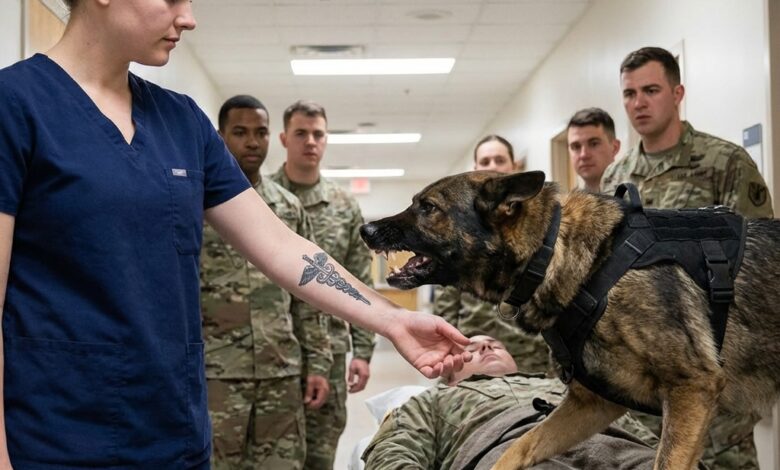
The trauma entrance of Norfolk General was a place where the air usually tasted of metallic adrenaline and sterile desperation. It had played host to every manner of catastrophe: highway pileups, gunshot wounds, and combat medevacs that arrived still smelling of jet fuel and scorched earth. But at 1:17 a.m. on a storm-lashed Tuesday, the emergency department came to a standstill for a reason that defied medical protocol. A helicopter had touched down carrying former special operations officer Mason Cole, a man officially listed as dead on arrival.
He was wheeled in strapped to a gurney under a silver thermal blanket—pale, cold, and unresponsive. The flight medic’s report was delivered in the flat, hollow tone reserved for cases where medicine had already surrendered. Severe exposure. Traumatic crash. No cardiac activity detected during the twenty-minute transport. In any other circumstance, the next steps would have been a routine march toward the morgue: a final pronouncement, a shroud, and a toe tag. But as the orderlies moved to transfer the body, the silence of the trauma bay was shattered by a low, guttural vibration that seemed to vibrate through the floorboards.
A black Belgian Malinois named Titan, a dog carved from muscle and tempered by cordite, would not let anyone touch the gurney. For six hours, the animal stood as a living barricade. He didn’t pace, and he didn’t whine. He planted his paws beside Mason’s chest and bared his teeth at every doctor, nurse, and security officer who dared to approach. Two nurses were nearly bitten trying to cover the “corpse” with a sheet, and a resident was chased back into a crash cart. By dawn, the hallway looked like a siege line. Hospital security had called for tactical support, and a marksman was positioned outside the observation window. The administrative consensus was grim: the dog was a liability and would likely have to be put down so the staff could retrieve the body.
Then, Eliza Hart walked into the eye of the storm. Eliza had been at Norfolk General for only three weeks. To the veteran staff, she was just another quiet face in a blue scrub suit, someone who double-checked supply cabinets and kept her head down. She had no seniority, no standing, and seemingly no business stepping toward a combat-trained K9 in a defensive lock. But Eliza didn’t stop at the yellow caution tape. She watched Titan for ten seconds, her eyes narrow and calculating, before she slowly rolled up her sleeve. On the inside of her forearm sat a faded, precise tattoo—a military K9 handling mark.
Titan saw it. The aggressive snarl died in his throat, replaced by a sharp, inquisitive tilt of the head. Eliza moved forward with a measured, rhythmic gait. Her voice wasn’t the soothing, high-pitched coo people used for pets; it was a low-frequency command built from years of tactical integration.
“Titan,” she said, the word a solid anchor. “Eyes on me.”
The dog snapped his gaze to hers. The room held its breath as Eliza reached the gurney. She didn’t flinch. She knew this dog, and more importantly, she knew the man beneath the thermal blanket. Years ago, in the dust-choked valleys of Afghanistan, she had been the K9 integration trainer who paired Titan with Mason Cole. As she stood beside the “dead” man, something about Titan’s behavior struck her as wrong. He wasn’t grieving or mourning; he was indicating. He slammed a heavy paw onto Mason’s sternum and barked—a sharp, rhythmic alert that vibrated through the metal frame of the bed. One. Two. Three.
“He’s dead, Eliza,” the attending physician whispered from behind the safety of the desk. “He’s been cold for hours.”
“Titan doesn’t indicate on corpses,” Eliza replied, her voice cutting through the clinical certainty like a scalpel. “If he’s barking at the chest, there’s a reason.”
She leaned down, ignoring the protocols of the “deceased” status. She placed two fingers against Mason’s carotid artery. She felt nothing. She pressed her ear to his lips, but there was no mistaking the lack of breath. However, when she touched the skin of his neck, she noticed a specific texture to the coldness. He wasn’t warm, but he wasn’t “dead-cold” either. He was in a state of profound, metabolic suspension.
“Get me a portable ultrasound and a core temp probe now!” she barked, her tone suddenly matching the dog’s intensity.
The attending doctor bristled, moving to intervene, but Eliza turned on him with an authority that far outstripped her nursing badge. “He’s been in sub-zero water for hours. If his core temperature dropped fast enough, it could have masked his vitals and slowed his heart to a near-stop. You know the rule: he’s not dead until he’s warm and dead. Now move!”
The gridlock broke. A tech ran for the monitor; a nurse grabbed the warming blankets. When the ultrasound transducer touched Mason’s chest, the room fell into a deafening silence. There, on the grainy black-and-white screen, was a flicker. It wasn’t a heartbeat in the healthy, rhythmic sense—it was a thin, electrical twitch, a ghost of a pulse hiding beneath layers of hypothermia and shock.
The trauma bay erupted into a frenzy of activity. Doctors who had signed him off as a statistic were now cutting away his tactical gear and pushing warmed IV fluids. Titan backed away only as far as Eliza’s hand signaled, his eyes never leaving Mason. As they stripped away the officer’s heavy tactical vest, Titan lunged again. He didn’t go for a throat; he seized a specific seam on the front panel of the vest, tearing at the reinforced nylon until a small, waterproof memory card tumbled onto the sterile white sheet.
Eliza picked it up, her heart hammering. She realized then that the helicopter crash hadn’t been an accident of the storm. Mason Cole hadn’t been flying a routine mission; he had been carrying something that people were willing to kill for. Titan hadn’t just been guarding a life; he had been guarding the truth.
As the rewarming blankets began to do their work and the flicker on the monitor grew into a steady, thumping rhythm, the “dead” man gasped, a ragged, wet sound that signaled a return from the abyss. Mason’s eyes didn’t open, but his hand spasmed, reaching out into the empty air. Titan immediately pressed his large head into Mason’s palm, a silent bridge between the living and the nearly lost.
Eliza stood back, clutching the memory card. She knew the hospital was no longer a sanctuary. If someone had rigged a helicopter to kill a special operations officer, they wouldn’t stop because he had reached a trauma ward. She looked at Titan, whose ears were pricked toward the hallway, listening for the sound of approaching footsteps that didn’t belong to nurses. The miracle of the morning was only the beginning. Mason Cole was alive, the evidence was in her hand, and they were still in the middle of a war zone. She signaled Titan to the “watch” position. The dog settled onto his haunches, a silent, black shadow of teeth and loyalty, ready to finish the mission they had started in a different world.