He Helped a Grieving Stranger on a Flight, Then She Returned by Helicopter!
The economy cabin of a cross-country flight is rarely a place where one expects to find a profound lesson in humanity. For Noah Granger, a man whose life had been recently upended by the loss of his wife, Elena, the flight was merely a logistical hurdle—a way to get his daughter, Lily, to his parents’ home in Denver. The cabin was crowded, smelling of stale air and recycled coffee, and the atmosphere was thick with the collective impatience of travelers each focused on their own small orbits.
Noah sat in the middle seat, his large frame cramped, watching Lily as she clutched a small bag of gummy bears like a talisman. At eight years old, Lily was a quiet observer of the world, her eyes wide with the serious, unblinking honesty of a child who has already seen too much grief. Noah had spent the last several months in a state of emotional paralysis, but as the plane ascended, he found himself recalling Elena’s voice. She had been a nurse—practical, blunt, and fiercely committed to the idea that kindness was a form of tactical courage. “Being tough is easy,” she used to say. “Being gentle takes real control.”
Halfway through the flight, the routine of the cabin was broken by a quiet disturbance in first class. A woman named Sienna, dressed in the understated elegance of the truly wealthy, was visibly trembling. Her grief was a raw, jagged thing that she was trying—and failing—to contain within the confines of her seat. While other passengers looked away, uncomfortable with the sight of such public vulnerability, Noah had caught her eye earlier during boarding. He had offered a small, steadying nod—not a look of pity, but a look of recognition. He knew that specific brand of “heavy air” that accompanies a fresh loss.
The Note and the Power of Being Seen
As the flight leveled off over the Rockies, a flight attendant approached Noah’s seat in economy. With a look of professional hesitation, she handed him a folded piece of cream-colored stationery. The note inside was written in a hand that was neat but slightly shaky. It didn’t ask for money or favors. It was a simple, searing acknowledgement: “You gave me comfort when I was preparing for shame. You did it in front of your daughter, which means you didn’t do it for applause. Thank you for seeing me as human.”
Noah stared at the words, feeling a lump form in his throat. He hadn’t realized that a simple gesture of eye contact and a lack of judgment could carry such weight. Lily, noticing her father’s reaction, whispered the words aloud. “She said you saw her,” Lily murmured. It was a moment of realization for both of them: even in the cramped, anonymous space of an airplane, the human connection remains the most powerful currency we possess.
When the plane finally touched down in Denver, the interaction seemed destined to remain a fleeting memory. Sienna passed them in the terminal, offering nothing but a hand over her heart—a silent promise of gratitude. Noah and Lily moved on into the arms of his waiting parents, beginning a three-day journey of healing, old photo albums, and pancakes. They eventually retreated to the family cabin high in the mountains, a place Noah had spent the last year repairing with his own hands. Building something tangible had been the only way he knew how to process the intangible void Elena had left behind.
A Cinematic Arrival in the Mountains
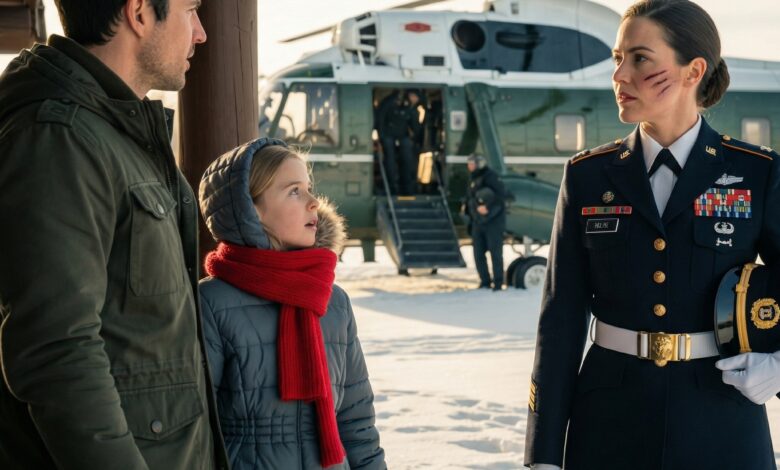
On the third evening, the silence of the mountain air was shattered. What Noah initially took for an approaching storm soon revealed itself to be something far more mechanical. The rhythmic, heavy thumping of a rotor grew into a roar that shook the very foundation of the cabin. Looking through the pines, Noah saw the searchlights of a private helicopter cutting through the dusk, descending into the small clearing he had cleared for firewood.
The machine touched down with a swirl of pine needles and mountain dust. As the side door slid open, Sienna stepped out. She wasn’t there as a grieving stranger; she was there as a woman of immense influence who had used her resources to track down the man who had shown her kindness when she was at her lowest.
Sienna’s return by helicopter was more than a dramatic gesture of wealth; it was a response to a world that often feels increasingly fragmented and cold. In early 2026, as the news cycle is dominated by the search for Nancy Guthrie in the Arizona desert, the geopolitical strikes in Iran, and the tragic loss of the eighteen-year-old twins Carolina and Luiza, stories of unexpected reciprocity serve as a necessary counter-narrative. Sienna revealed that she was the head of a major philanthropic foundation, and she had come to the mountains not just to say thank you, but to offer Noah a partnership in a new medical initiative named in honor of Elena’s legacy.
The Mathematics of Reciprocity
The story of Noah and Sienna highlights a fundamental truth about 2026: we are a society searching for grounding. From the “visionary” wigwam of Jonah Redfeather to the $265 million cabin inherited by Rachel Whitmore, there is a recurring theme of people finding immense value in the simplest of places. Noah Granger helped a stranger in an economy seat because it was “the right thing to do,” never suspecting that his gesture would return to him in the form of a helicopter in his front yard and a future he thought he had lost.
This reciprocity is a reminder that the “résumé that matters,” as Elena called it, is built in the quiet moments of life. While the “Prophet of Doom” shares worrying predictions and the world watches the fallout of “DOGE-style” cuts, the individual acts of empathy remain the only thing that truly moves the needle. Sienna’s arrival by helicopter was the physical manifestation of a “silver lining,” proving that when you see someone as human, you invite a humanity back into your own life that no amount of money can buy.
As Noah stood on his porch, the rotor blades slowing to a halt, he realized that the “castle” Lily had joked about wasn’t a building—it was the community of people who recognize and support one another in the dark. Sienna’s foundation would eventually fund the very clinics Elena had dreamed of, transforming a chance encounter on a crowded flight into a legacy of healing.
The story of the grieving stranger who returned by helicopter is a testament to the fact that in 2026, kindness isn’t just a decoration; it’s a form of high-altitude courage. It reminds us that whether we are in a flooded garage like Emma Chin or a hidden room like Lila Harper, the most valuable assets we can ever discover are the connections we make when we choose to look someone in the eye and say, “I see you.”