He Could Have Kept the Money, Instead, This Single Dads Honesty Changed Everything
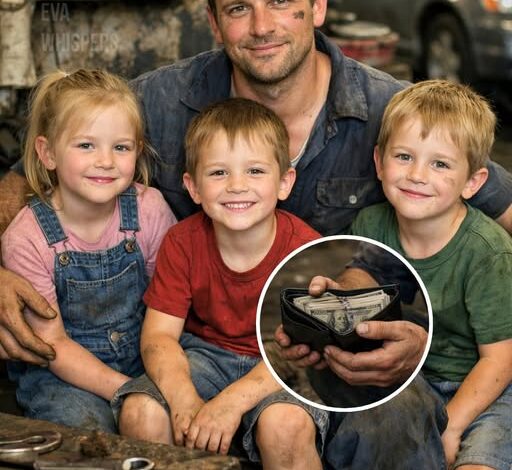
The fluorescent hum of the auto shop has been the soundtrack to my life for fifteen years. It’s a space defined by the scent of spent oil, the metallic clanging of wrenches against stubborn bolts, and a coffee maker that has been a glorified paperweight since 2012. At thirty-six, my hands are permanently etched with grease—lines of black ink that map out twelve-hour shifts and a thousand small sacrifices. People see the dirt under my fingernails and make assumptions about my intellect or my character, but those hands are the only thing standing between my family and the abyss.
I am a single father to six-year-old triplets. Their mother vanished when they were barely eight months old, leaving behind a suitcase-sized hole in our lives and a silence that I eventually stopped trying to fill. I live with my seventy-two-year-old mother, a woman whose spine is made of iron and whose heart is the only reason our household doesn’t collapse. She braids hair, negotiates with picky eaters, and manages the chaos of three high-energy children while I’m under the belly of a sedan, trying to squeeze a few more miles out of a dying transmission.
Last Tuesday was the kind of day that makes you wonder if you’re actually moving forward or just spinning your tires in the mud. The shop was overbooked, and a particularly vitriolic customer was shouting in my face about a check engine light that had dared to illuminate a week after a different repair.
“You’re a thief! I authorized the fix, and it’s still broken!” he roared, spit flying.
“Sir,” I said, keeping my voice as level as a plumb line, “the emissions system and the brake pads are entirely separate issues. I fixed what you signed for. It’s all right here on the invoice.”
He snatched his keys, cursed the shop, and promised a review that would bury us. I stood there, wiping my hands on a rag that was more grease than cloth, feeling the familiar sting of being misunderstood. I wasn’t trying to scam him; I was trying to keep his family safe while keeping my own fed.
Near closing time, the shop was finally quiet. I was sweeping beneath a lift when my broom snagged on a heavy, worn object. I reached down and pulled a black leather wallet from the shadows. It was thick—impossibly thick. When I opened it, my breath hitched. Stacks of crisp one-hundred-dollar bills stared back at me. There was more money in that leather fold than I had seen in my bank account in three years.
For a heartbeat, the “what ifs” flooded my mind. This wasn’t just cash; it was a new pair of shoes for my daughter. It was the overdue electric bill. It was three months of breathing room. It was the end of the constant, low-grade panic that defined my existence.
Then, I saw the ID. It belonged to Gary, a gentleman in his late seventies who had been in earlier for a simple oil change. Tucked behind the ID was an emergency contact card. My heart hammered against my ribs, not with greed, but with the terrifying weight of a choice. I locked the wallet in my toolbox and drove home in a daze.
Dinner was spaghetti and the loud, beautiful chaos of three six-year-olds recounting their day. My mother watched me closely over her plate. “You’re quiet, Evan. Rough day?”
“Just long, Mom,” I said. But the wallet felt like a lead weight in my pocket. I knew what I had to do. I couldn’t teach my children to be good people if I was willing to build our comfort on someone else’s catastrophe.
I drove to the address on the card—a modest, well-kept bungalow with a flickering TV visible through the curtains. When I knocked, Gary answered, leaning heavily on a carved wooden cane. When I held out the wallet, his face went from confusion to a deep, trembling relief.
“I thought it was gone,” he whispered, his hands shaking as he took it. “This is my entire pension draw for the quarter. I didn’t know how I was going to pay for my wife’s care.”
He tried to peel off a hundred-dollar bill, his eyes wet with gratitude. I stepped back and shook my head. “No, sir. I didn’t bring it back for a finders fee. I brought it back because it belongs to you.”
“Why?” he asked, truly perplexed. “Most people today… they wouldn’t have come.”
“Because I have three kids at home,” I said. “And I want them to grow up in a world where people still look out for each other. That starts with me.”
I drove home feeling lighter than I had in months. The bills were still there, and the bank account was still empty, but my conscience was clear.
At 7:30 the next morning, a sharp, authoritative knock at my front door startled us. I opened it to find a sheriff in full uniform. Behind me, I heard my mother gasp, her mind likely jumping to the same dark places mine was.
“Evan Carter?” the officer asked.
“Yes?”
“My name is Sheriff Daniels. I believe you met my father, Gary, last night.”
The tension in my shoulders dissolved instantly. The Sheriff didn’t wait for an invitation; he signaled to two other officers who began carrying heavy cardboard boxes into my small living room.
“My father told me what you did,” Daniels said, his voice dropping the professional edge. “He told me you’re a mechanic, raising three kids and taking care of your mother. He was so moved by your honesty that he insisted on doing something. And frankly, so did I.”
The boxes were a treasure trove: winter coats that actually fit, sturdy school shoes, backpacks filled with supplies, and bags of high-quality groceries. There were gift cards for gas and a stack of vouchers for a local supermarket.
“I can’t take this,” I stammered, looking at my mother, who was already crying into her apron.
“You can, and you will,” the Sheriff replied firmly. “You gave my father more than just his money back; you gave him his faith in people. That’s worth a lot more than some groceries. Consider this a ‘thank you’ from a son who was worried sick about his dad.”
The following weeks didn’t magically turn my life into a fairy tale. I still woke up with a sore back, and the shop was still a struggle. But the Sheriff’s intervention opened doors I didn’t know existed. He connected me with a local community outreach program that helped bridge the gap for working families. They assisted with childcare costs for a few months, allowing me to enroll in a specialized diesel technician certification—a move that would eventually double my hourly wage.
The most important change, however, was internal. The next time an angry customer shouted at me, I didn’t feel the old, familiar shame. I looked at my greasy hands and realized they weren’t just the tools of a “struggling mechanic.” They were the hands of a man who had been tested and found himself whole.
Honesty didn’t make me rich, but it made me solid. It reminded me that while I couldn’t control the economy, the shop’s broken coffee maker, or the people who walked out on us, I was the sole architect of my own integrity. And in the eyes of my three children, that made me the wealthiest man in the world.