Forgotten Ranger Cabin Saves Orphaned Brother and Sister!
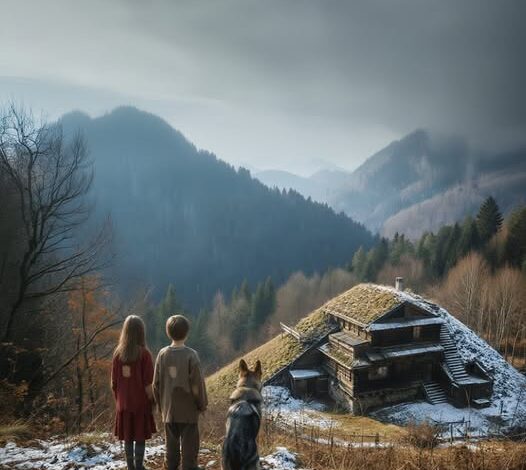
The letter arrived on a Thursday in late October, carried up the rutted dirt road outside Asheville by a mail carrier who had no idea he was delivering the final blow to a crumbling family. Fourteen-year-old Lily Harper was out back, her rhythmic strikes with the dull axe splitting kindling into thin slivers of cedar, when her nine-year-old brother, Owen, ran toward her. He held the envelope at arm’s length as if it were a live coal.
“It’s from the county,” Owen whispered, his breath hitching.
Lily didn’t need to break the seal to understand the contents. Their parents had been gone for three weeks, victims of a rain-slicked mountain highway and a late-night shift that never ended. Since then, the silence in their sagging rental cabin had been deafening. The meager savings were gone, swallowed by the predatory hunger of hospital bills and funeral costs. Their landlord had been patient, but in the mountains, patience usually expires when the first frost hits.
Inside the envelope was a thirty-day notice. After that, the only home they knew would belong to someone else. Owen read the letter twice, his brow furrowed as he folded it into a neat, desperate square. “What do we do, Lily?”
Lily looked past the clearing toward the Blue Ridge Mountains, which rose like ancient, bruised giants against the autumn sky. She remembered her father’s hands—calloused, smelling of pine resin and woodsmoke. He had spent his life clearing brush for trail crews and repairing the forgotten bones of the forest. “We don’t wait for the county to decide where we go,” she said, her voice hardening with a resolve she didn’t yet feel. At her feet, Scout, their scruffy brown mongrel, thumped his tail against the hard-packed dirt, a silent vote of confidence.
The options available to them were bleak: a foster system that would likely split them apart or a distant aunt in Florida who was a stranger in every way that mattered. Lily wasn’t thinking about being a hero; she was thinking about the way Owen reached for her hand in his sleep. She made her decision that night while the wind scraped against the thin cabin walls.
They left three days later, long before the sun touched the valley floor. Their backpacks were heavy, stuffed with canned beans, oatmeal, matches, a dented cooking pot, and two wool blankets. Lily turned the key in the lock for the last time and slipped it into the mailbox. The hike was grueling. Within a mile, the familiar trails dissolved into animal paths choked with briars. Fallen leaves hid slick rocks and treacherous roots. Owen stumbled often, his small frame shaking with exhaustion, but Scout acted as an anchor, circling back to nudge the boy’s hand whenever he lagged.
By midday, the world they knew had shrunk into a watercolor blur far below. “Are you sure it’s even there?” Owen asked, his voice small against the vastness of the woods.
“No,” Lily admitted, “but Dad said the old rangers never built where the water couldn’t reach.”
As the afternoon light slanted gold through the hemlocks, Scout suddenly froze. He didn’t bark; he simply stared into a dense thicket of rhododendron. Hidden behind a screen of overgrown pine stood a structure that seemed more like a growth of the earth than a man-made thing. It was a cabin, half-swallowed by the forest. The timber walls were rough-hewn and grey with age, topped by a sagging metal roof. One window shutter hung by a single rusted hinge, revealing a hollow darkness.
Owen pulled back. “Is it haunted?”
“It’s empty,” Lily said, pushing through the brush. The door groaned on its hinges, protesting the intrusion. Inside, the air was thick with the scent of dust and old pine, but the floorboards didn’t give way. A massive stone hearth dominated the main room, and a sturdy loft ladder leaned against a hand-cut beam. It was a sanctuary that time had forgotten to reclaim. “We clean it,” Lily declared. “We see if it holds.”
The first few weeks were a lesson in the brutality of the wild. The cold seeped through gaps in the logs, and the wind hissed under the door like a living thing. Their first fire filled the room with choking grey smoke until Lily learned to read the chimney’s draft, adjusting the airflow by trial and error. They spent their days transforming survival into a routine. Owen gathered fallen branches for firewood while Lily cleared years of debris from the flue. They discovered a rain barrel system that had rotted through; Lily patched it with strips of bark and pine resin. A shallow well, capped with heavy stones, provided water that tasted of iron and earth.
Food became their primary obsession. They rationed their beans and oatmeal, supplemented by what the forest offered. Owen learned to set simple snares for rabbits, and Lily spent hours by a narrow, ice-fringed creek, her fingers numb as she waited for a strike on her makeshift line. They weren’t playing house; they were fighting a war of attrition against the winter.
January arrived with a sudden, suffocating whiteness. The snow layered the roof, but the old beams held firm. Lily stuffed the cracks between the logs with a mixture of moss and mud to block the drafts. She remembered her father saying that stone was a battery for heat, so she kept a small, constant fire burning, letting the hearth glow deep into the night.
One afternoon, the silence was shattered. While gathering wood on a steep, icy slope, Owen’s foot slipped. He tumbled twenty feet down the ridge, his body slamming against a frozen oak. Lily reached him in a panic, her heart hammering against her ribs. He was conscious, but his ankle was already turning a sickening shade of purple. She managed to haul him back to the cabin, where she splinted the limb with carved branches and cloth strips. For three days, Lily worked the tasks of two people—chopping wood, hauling water, and tending the fire—while Scout never left the boy’s side, his warm fur acting as a living heating pad.
During Owen’s recovery, Lily noticed a loose floorboard near the hearth. Prying it up, she found a rusted tin box containing yellowed papers dated 1948. They were the journals of Samuel Harlan, a retired forest ranger. He had written of the storms he weathered and the solitude he cherished. One line, written in a cramped, steady hand, changed everything for her: “If anyone finds this place after I’m gone, know that it was built to shelter. Use it. Respect it. Pass it on.” Lily realized then that they weren’t intruders. They were the latest inhabitants of a legacy of resilience.
By March, the thaw began. The smoke from their chimney, a steady grey ribbon against the spring sky, was eventually spotted by hikers on a distant ridge. When the authorities finally climbed the trail—two deputies and a social worker—they didn’t find two bedraggled orphans. They found a homestead.
The social worker stood inside the cabin, her eyes taking in the neatly stacked wood, the repaired rain barrels, and the way the children stood together, shoulders squared. She looked at the splint Lily had fashioned and the journal entries of Samuel Harlan laid out on the table. “You did this yourselves?” she asked, her voice trailing off in disbelief.
“We didn’t break anything,” Lily said quietly. “We just finished what Mr. Harlan started.”
The law could not allow them to live in the wilderness indefinitely, but the story of the Harper children touched a chord in the mountain community. Instead of being lost in a faceless system, they were placed with a local couple who ran an outdoor education program only a few miles from the trailhead. The cabin was not boarded up or torn down; it was designated as a historical landmark under the children’s care. Lily and Owen returned every weekend, no longer as fugitives from grief, but as keepers of the mountain’s secret. They had lost their parents, but in the heart of the Blue Ridge, they had found a way to stand on their own.