Do Not Judge by Appearances, The Story of a Misjudged Customer at the Bank
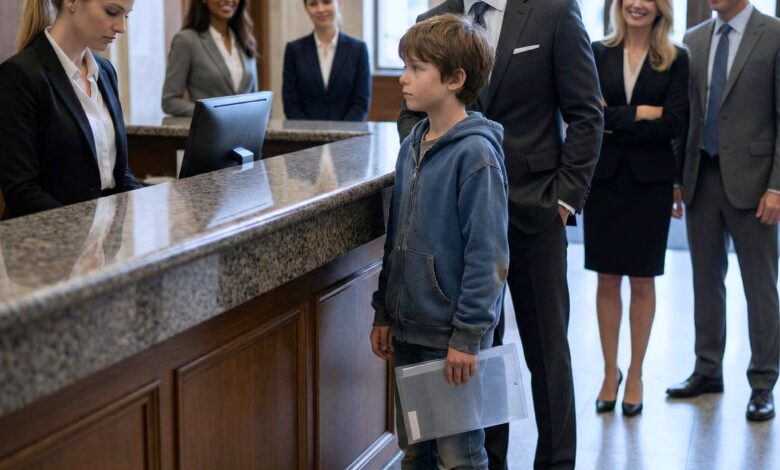
Noah Carter was only ten years old, yet as he stepped into the vaulted marble lobby of Chicago’s most exclusive financial institution, he carried himself with a gravity that seemed to anchor the very air around him. The North State Financial Tower was a temple of old money and silent influence, a place where the floors gleamed like frozen mirrors and chandeliers hung like captive stars from a glass ceiling. Around him, the city’s architects of power—men and women in tailored silks and wools that cost more than his mother’s annual salary—moved with the effortless confidence of those who owned the horizon. As Noah crossed the threshold into the VIP wing, the low hum of jargon regarding mergers and acquisitions withered into a sharp, judgmental silence. He was a small, solitary figure in worn-out sneakers and a faded blue hoodie, an anomaly in a sanctuary designed for billionaires.
When he reached the high marble counter of the teller station, his voice cut through the heavy atmosphere, calm and impossible to ignore. “I just want to check my balance.” The hush that followed was absolute, as if the oxygen had been vacuumed from the room. Noah didn’t flinch. He rested his elbows on the polished stone, his chin tilted upward in defiance of the smirks and muffled chuckles rippling through the waiting area. Behind the counter, Mr. Whitaker, the VIP manager, stared down at the boy with a professional mask that was rapidly slipping into irritation. To Whitaker, this was a nuisance, a child who had somehow wandered away from the junior savings desk in the main lobby. He asked with thinly veiled sarcasm if Noah was looking for a grandfather’s twenty-dollar birthday deposit. In response, Noah slid a transparent plastic folder across the counter. He explained quietly that his grandfather had passed away the previous week and that the account now belonged to him.
The mention of death softened the laughter into uncomfortable murmurs, but the air remained thick with arrogance. One wealthy patron whispered loudly to his wife about “the son of a cleaner” finding a loophole. Noah ignored them. He told the manager that his grandfather, Robert Carter, had instructed him to come to this exact floor, and he intended to keep that promise. With a sigh of theatrical boredom, Whitaker began to type, fully expecting to see a balance so insignificant it would serve as a joke for his next cocktail hour. But then, his fingers froze. His face went from flushed irritation to a ghostly, translucent white. He cleared the screen and re-entered the command once, twice, three times, his hands beginning to shake with such violence that the clatter of the keys echoed.
The room sensed the shift. The mockery died, replaced by a cold, prickling confusion. Whitaker surged to his feet, his chair screeching against the floor, and demanded to know who Noah’s grandfather really was. Noah looked him in the eye and replied simply, “The only person who never laughed at me.” Whitaker practically ran into a side office to fetch the senior superintendent, Mr. Harrison. While he was gone, a woman in the lobby stepped toward Noah, her expression melting into genuine concern, asking if his mother knew where he was. Noah shook his head; he had come alone because the promise was his to keep.
When the bankers returned, the transformation was total. The smugness was gone, replaced by a reverence that bordered on fear. They ushered Noah into a private inner sanctum, a room of deep mahogany and soft lamplight that felt weighted with the secrets of a century. Mr. Harrison sat across from the boy, whose feet dangled from the oversized leather chair, and introduced a third party: Linda Graves, an attorney who looked as though she walked through emergencies for a living. She placed a briefcase on the table and revealed that Robert Carter hadn’t just left behind money; he had left a legacy that was currently shaking the foundations of the bank.
As Ms. Graves broke a red wax seal on a thick envelope, she explained that Noah was the beneficiary of a fortune that had been hidden in plain sight for decades. But more importantly, she began to read a letter from his grandfather that unraveled the mystery of Noah’s life. It revealed that Noah’s father hadn’t abandoned him out of weakness, but had been forced into hiding to protect the family from “shadows” that sought their wealth. Robert had spent his life shielding Noah from this dangerous world, waiting until the boy was brave enough to claim his inheritance. The letter presented Noah with three choices: take the billions now and live as a hunted man in the spotlight, lock the wealth away until he was twenty-one to allow himself a normal childhood, or reject the blood-stained legacy entirely and walk away free.
The weight of the choice pressed down on the ten-year-old’s shoulders, a burden far too heavy for a child’s heart. Before he could speak, the heavy door to the office was slammed open with a force that made the walls vibrate. A man stood there, disheveled and gasping for air, his eyes wild with a mixture of terror and love. Behind him, Noah’s mother, Emily, burst in with tears streaming down her face, calling out his name. But Noah’s gaze was locked on the man. It was a face he had only seen in faded photographs and his own dreams. The stranger whispered Noah’s name, his voice breaking as he begged the boy not to look at the screen—not to step into the darkness just yet.
Noah felt the room tilt. The high-finance world of Chicago, the billions of dollars, and the gleaming marble were all forgotten. He reached out to grip the edge of the table as the man he thought was a ghost stepped into the light. The choice Noah faced was no longer about a bank balance; it was about the man standing before him and the secrets that had kept them apart. The silence in the room was no longer cold; it was the silence of a long-overdue reunion, pregnant with the explosive truth that was about to redefine everything Noah knew about his past and his future.